
DOMINANT ANGLE
Canberra is gauging the Panamanian earthquake in terms of global trade: the Australian press is highlighting the spared canal and the USGS's estimated loss range of between 1% and 10% of Panama's GDP.
Dominant angle identified — does not reflect unanimity of this country’s media
KEY POINTS
- 01
The USGS estimates economic losses between 1 and 10 % of Panama's GDP (ABC News).
- 02
The canal, about 200 km from the epicentre, is operating normally; around 90 vessels, including bulk carriers, are affected according to ABC.
- 03
The 2026 earthquakes in Venezuela (more than 6,500 dead) and Colombia (at least 289 dead) serve as the regional backdrop (The Age, SMH).
ANALYSIS
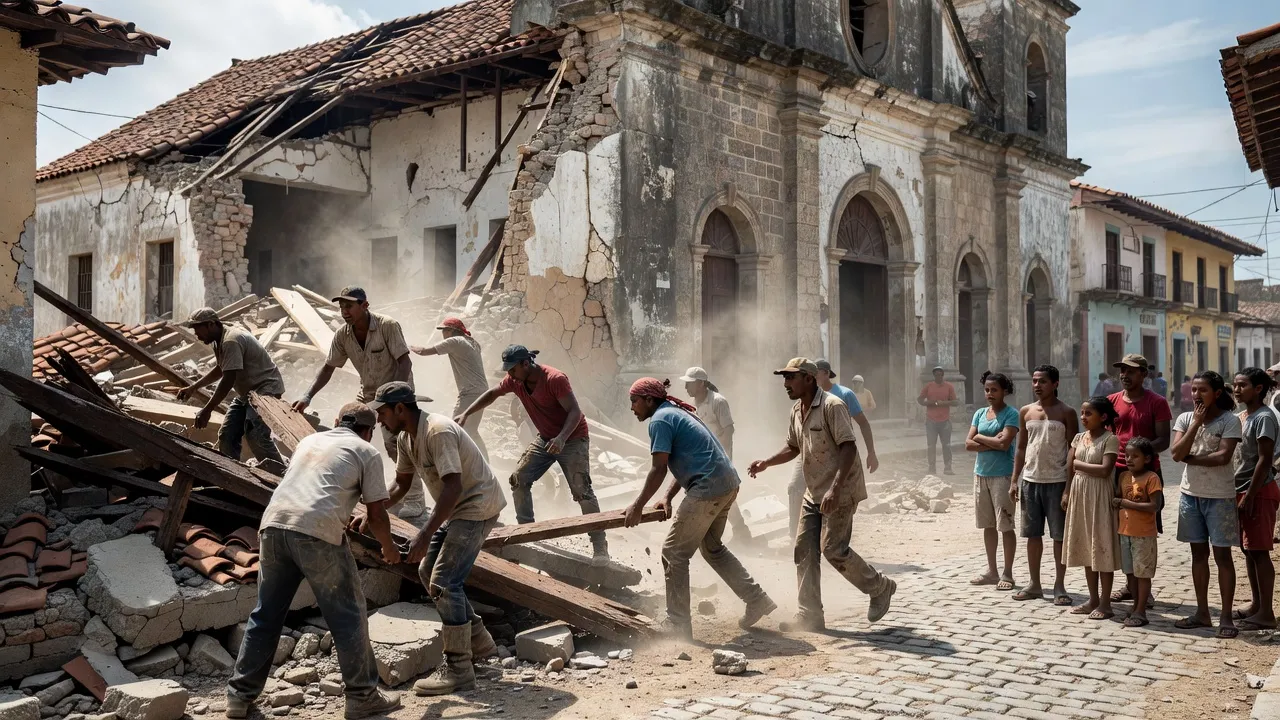
Canberra, October 10, 2026. In the Australian press, the magnitude 7.7 earthquake that struck Panama on Friday, October 9, is first presented as a rare and powerful event that left the canal unscathed. SBS headlines a "rare" earthquake that "spares" the canal. The article states that the tremors caused buildings and roads to collapse in the center of the country, but spared "the critical commercial route" that is the canal. ABC News specifies that it is located about 200 kilometers from the epicenter and "operating normally". The channel adds that around 90 ships, including bulk carriers, were affected.
ABC also picks up the USGS estimate, which suggests that economic losses could represent between 1 and 10% of Panama's gross domestic product. This range gives the coverage its numerical backbone.
The human aspect follows, carried by testimonials collected by the agencies. Ricardo Brown, 74, in Las Minas, in the province of Herrera, says: "The house cracked, and we're afraid it will fall on us." In Panama, Salomon Andion, 46, evacuated his 15-story building twice after aftershocks. The head of emergency operations, Rene Garcia, told AFP that no deaths had been reported, but people were trapped in collapsed structures, near a church in Veraguas and in a hotel in Coclé. PerthNow mentions a historic building's tower collapsed in Penonomé, two suspended metro lines, and the closure of all schools.
The Age and the Sydney Morning Herald, which publish the Associated Press dispatch, put the earthquake into a regional black series: two earthquakes of 7.2 and 7.5 in Venezuela in June, over 6,500 dead; a 7.4 earthquake in Colombia in August, at least 289 dead. They quote President José Raúl Mulino, who calls for calm: "What happened should not be used to sow alarm or disorder." SBS also reports his words: "We are facing a major catastrophe".
On the scientific level, ABC cites Nestor Luque, director of the Panama Institute of Geosciences: the earthquake comes from an active fault system where constraints accumulate before being released. The figures diverge according to the titles: a depth of 10 km for the USGS in The Age, 12.6 km in ABC and PerthNow. The tsunami alert is lifted.