
DOMINANT ANGLE
Berlin is measuring the Panamanian earthquake in terms of seismic risk and tsunami alert, with agency coverage focused on USGS data and its revised magnitude.
Dominant angle identified — does not reflect unanimity of this country’s media
KEY POINTS
- 01
According to the USGS, as cited by the Tagesschau, the earthquake reached a magnitude of 7.7, at a depth of about ten kilometers near Pitaloza Arriba (Herrera province), followed by dozens of aftershocks.
- 02
The Handelsblatt notes that the magnitude was initially announced at 8.0 before being corrected to 7.6, and that the tsunami alert targeted Mexico, Guatemala, Costa Rica, Colombia, Ecuador, and Peru.
- 03
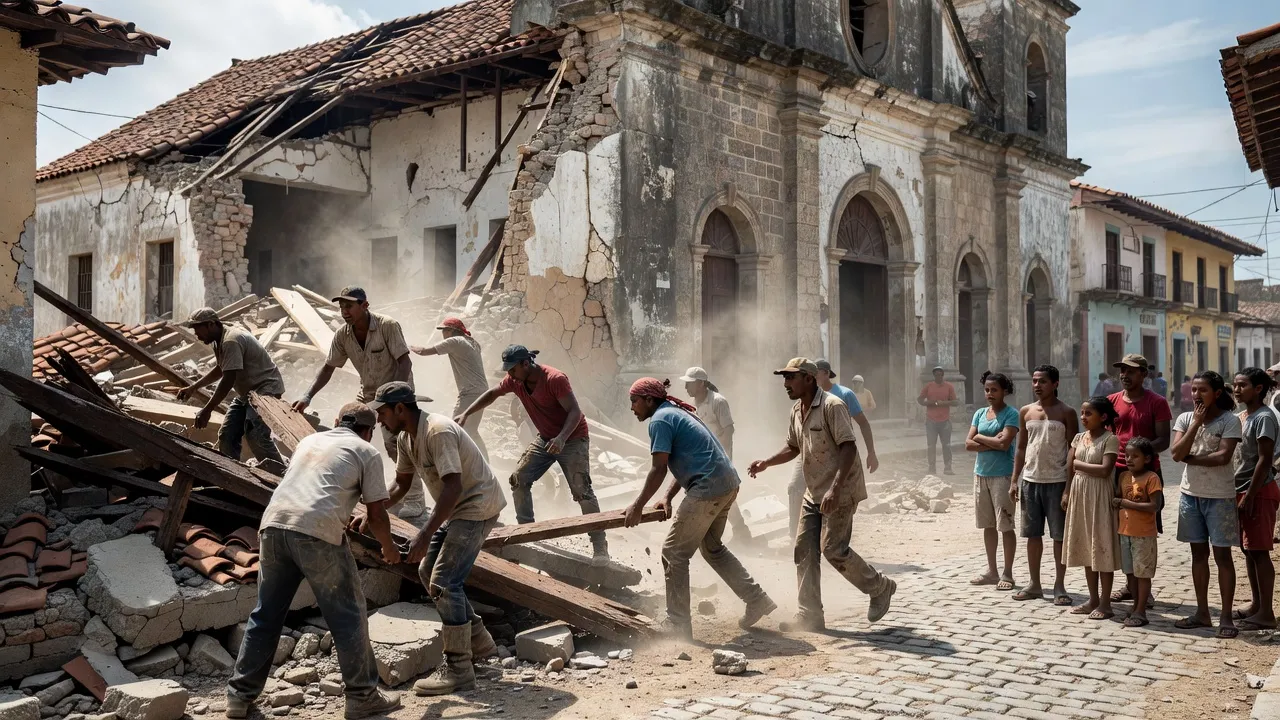
The Tagesschau reports damage to the San Juan Bautista cathedral in Penonomé, a hotel, the provincial administration building, and the Santiago cathedral, as well as the lifting of the tsunami alert.
ANALYSIS
Berlin, October 10, 2026. The German press is treating the Panama earthquake as a geophysical event first, and a human one second, largely relying on the United States Geological Survey (USGS).
The Tagesschau, headlining "Schweres Erdbeben erschüttert Panama" (Severe earthquake shakes Panama), reports a magnitude of 7.7. The epicenter was located at a depth of about ten kilometers, ten kilometers southwest of the isolated town of Pitaloza Arriba, in the central province of Herrera. It notes that dozens of aftershocks followed, that buildings shook in Panama City, where residents took to the streets, and that the tremors were felt as far as Colombia.
The Handelsblatt, in a report from the first hour, highlights the uncertainty of the initial measurements: the magnitude had initially been given as 8.0 before being revised to 7.6 by the USGS. It mentions a tsunami alert for large parts of Central and South America and cites the Pacific coasts of Mexico, Guatemala, El Salvador, Nicaragua, Costa Rica, Colombia, Ecuador, and Peru. It relies on Reuters witnesses to describe the tremors in Panama City and Costa Rica, and specifies that initial reports did not mention any damage.
The Tagesschau, in a later report, details the damage reported by Panamanian media: a tower of the San Juan Bautista cathedral in Penonomé, in the province of Coclé, a hotel, and the headquarters of the provincial administration, as well as damage to the Santiago cathedral, in the province of Veraguas. It indicates that the government has suspended afternoon classes throughout the country and that residents have left, as a precaution, shops, schools, and buildings.
Regarding the alert, the channel reports that the Pacific Tsunami Warning Center in Honolulu has lifted the threat for the nine countries: "Die Gefahr gefährlicher Wellen sei vorüber" (The danger of dangerous waves is over). It specifies that no information on potential casualties was available at this stage.
The two sources stick to the facts measured and attributed to American agencies, without editorializing, without quoting President Mulino, or addressing the situation of the canal or the airport.