DOMINANT ANGLE
Santiago is analyzing the Panamanian earthquake through the prism of tsunami risk: the SHOA alert for Easter Island, lifted in just over an hour, takes precedence over the damage report in Panama.
Dominant angle identified — does not reflect unanimity of this country’s media
KEY POINTS
- 01
The SHOA cancelled the tsunami threat for Easter Island and the entire coastline at 16:18, about an hour after the first bulletin at 15:07 (La Cuarta, Publimetro).
- 02
The cited magnitude varies by source: 7.7 for the USGS, 7.5 for the Geosciences Institute of the University of Panama, with an initial estimate of 8.0 (La Tercera, Publimetro).
- 03
Mulino speaks of a "major disaster"; Panamanian authorities reported no fatalities at this stage (La Tercera).
ANALYSIS
Santiago, October 10, 2026. In Chile, the Panama earthquake is first assessed in terms of the national alert system. La Cuarta and Publimetro reported the tremor at 2:56 pm, Chilean time, on Friday, October 9, with a magnitude of 7.7 and a depth of 12.6 km according to the USGS, after an initial estimate of 8.0. At 3:07 pm, the Hydrographic and Oceanographic Service of the Navy (SHOA) issued a first "informational status" bulletin for the entire coastline, and then a precautionary status for Easter Island, with a possible wave arrival at 10:41 pm, island time.
The Deputy Minister of the Interior and government spokesperson, Claudio Alvarado, recalled this schedule during a press conference, according to Cooperativa. The Senapred established a precautionary status, and according to La Cuarta and Publimetro, evacuation of the island's coastline was considered. At 4:18 pm, the SHOA canceled the threat for Rapa Nui and the entire coast: "according to modeling by the SNAM and PTWC", the earthquake did not meet the conditions for a tsunami in Chile. The SHOA specifies that surveillance continues and that this bulletin is the last, unless new information becomes available.
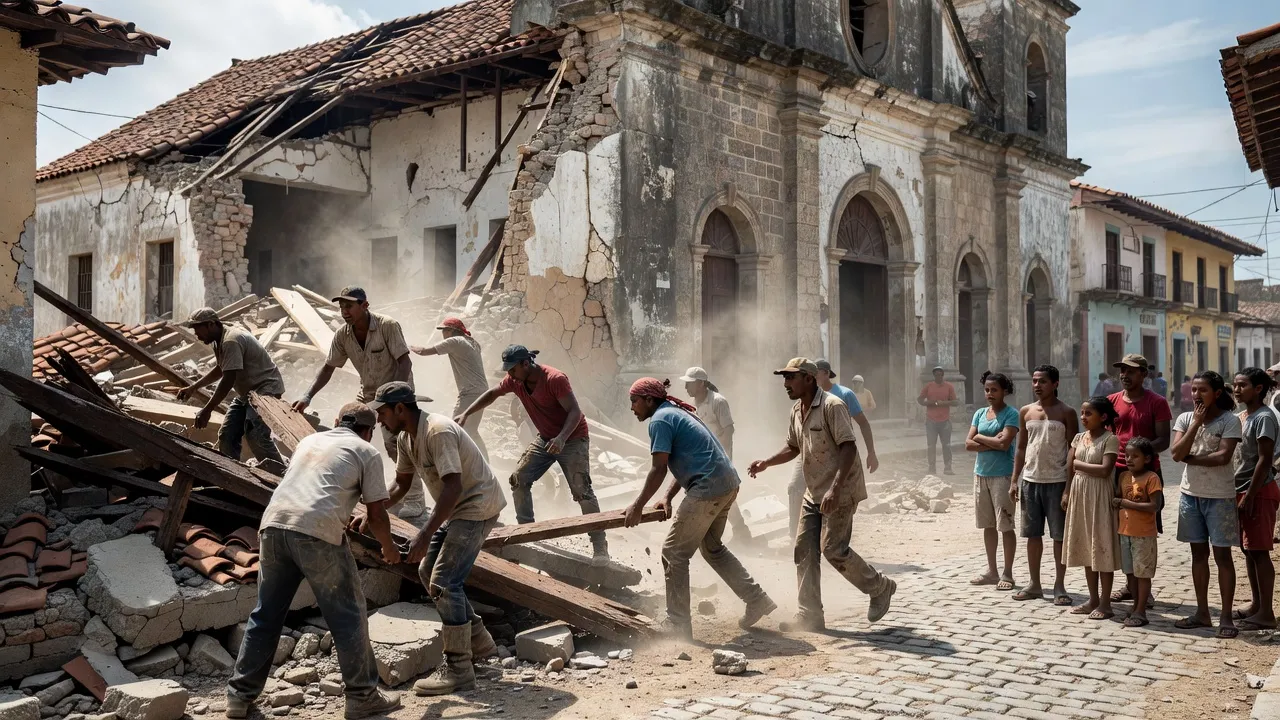
La Tercera dedicates a second section to Panama. President José Raúl Mulino speaks of a "major disaster" with roads "completely collapsed"; Government Minister Dinoska Montalvo mentions damage to schools, health centers, churches, hotels, and roads, with no reported victims at this stage. The Geosciences Institute of the University of Panama revised the magnitude to 7.5 in the afternoon, which explains the divergent figures (7.5, 7.6, 7.7) published by Chilean media.
Cooperativa gives the floor to two Chileans. Jorge Urbano Gatica, who has been living in Panama since 2011, believes that "one takes it more calmly" than people not used to earthquakes, but adds that "nobody here was psychologically prepared". Guillermo Sepúlveda, a passenger on a flight approaching Tocumen Airport, recounts that the plane was diverted to Cartagena de Indias, the airport being closed and evacuated.
The coverage remains factual and focused on the national experience: determining whether the threat concerns the territory, how the Navy's protocol worked, and how compatriots experienced the event. The economic stakes of the canal or Panama's domestic policy do not appear in the articles from the pool.
SOURCES (4)
- La TerceraMEDIUM
- CooperativaMEDIUM
- Publimetro CLMEDIUM
- La CuartaMEDIUM