
DOMINANT ANGLE
London is focused on the immediate human toll of the Panamanian earthquake: collapsed buildings, residents trapped under rubble, and testimonials from victims, before any economic or political analysis.
Dominant angle identified — does not reflect unanimity of this country’s media
KEY POINTS
- 01
According to the BBC, around 4.6 million people experienced moderate to severe shaking, according to the USGS, from a magnitude 7.7 earthquake at a depth of 12 km.
- 02
The Pacific Tsunami Warning Center targeted nine countries before confirming, about three hours after the earthquake, that the threat had passed (Daily Mail).
- 03
President Mulino wrote on X that the event "must not be used to generate alarm and disorder" (The Guardian).
ANALYSIS
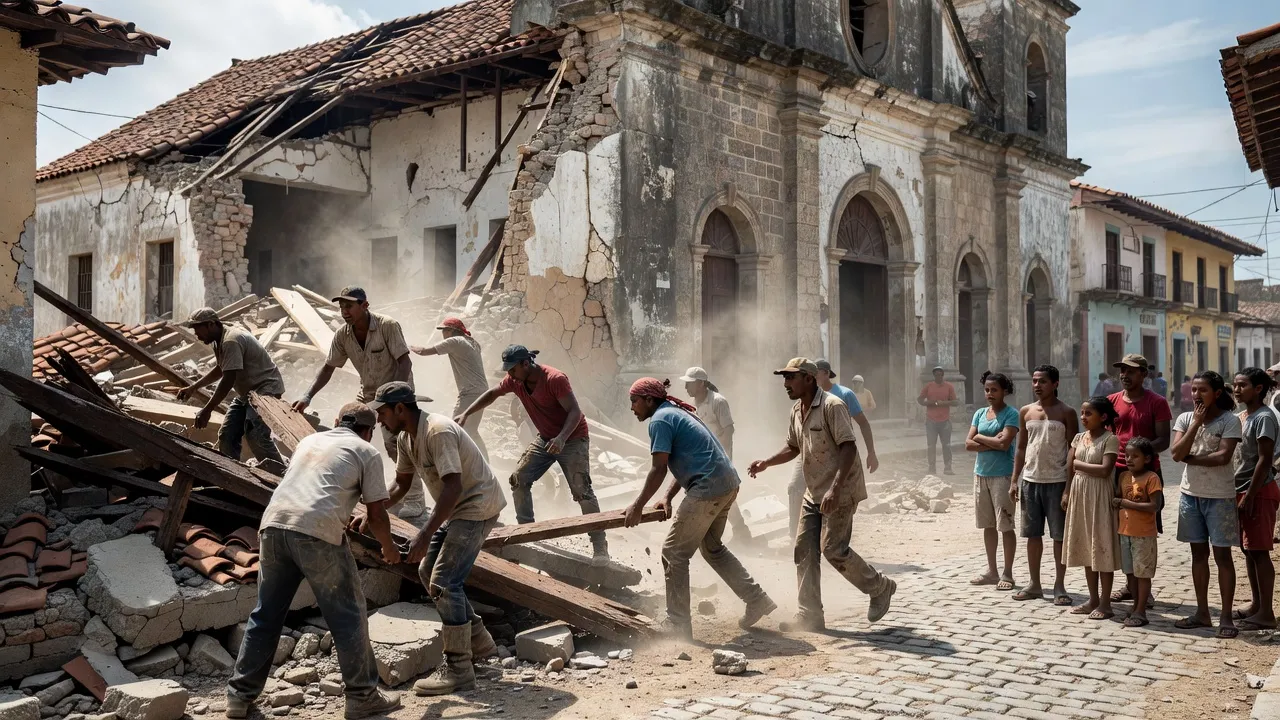
London, 10 October 2026. The British press is treating the earthquake that struck Panama on Friday, 9 October, as a catastrophe with visible initial damage, although no official toll has been established. The BBC describes a "massive" 7.7-magnitude earthquake, whose epicentre was located about 10 km from Pitaloza Arriba, and cites the USGS as saying that some 4.6 million people felt moderate to strong tremors. It notes that the depth, a mere 12 km, increases the risk of severe effects on the surface.
The narrative is organised around images. The BBC mentions videos that appear to show buildings collapsing in Penonomé and Soná, including a man calling out to potential victims trapped under the rubble, a cathedral with one side and a spire collapsed, and a hotel almost entirely destroyed. It specifies that no victims had been reported at this stage and that the extent of the damage remained uncertain, with significant aftershocks complicating the situation. The Daily Mail mentions people trapped under the rubble, including a hotel that fell on an occupied car, and split roads.
The Independent gives a voice to the victims. It shows elderly people in tears in the street and quotes Ricardo Brown, 74, in Las Minas: "We are afraid. We are only two old people here. The house is cracked." It also reports the assessment of Omar Smith, head of civil protection, who signals impacts in Chitré and the province of Los Santos.
The Guardian focuses on crisis communication. President José Raúl Mulino asked a minister to call for calm and wrote on X that the event "should not be used to generate alarm and disorder". The newspaper cites local newspaper La Prensa on the evacuation of schools and housing, and publishes a photo of a highway sectioned off west of the capital. Its initial figure, 7.6, differs from that of the other titles.
On a regional level, the Daily Mail and the Independent recall that the Pacific Tsunami Warning Centre initially targeted nine countries, from Mexico to Colombia, before lifting the threat about three hours later. The Independent stresses that the Panama Canal, an essential trade route, was not affected, and that earthquakes of this force are rare in the country. The Daily Mail adds a more alarmist tone by referring to the risk of a megathrust earthquake on the Pacific Ring of Fire.
SOURCES (4)
- The IndependentMEDIUM
- Daily MailMEDIUM