
DOMINANT ANGLE
Ottawa is nuanced in its assessment of the Panamanian earthquake: Canadian media highlights real material damage but notes the absence, in the initial hours, of deaths and injuries, unlike the deadly tremors in Venezuela and Colombia.
Dominant angle identified — does not reflect unanimity of this country’s media
KEY POINTS
- 01
The USGS measured two earthquakes of magnitude 7.7 and 6.6 in Panama on Friday, October 9, with an epicenter at a depth of 10 km near Pitaloza Arriba (Herrera).
- 02
Seismologists from the University of Panama recorded more than 45 aftershocks, according to the Globe and Mail.
- 03
The Panama Canal and the Cobre Panamá mine reported normal operations, and Tocumen Airport lifted its flight suspension, according to CBC.
ANALYSIS
Ottawa, October 10, 2026. Canada's capital is closely following the earthquake in Panama, which is being covered by The Globe and Mail and CBC News as a catastrophe that could have been worse. According to the United States Geological Survey (USGS), two earthquakes of magnitude 7.7 and 6.6, followed by aftershocks, struck the country on Friday, October 9, in the afternoon. The first earthquake, felt as far as Colombia, was centered about 10 kilometers southwest of the isolated town of Pitaloza Arriba, in the central province of Herrera. The USGS initially evaluated it at 8, then at 7.6, before setting it at 7.7.
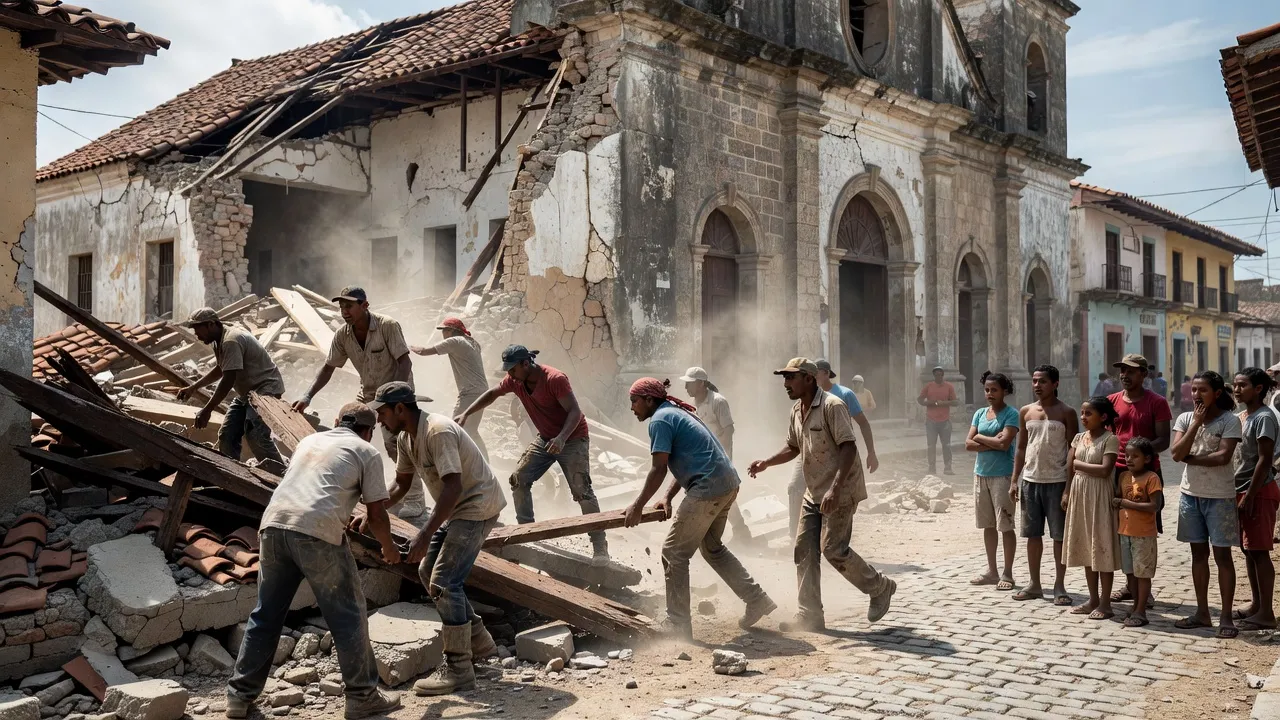
The Globe and Mail focuses on the images: buildings collapsed near the epicenter, deep cracks in the roads, evacuations throughout the country. Seismologists from the University of Panama recorded more than 45 aftershocks, including several of magnitude 5.8, 5.5, and 5.2. The newspaper collects the testimony of Rosendo Domínguez, 60, from Herrera: "Everyone is outside, frightened," he told the Associated Press. President José Raúl Mulino called for calm on X: what happened should not be used to "cause alarm or disorder".
CBC News takes a more reassuring tone. The country "seems to have escaped" widespread destruction, writes the public broadcaster: no deaths or injuries were reported immediately, the Panama Canal and the Cobre Panamá copper mine were operating normally, and Tocumen Airport lifted its flight suspension. Mulino traveled to Penonomé, halfway between the epicenter and the capital, where buildings collapsed and a church was damaged. In Panama, evacuated office workers wondered how to get home in the traffic jams.
Both media outlets put the event into a regional series: two earthquakes of magnitude 7.2 and 7.5 struck the state of La Guaira, Venezuela, in June, killing more than 6,500 people, according to The Globe and Mail, and the one of 7.4 in Colombia, in August, killed at least 289 people. CBC mentions more than 300 deaths in Colombia. This comparison structures the Canadian reading: the fear of a new heavy toll, tempered by initial findings that are less somber.