
DOMINANT ANGLE
Oslo is deciphering the Panamanian earthquake first through its scientific measurement and the logic of the tsunami alert, with a Norwegian seismologist as a guarantee, before assessing the damage.
Dominant angle identified — does not reflect unanimity of this country’s media
KEY POINTS
- 01
According to the USGS, the 7.7-magnitude earthquake had its epicenter at a depth of about 10 to 12 kilometers near Pitaloza Arriba, followed by a 6.6-magnitude aftershock.
- 02
President Mulino speaks of a "great catastrophe" and roads that are "completely collapsed"; no deaths were reported, but the toll could change (VG).
- 03
The tsunami alert, issued for nine countries including Panama, was lifted at midnight from Friday to Saturday (VG).
ANALYSIS
Oslo, October 10, 2026. The Norwegian press is covering the Panama earthquake with its own timeline: the quake struck around 8 pm, Norwegian time, on Friday, October 9. Aftenposten recalls that the magnitude was initially measured at 8, then lowered to 7.6, before being revised to 7.7 according to the USGS. The newspaper emphasizes these revisions and the subsequent alert.
The journal quotes Volker Oye, research director at the Norsar foundation, cited by the NTB agency: "A magnitude 7.6 earthquake is very powerful. I understand that a tsunami alert was issued." Aftenposten specifies that the epicenter was located about 10 kilometers deep near Pitaloza, some 300 kilometers southwest of the city of Panama, and that a 6.6 magnitude aftershock followed. A subheading indicates that the phenomenon was "visible on Norwegian stations".
The American system's alert targeted Costa Rica, Ecuador, Peru, Nicaragua, Guatemala, El Salvador, and Mexico, with waves of 1 to 3 meters above sea level possible on some Panamanian coasts. VG reports that the warning, which also covered Colombia, was lifted at midnight, on the night of Friday to Saturday.
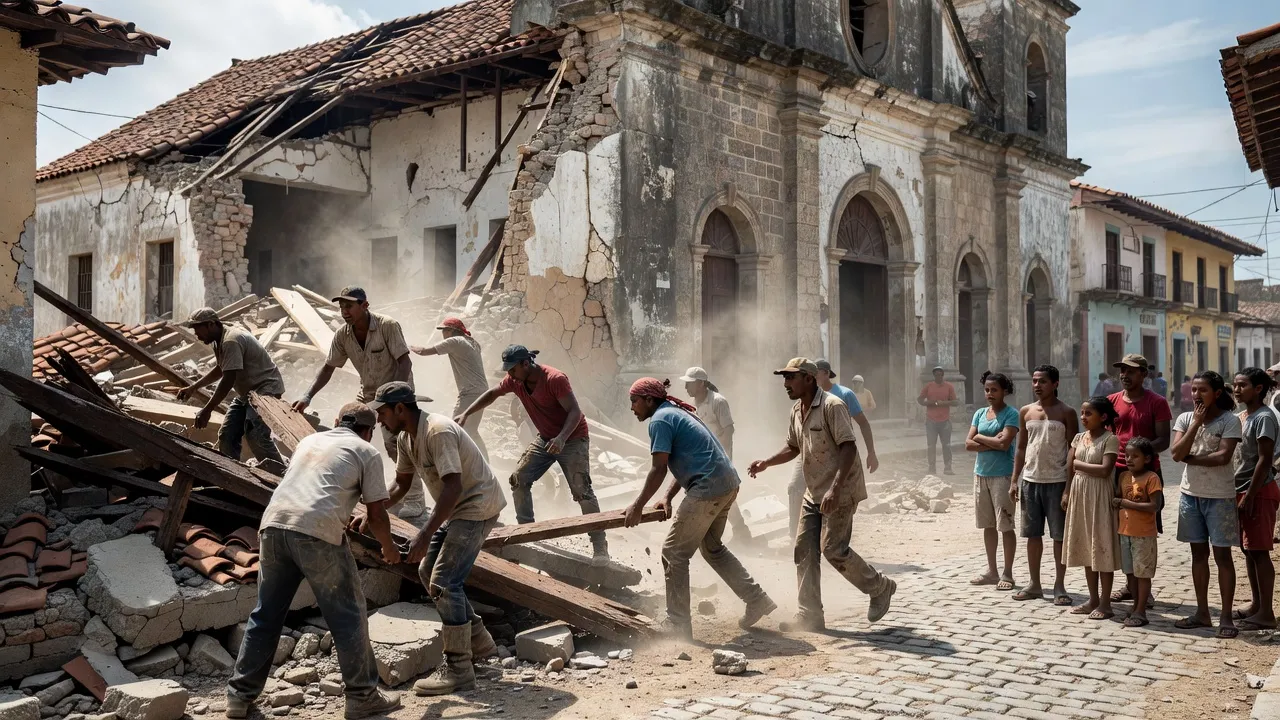
On the ground, VG reports the words of President José Raúl Mulino: "We are facing a great catastrophe". Some roads have "completely collapsed" and the toll could evolve in the hours or days to come, but no deaths were reported. Health Minister Fernando Boyd identifies Herrera, Coclé, and Los Santos as the most affected areas and is seeking a way to access them by air, as Los Santos is no longer accessible by the usual road. The international airport of the capital was temporarily closed, then reopened. Colombia, Ecuador, and Guatemala have offered emergency aid.
VG puts the event into a regional series, according to the AP agency: at least four earthquakes with a magnitude above 7 in Latin America this year. In June, two earthquakes of 7.2 and 7.5 in Venezuela killed more than 6,500 people, with at least 190 buildings collapsed in the state of La Guaira. In August, the 7.4 magnitude earthquake in Colombia killed at least 280 people, the strongest in the country since the beginning of the century. Both titles stick to the facts and official sources, without editorial commentary.