
DOMINANT ANGLE
Paris is assessing the human toll of the Panamanian earthquake as reports come in: panic in the capital, buildings collapsed in the center, two injured and no deaths announced, with a still provisional toll.
Dominant angle identified — does not reflect unanimity of this country’s media
KEY POINTS
- 01
Earthquake of magnitude 7.7 on Friday, October 9 at 12:56 local time, epicenter ten kilometers from Pitaloza Arriba (Herrera province), according to the USGS.
- 02
Preliminary report from the Emergency Operations Center: two people injured and trapped in Veraguas, no fatalities "so far".
- 03
The Panama Canal Authority indicates that operations are continuing "normally" during the inspection of facilities.
ANALYSIS
Paris, October 10, 2026. The French press is following the 7.7 magnitude earthquake that struck Panama on Friday, October 9, at 12:56 local time (7:56 pm in Paris), through AFP dispatches relayed by BFMTV, Le Monde, 20 Minutes, Sud Ouest, and France 24. According to the USGS, the epicenter was located ten kilometers from Pitaloza Arriba, in the province of Herrera (central-south). The American agency initially announced a magnitude of 8, corrected to 7.6, then to 7.7.
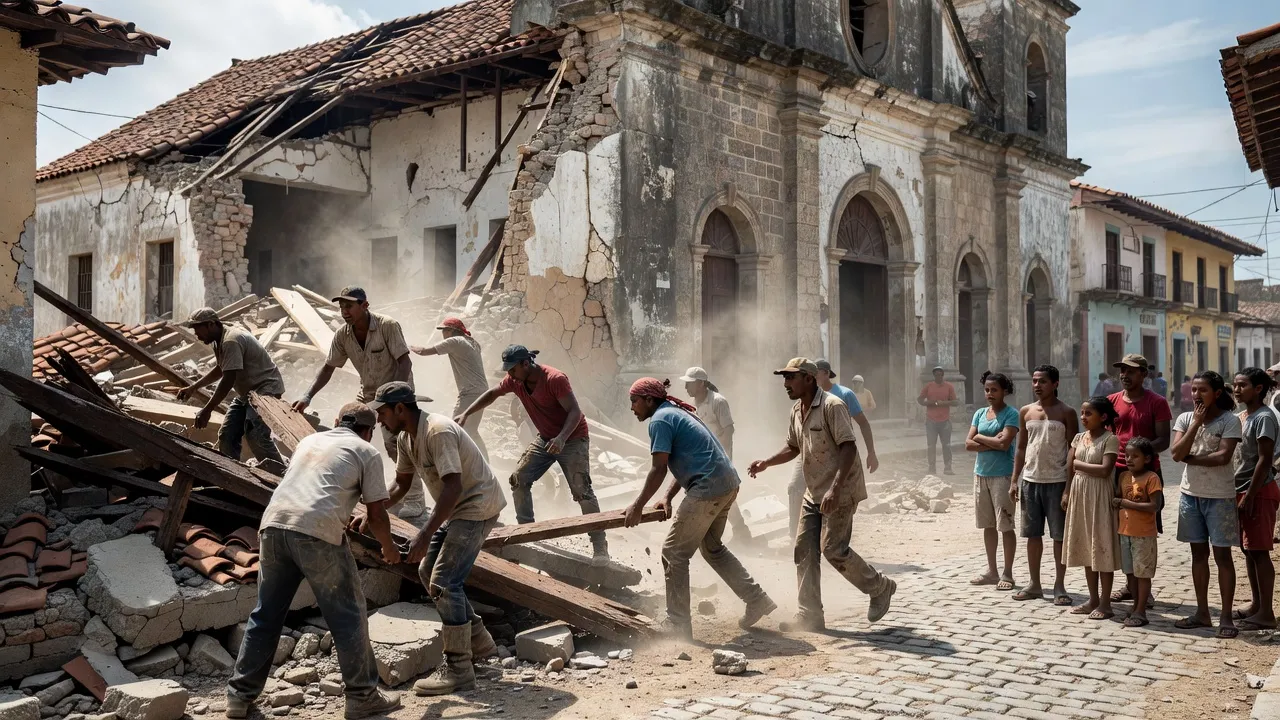
The first reports emphasize the panic: in Panama, "hundreds of people evacuated buildings," and classes are suspended in all schools. The preliminary toll, given by René García, head of the Emergency Operations Center, reports two people injured by the collapse of buildings in Veraguas and no deaths "so far." AFP journalists observed several collapsed buildings and a damaged cathedral in Penonomé, in the province of Coclé, as well as damage in the fishing village of Santa Catalina.
The voice of the inhabitants takes a prominent place. Juana Alveo, a cashier in Penonomé, recounts: "It was horrible, we had never experienced that. My daughter was stuck at school." Luis Poveda, a factory worker in Santiago de Veraguas, says he is "in shock" and was unable to reach his family. Professor Ariel Apolayo describes a increasingly strong shock: "The cars were swaying."
The headlines differ on the extent. Ouest-France quotes President José Raul Mulino, who mentions buildings "completely collapsed" and over a hundred aftershocks. RFI, through its correspondent, reports that Mulino lamented a "great disaster" while calling not to spread false information, and judges the material damage to be limited, comparing it to the earthquake in Colombia on August 10, which killed at least 321 people.
The tsunami alert issued in the eastern Pacific and the fate of the canal are treated as secondary elements: the Canal Authority indicates that operations are continuing "normally" and that the facilities are being inspected. The press finally recalls that earthquakes are unusual in the capital and occur mainly in the province of Chiriquí, in the west.
SOURCES (5)
- 20 MinutesMEDIUM
- Ouest-FranceMEDIUM
- BFMTVMEDIUM