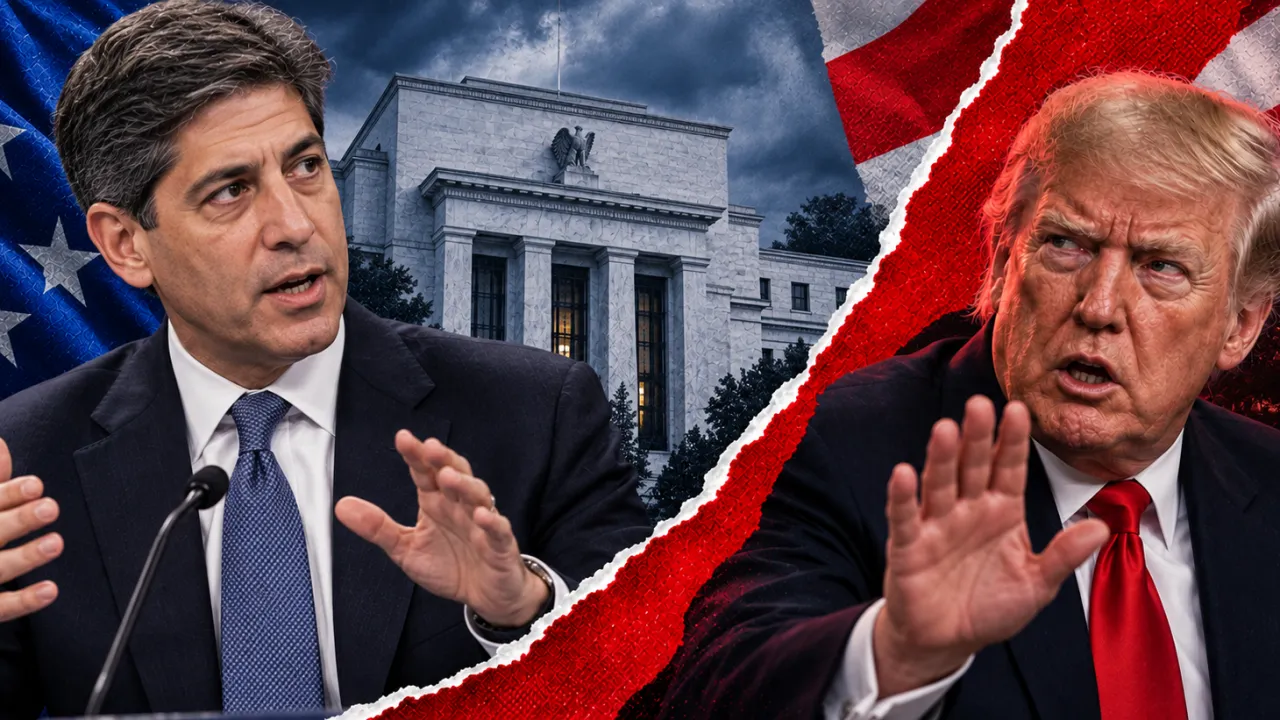
The Fed raises rates for the first time in three years and signals more; Trump demands the opposite
published on
countries
sources
articles
From one continent to another, the increase is seen differently: an institutional duel between Donald Trump and Kevin Warsh in most of the countries covered, a quantified effect on the Colombian peso, the Peruvian sol, or the yen elsewhere, from Buenos Aires to Seoul via Tokyo.
The White House spokesperson described the decision as "rather unfortunate", but Kevin Warsh did not publicly respond to Donald Trump's request.
A global shockwave
In Australia, ASX futures contracts indicated a decline of 68 points, or 0.8%, at Thursday's opening, according to The Age. The Australian dollar rose 0.01% to 70.87 US cents, gold fell 0.71% to $4,262 an ounce, and Brent crude oil dropped 2.88% to $105.62 a barrel. Iron ore, meanwhile, gained 0.32% to $97 a ton, according to ABC News.
In Germany, the Dow Jones closed 1.2% lower at 51,462 points after Kevin Warsh's press conference, Handelsblatt reports. In India, the yield on the 10-year US Treasury bond reached 5.041%, its highest level since July 2007, even before the announcement, according to the Economic Times, which also notes a 4% decline in bitcoin, stabilized around $75,700.
In Asia, the Tokyo Stock Exchange opened slightly higher on Thursday morning: the Nikkei gained 43.87 points (+0.07%) to 63,966.87 points, and the Topix rose 29.34 points (+0.72%) to 4,091.06 points, according to Kyodo News and The Mainichi; the dollar was trading around 156.21-156.22 yen, compared to 154.97-99 yen the previous day. Channel News Asia reports that the stock exchanges in Tokyo, Seoul, Singapore, Taipei, Wellington, and Jakarta all rose on Thursday, a movement partly attributed to the partial restart of Saudi oil capacity after a drone attack on a pipeline.
In Colombia, the dollar was trading at 3,110.47 pesos at the market opening on Wednesday, compared to a TRM of 3,100.45 pesos, even before the Fed's announcement, according to El Colombiano. In Peru, the dollar closed at 3.370 soles on Wednesday, slightly down from 3.372 soles on Tuesday: the Peruvian market had already factored in the increase in previous days, with the exchange rate rising from 3.365 soles on Friday to 3.381 soles on Monday, according to RPP Noticias.
Two interpretations of the same vote
In a majority of the countries covered by the analyzed corpus — thirteen out of nineteen —, the national coverage presents the increase first as a political disavowal of Kevin Warsh towards Donald Trump, the man who appointed him to head the Fed in May hoping for the opposite. This is the case, in particular, in the United States, Canada, Chile, Germany, Spain, Australia, South Africa, India, Malaysia, Mexico, Pakistan, Singapore, and France.
« Trump is going to blow up in anger »
Six other national corpora — Argentine, Colombian, Japanese, Korean, Peruvian, and Qatari — focus their narrative on economic mechanisms and market effects rather than on this confrontation, which they relegate to the background or omit. For example, the Japanese press does not mention the demand for a decrease made by Donald Trump, focused on the interest rate gap with the Bank of Japan, according to The Mainichi; the Qatari press retains the oil shock linked to the war in Iran as the cause of the increase, according to Gulf Times and Al Jazeera.
The price for emerging countries
In Argentina, Perfil reports that the increase "obliges a recalibration of the government's financing strategy" under Javier Milei's administration ahead of the 2027 elections. Economist Diego Piccardo, from the Fundación Libertad y Progreso, cited by the same newspaper, believes that the option to place Argentine debt on international markets is now "practically cancelled", whereas the executive had hoped to use it to finance $4.9 billion in currency purchases from the Central Bank before the election.
« Mexico's monetary policy is independent of that of the United States, but the Fed's hike takes away room for new rate cuts at Banxico »
In Mexico, Vanguardia quotes economist Gabriela Siller, from Banorte, on the remaining room for manoeuvre for the Mexican central bank.
In Pakistan, where external debt is denominated in dollars under the IMF programme, Geo News and Business Recorder note that the dollar reached a seven-week high after the announcement, which mechanically increases the cost of servicing this debt. Gold jumped 1.1% to $4,310.49 per ounce. Oil, on the other hand, fell back after the announcement of additional Saudi shipments via Oman — a partial reprieve for this net energy importer.
In South Korea, Yonhap reports that the gap between Korean and US benchmark rates now reaches up to one percentage point. KBS World reports that this movement is fuelling speculation about an upcoming rate hike by the Bank of Korea before the end of the year, as the institution must contain imported inflation without further slowing an economy already weighed down by US tariffs.
Figures that diverge depending on the source
On the variation of the Dow Jones during the September 16 session, three national corpora — Argentine, Australian, and German — as well as a US article converge on a decline of close to 1.2%, according to Ámbito, The Age, Handelsblatt, and CNBC. An article from the Korea Times, for the same session, reports a much lower decline of 0.20% (-101.92 points): a gap between sources that the reader can verify by opening each of the cited articles.
On the number of Fed officials anticipating a new rate hike before the end of the year, seven national corpora agree on a figure of 16 officials out of a total of 18, according to Portafolio, Deccan Chronicle, The Vibes, Geo News, Gulf Times, and Moneyweb. An article from Gestión, in Peru, reports the same figure of 16 officials, but for a total of 19 — which gives a slightly different proportion.
Some national corpora detail the effects of the rate hike on loans and the US markets without providing a quantified equivalent for their own economy: this is the case for Canadian, South African, and Indian coverage, according to CBC News, Moneyweb, and Deccan Chronicle themselves. Other corpora — Mexican, Peruvian, Colombian, and Korean — fill this type of gap by directly quantifying the effect on their currency or the cost of their debt. The difference measures what each national corpus has chosen to cover, not a lack of information in these countries themselves.
Appointed by Trump in May 2026 to succeed Jerome Powell, who was the subject of a criminal investigation by the Department of Justice, which has since been dropped.
The committee had not voted unanimously since May 2025.
The yield on two-year Treasury bonds climbed by more than 7 basis points after the announcement.
Prices rose 3.4% over one year in August, with underlying inflation reaching 2.4%, according to TD Economics.
How each country reads it
19 perspectives, each in the voice of that country's press.
 Argentina
Buenos Aires is tallying the bill for its external financing: the Fed's rate hike is closing, according to economists cited by the local press, the option of placing debt in dollars before the 2027 elections.
3 sources
 Australia
Australia quantifies the shock in index points and dollar cents: the Fed's hike is first measured on the ASX, the Australian dollar, gold, and iron ore, before any debate on the RBA's domestic policy.
5 sources
 Canada
Ottawa is watching the unprecedented showdown between Kevin Warsh, a central banker appointed by Donald Trump himself, and the President who is now demanding the opposite of his decision.
3 sources
 Chile
ChileSantiago sees the confrontation between Trump and the Fed as a test of monetary independence, with the Chilean press highlighting that Kevin Warsh, appointed by the president himself, has chosen to defy him rather than give in to his pressure.
2 sources
 Colombia
Bogotá measures the Fed's hike first in pesos: the dollar rises from the opening of the market, even before the official announcement, while gold benefits from a weakened greenback.
3 sources
 Germany
Berlin is particularly taking note of the demonstration of independence by Kevin Warsh, the Fed president appointed by Donald Trump himself, who raised rates against the explicit will of his political patron.
3 sources
 Spain
SpainMadrid sees the Fed's rate hike as an unprecedented rebuke of Kevin Warsh by Donald Trump, who had nonetheless appointed him to the institution's presidency six weeks before crucial midterm elections for the Republicans.
2 sources
 France
Paris sees the Fed's rate hike as an institutional showdown between Donald Trump and the man he himself appointed to head the central bank, and highlights the irony of a decision triggered by the president's own wars.
4 sources
 India
IndiaNew Delhi is measuring the Fed's rate hike primarily by its impact on markets — gold, bonds, bitcoin — rather than the open confrontation between Donald Trump and Kevin Warsh, the man he himself chose to lead the US central bank.
4 sources
 Japan
JapanTokyo is measuring the widening gap in rates with Washington: the yen is slipping to 156 against the dollar, while the stock market is benefiting from a reprieve ahead of the Bank of Japan's monetary policy meeting.
2 sources
 South Korea
Seoul is measuring the gap in rates that has grown with Washington, now up to a full percentage point, and the pressure this hike is putting on the Bank of Korea to follow suit by the end of the year.
4 sources
 Mexico
Mexico City separates the independence claimed by Banxico from the actual margin, now reduced, that the Fed's rate hike leaves it.
3 sources
 Malaysia
Kuala Lumpur is measuring the combined shock of the rise in American rates and the oil surge on already tense Asian markets, while watching the open confrontation between Trump and Warsh.
2 sources
 Peru
PeruLima is downplaying the shockwave: Peru's financial sector had already anticipated the Fed's rate hike, and the sol even gained a bit of ground on the day of the announcement.
2 sources
 Pakistan
Islamabad is measuring the cost in dollars of a decision it did not vote for: the Fed is tightening its monetary policy while Washington demands the opposite, and each rate hike increases the debt service burden of countries indebted in dollars.
2 sources
 Qatar
QatarDoha is gauging the Fed's rate hike in light of the oil price, presented by Qatari media as the main driver of American inflation rather than simply a Trump-Warsh showdown.
2 sources
 Singapore
Singapore gauges the Asian shockwave of the Fed's rate hike, amidst pressured currencies, falling bond yields and regional stock markets that rise nonetheless
2 sources
 United States
The United States is measuring the political cost of a Fed that Trump himself chose, which has just dealt him an unprecedented setback on interest rates.
4 sources
 South Africa
Pretoria is mainly gauging, in the dispatch relayed by its press, the balance of power between Donald Trump and the Fed boss he himself chose, without yet quantifying what the hike costs the rand or South African debt in dollars.
4 sources
What the comparison reveals
Common ground and differences in coverage across the media analysed.
What the media report in common
The Federal Reserve has raised its benchmark interest rate by a quarter of a point, to a range of 3.75% to 4.00%, on Wednesday, September 16, 2026 — its first increase since July 2023, decided unanimously by the monetary policy committee.
Kevin Warsh, appointed by Donald Trump in May to the presidency of the Fed in anticipation of a rate cut, has presided over this increase, which goes against this expectation.
Where media coverage diverges
Dominant framing of the increase
Some of the press initially focuses on the political setback inflicted by Kevin Warsh on Donald Trump, who appointed him, while another part centers its narrative on economic and market mechanisms, relegating this confrontation to the background or omitting it.
Quantifying a domestic cost
Some perspectives translate the increase into a quantified effect for their own economy — exchange rate, margin of the national central bank, cost of debt in dollars — while others remain focused on the US markets without an equivalent indicator for their country, which their own articles acknowledge.
Coverage that diverges
This grouping describes the publications analysed, not the position of these countries’ populations or of their governments.
The full text, country by country
Argentina
DOMINANT ANGLE
Buenos Aires is tallying the bill for its external financing: the Fed's rate hike is closing, according to economists cited by the local press, the option of placing debt in dollars before the 2027 elections.
KEY POINTS
- The Fed raised its target rate by a quarter of a point to 3.75%-4.00%, the first increase since July 2023, unanimously voted by the 12 members of the FOMC
- Economist Diego Piccardo (Fundación Libertad y Progreso) estimates that access to external financing is now "practically nullified"
- The Argentine country risk hit a monthly high and the S&P Merval fell for the third consecutive session at the time of the announcement, according to Ámbito
ANALYSIS
Buenos Aires, Thursday, September 17, 2026. The US Federal Reserve raised its benchmark interest rate by a quarter of a point on Wednesday, to a range of 3.75% to 4.00%, its first increase since July 2023. For the Argentine economic press, the event is less significant as a turning point in US monetary policy than as an additional constraint on the financing of Javier Milei's government.
Perfil summarizes the issue: the decision "obliges the Argentine state to recalibrate its financing strategy" as the 2027 elections approach, which will decide whether Milei remains in the presidency. The chief economist of the Fundación Libertad y Progreso, Diego Piccardo, judges it straightforwardly: "the increase in the interest rate in the United States is bad news for Argentina." He specifies that the government's financial program did not depend on it directly, as access to international capital markets was only an option — "that option is now practically nullified." In the best-case scenario, the executive had hoped to place debt abroad to finance the $4.9 billion in foreign currency purchases planned from the Central Bank (BCRA), in order to preserve solid reserves before the election.
On local markets, nervousness was immediately apparent: the Dow Jones lost 1.2% at the time of the announcement, the S&P Merval in Buenos Aires fell for the third consecutive session, and the Argentine country risk reached a monthly high, according to Ámbito.
The committee's unanimous vote — all twelve members, including President Kevin Warsh — is presented as a victory for the "hawks" who had been calling for an increase since July. Warsh justified the decision by citing inflation that is "too high for too long" and a US economy that has regained strength since the summer. The committee forecasts another increase by the end of the year, to 4.1%.
Clarín, quoting an AP dispatch, recalls that the measure comes as American households are already suffering from high food, gas, and housing costs, just seven weeks before the midterm elections, and that it defies the demands for cuts made by Donald Trump.
For the Argentine press, the question posed is therefore not primarily geopolitical but budgetary: each additional American interest rate point increases the cost of the dollar for a country that structurally depends on external financing and its foreign currency reserves.
Australia
DOMINANT ANGLE
Australia quantifies the shock in index points and dollar cents: the Fed's hike is first measured on the ASX, the Australian dollar, gold, and iron ore, before any debate on the RBA's domestic policy.
KEY POINTS
- ASX futures contracts indicated a 68-point (0.8%) drop at Thursday's opening, following a 631-point (-1.2%) decline in the Dow Jones (The Age).
- The Australian dollar rose 0.01% to 70.87 US cents, while gold fell 0.71% to $4,262 an ounce and Brent dropped 2.88% to $105.62 a barrel (ABC News).
- JP Morgan's chief economist, Bruce Kasman, notes a global shift towards higher interest rates, but emphasizes that this movement does not necessarily apply to Australia (ABC News).
ANALYSIS
Sydney, September 17, 2026. The US Federal Reserve raised its key interest rate by a quarter of a point on Wednesday, to a range of 3.75% to 4.00%, its first increase since 2023. The decision, voted unanimously (12-0) — a first since May 2025 —, immediately weighed on Australian markets. According to The Age, futures contracts on the ASX, at 6:21 AEST, indicated a drop of 68 points, or 0.8%, at the opening on Thursday, after a difficult night on Wall Street: the Dow Jones lost 631 points (-1.2%), the S&P 500 0.4%, and the Nasdaq remained almost stable.
The President of the Fed, Kevin Warsh, appointed by Donald Trump with the expectation that he would lower rates, described the decision as "sober, serious, and responsible", emphasizing: "The fact is simple: inflation is too high, and has been for too long." Sixteen of the eighteen Fed officials anticipate at least one more rate hike before the end of the year.
Trump's response was not long in coming. On Truth Social, he demanded a rate "of 1% or less", arguing that the United States has "the best credit in the world, by far". The Sydney Morning Herald notes that the decision "openly defies" presidential pressure on his own choice to head the institution.
This exchange is part of a broader offensive: SBS News recalls that Trump has led an "unprecedented assault" on the Fed's independence since his return to power, going so far as to try to fire a governor and launch a criminal investigation targeting Warsh's predecessor, Jerome Powell. PerthNow also notes that the "hawkish" tone of the decision has put into perspective the calendar of other central banks: the Bank of England was to maintain its rates on the same day, while the Bank of Japan was preparing to raise them on Friday, September 18, 2026.
For Australian markets, the effect was felt on several fronts: the Australian dollar rose 0.01% to 70.87 US cents, spot gold fell 0.71% to $4,262 an ounce, and Brent oil fell 2.88% to $105.62 a barrel, according to the ABC's live update. Iron ore, on the other hand, rose 0.32% to $97 a tonne — a positive note for Australian exporters.
Bruce Kasman, chief economist at JP Morgan, cited by the ABC, observes a global shift towards rate hikes, but nuances: this movement may not necessarily concern Australia. Goldman Sachs, on the other hand, already anticipates another Fed rate hike in October.
Canada
DOMINANT ANGLE
Ottawa is watching the unprecedented showdown between Kevin Warsh, a central banker appointed by Donald Trump himself, and the President who is now demanding the opposite of his decision.
KEY POINTS
- The Fed raised its target rate by a quarter point to 3.75%-4.00% on Wednesday, its first hike since 2023, under the presidency of Kevin Warsh, appointed by Trump in May.
- Donald Trump called for rates to be cut to 1% or less "AND FAST" on Truth Social; advisor Peter Navarro termed the hike a "bad decision".
- TD Economics (Thomas Feltmate) notes that the decision comes as US inflation reached 3.4% in August and oil prices have risen; investors had priced in over a 90% probability of action.
ANALYSIS
Ottawa, September 17, 2026. The US Federal Reserve raised its benchmark interest rate by a quarter of a point on Wednesday, to a range of 3.75% to 4.00%, its first increase since 2023. Canada's economic press first notes the confrontation: CBC News reports that the Fed acted in "defiance of Trump's demands for a cut", and Financial Post mentions a decision made "in defiance" of the US President.
The choice is all the more commented on in Canada as it comes from Kevin Warsh, the man Donald Trump himself appointed to head the institution in May. Yet it is this same Warsh who, in a press conference, judged that "the fact is simple: inflation is too high, and for too long". A notable about-face for a central banker who, before his appointment, was rather evoking rate cuts, in line with the President.
The expected reaction from the White House: Donald Trump called for rates to be cut to 1% or less, "AND FAST", on Truth Social, while advisor Peter Navarro described the increase as a "bad decision". The committee's projections suggest a new increase by the end of the year, to a range of 4.00%-4.25%.
For economists cited by Financial Post, the measure was widely anticipated. Thomas Feltmate, of TD Economics, notes that the decision comes as oil prices have risen and US inflation reached 3.4% in August, a context that made the status quo risky for the Fed's credibility, in his view. Investors had already factored in a more than 90% probability of action this week, and a new increase before the end of the year.
What Canadian coverage details little, on the other hand, are the quantified repercussions for the Canadian economy itself: the articles mention the borrowing costs for American mortgages, car loans, and credit cards, without advancing an equivalent for the rates or the policy of the Bank of Canada. The preferred angle remains that, very American, of an institutional showdown in Washington, seven weeks from the midterm elections where affordability has become a central issue.
Chile
DOMINANT ANGLE
Santiago sees the confrontation between Trump and the Fed as a test of monetary independence, with the Chilean press highlighting that Kevin Warsh, appointed by the president himself, has chosen to defy him rather than give in to his pressure.
KEY POINTS
- The Fed raised its rate by 25 basis points to 3.75%-4.00%, unanimously, its first hike since July 2023, after three consecutive cuts that had set it at 3.50%-3.75% in December.
- Kevin Warsh, appointed by Trump in May, stated that "this summer's inflation data do not indicate to me that the underlying trends have improved significantly".
- Trump demanded on Truth Social a rate of "1% or less", claiming that the US has "the best credit rating in the world, by far".
ANALYSIS
Santiago, September 17, 2026. Chilean media is first focusing on the duel between Donald Trump and the central bank he himself chose to lead. On Wednesday, the Federal Reserve raised its benchmark rate by a quarter of a point, to a range of 3.75% to 4.00%, its first increase since July 2023. The decision, made unanimously, puts an end to three consecutive 25-point cuts that had brought the rate to 3.50%-3.75% in December. The committee also indicated that another rate hike could occur before the end of the year.
La Tercera sums up the episode in one word: the Fed "defies" Trump. The newspaper emphasizes that the institution, chaired since May by Kevin Warsh, appointed by the president himself, has chosen to contradict a representative who "has been pushing for months for an expansive monetary policy". Warsh justified the rate hike by pointing to persistent inflation: "this summer's data does not indicate to me that the underlying trends have significantly improved", he said in a press conference. The newspaper also recalls the oath of independence sworn by Warsh when he took office: the "guardian of the dollar" must lead the central bank without looking to the president or anyone else.
BioBioChile details the presidential response. Trump wrote that US rates "should be 1% or less, because we have the best credit rating in the world, by far!", adding that his country is experiencing an "investment boom" and that he could cut trade with countries with a trade surplus if the Fed does not lower its rates. The media recalls that this showdown comes six weeks before the US legislative elections, and that Trump had already called the former Fed president, Jerome Powell, a "moron" and "always behind" for his refusal to lower rates.
Chilean media does not explicitly link the episode to local markets: neither the peso nor the rates of the Central Bank of Chile are mentioned, with the focus on the institutional mechanics in Washington and the question of whether a central bank appointed by a president can, or should, resist him.
Colombia
DOMINANT ANGLE
Bogotá measures the Fed's hike first in pesos: the dollar rises from the opening of the market, even before the official announcement, while gold benefits from a weakened greenback.
KEY POINTS
- The Fed raised its target rate by a quarter of a point, to 3.75%-4.00%, its first hike since July 2023, unanimously under the presidency of Kevin Warsh
- The dollar opened at 3,110.47 pesos in Bogotá on Wednesday, against a TRM of 3,100.45 pesos, ahead of the Fed's decision
- 16 of the 18 Fed officials anticipate at least one more rate hike by the end of 2026; gold rose 0.7% to $4,324.36 an ounce before the announcement
ANALYSIS
Bogotá, September 17, 2026. The US Federal Reserve raised its benchmark interest rate by a quarter of a point on Wednesday, to a range of 3.75% to 4.00%, its first increase since July 2023. The Colombian economic press first reads the news through the exchange rate: as soon as the market opened, the dollar rose to 3,110.47 pesos, compared to a TRM (representative market rate) of 3,100.45 pesos, "amid market expectations" according to El Colombiano, which notes six transactions for $1.5 million at the start of the session.
The decision, made unanimously under the presidency of Kevin Warsh — appointed by Donald Trump in May with the hope that he would lower rates —, is presented as an implicit disavowal of the White House's economic strategy. La Republica notes that the committee's unanimity "recognizes, in practice, the inability of the Donald Trump government to control inflation". Warsh, who says he appreciates that the institution makes a decision after "a good family fight", had reaffirmed his commitment to the Fed's "2% price stability target" at Jackson Hole in August. He justified the rate hike due to the strength of employment and investment, while admitting that "inflation remains high" and that summer data "does not reflect sufficient improvements" — the August PCE inflation rate is estimated at 3.6% annually, the underlying rate at 3.2%.
The committee's projections, relayed by Portafolio, indicate that 16 of the 18 officials anticipate at least one more rate hike before the end of the year. BBVA analysts believe that Warsh "has put himself in a scenario of rising interest rates by adopting a firm rhetoric" against inflation; economist Gregory Daco (EY) estimates that the Fed should not also "hold back" from acting as the mid-term elections approach. Gold, a safe-haven asset, was already up 0.7% to $4,324.36 an ounce before the announcement, driven by the weakening of the dollar and the decline of oil.
For the Colombian markets, the immediate challenge remains the cost of external financing and the trajectory of the peso against the dollar, more than the institutional duel that is looming between the Fed and the White House.
Germany
DOMINANT ANGLE
Berlin is particularly taking note of the demonstration of independence by Kevin Warsh, the Fed president appointed by Donald Trump himself, who raised rates against the explicit will of his political patron.
KEY POINTS
- The Fed raised its benchmark rate by a quarter point to 3.75-4.00%, the first hike since mid-2023, decided unanimously by voting members (FAZ)
- Twelve of the eighteen Fed officials anticipate another rate hike this year, four are even expecting two (FAZ)
- The Dow Jones plummeted 1.2% to 51,462 points after Kevin Warsh's press conference, while the S&P 500 lost 0.4% (Handelsblatt)
ANALYSIS
Berlin, September 17, 2026. The German economic press first notes the demonstration of independence by Kevin Warsh, the Federal Reserve president appointed by Donald Trump himself, who dared to raise the key interest rates against the explicit will of his political patron. On Wednesday evening, the Fed raised its interest rate range to 3.75-4.00%, a quarter of a point more, the first increase since mid-2023. The decision was made unanimously by the voting members, emphasizes the FAZ, which speaks of a risky bet by Warsh "in the lion's den". The committee expects further rate hikes: twelve of the eighteen officials anticipate another increase this year, four are even expecting two, according to the projections cited by the Frankfurt daily.
For Tagesschau, the decision "shows independence from Trump": the American president had multiplied the pressure to obtain a rate cut in the midst of inflation, contrary to the economic doctrine in force during periods of high inflation. Asset manager Eckhard Schulte, from MainSky Asset Management, sums up the atmosphere in Washington with a phrase: "Trump wird toben" - Trump will explode with anger - particularly because the US Treasury has multiplied short-term debt emissions, which are more sensitive to the key interest rate.
On the markets, the sanction was immediate: the Dow Jones lost 1.2%, to 51,462 points, after Warsh's press conference, while the S&P 500 gave up 0.4% and the Nasdaq remained almost stable. The American inflation remains the real reason for the increase: prices rose by 3.4% over one year in August, underlying inflation by 2.4%, still above the Fed's 2% target for five years.
Another paradox highlighted by Tagesschau: despite the rate hike, the dollar is not strengthening much. Stephan Kemper, chief strategist at BNP Paribas Wealth Management, explains this by a conflict of forces: "in the short term, higher rates support the currency, but in the long term, high public debt, deficits, and doubts about monetary credibility are holding it back." In Germany, the issue is also linked to oil: even before the announcement, Chancellor Friedrich Merz had promised measures to alleviate prices at the pump, inflated by the war in Iran, while the DAX was hoping to open with a slight increase.
Spain
DOMINANT ANGLE
Madrid sees the Fed's rate hike as an unprecedented rebuke of Kevin Warsh by Donald Trump, who had nonetheless appointed him to the institution's presidency six weeks before crucial midterm elections for the Republicans.
KEY POINTS
- The Fed raised its benchmark rate by 25 basis points, to a range of 3.75% to 4%, by a unanimous vote of 12 to 0, according to Expansión.
- A Financial Times and Booth School of Business (University of Chicago) survey shows that 50 out of 51 economists deemed the hike justified, with 14% calling for a half-point increase.
- Kevin Warsh, appointed by Trump in May to replace Jerome Powell, presided over a major decision for the first time six weeks before midterm elections where Republicans risk losing Congress.
ANALYSIS
Madrid, September 17, 2026. The Spanish economic press first highlights the personal confrontation: the Federal Reserve dared to "defy" Donald Trump, writes Expansión, by raising its benchmark interest rate by a quarter of a point on Wednesday, to a range of 3.75% to 4%. This is the first increase in more than three years — exactly 38 months, the last one dating back to July 2023 — and it comes under the presidency of Kevin Warsh, the same conservative that Trump had appointed to head the institution in May, replacing Jerome Powell. The vote was unanimous, twelve votes in favor, none against, which, according to Expansión, strengthens the Fed's position in the face of criticism. The move was anticipated by 90% of investors, but Warsh, faithful to his desire to abandon forward guidance, delivered a shorter-than-usual press conference, limiting himself to judging that inflation "is too high and has been for too long". The title of Expansión itself cited the immediate reaction of the American president: "¡Bajen los tipos de interés y rápido!", a call that had no effect on the committee. El País emphasizes that the decision comes six weeks before midterm elections where Republicans risk losing Congress — a calendar that Trump, who demands interest rates close to zero, would have wanted to avoid at all costs.
The economic newspaper also relies on a survey conducted by the Financial Times and the Booth School of Business at the University of Chicago: 50 of the 51 economists surveyed considered the rate hike justified, and 14% even demanded a half-point increase, citing the oil surge linked to the conflict with Tehran. Academic Olivier Coibion is quoted: "La Reserva Federal va muy por detrás de la curva" — the Fed is lagging behind the inflation curve, which shows no signs of returning to the 2% target, according to him. Expansión finally evokes the quote from Lao-Tseu — "a journey of a thousand leagues begins with a first step" — to summarize the markets' anticipation of a new rate hike before the end of the year, a scenario that Goldman Sachs already situates in October.
For the Spanish press, the stakes go beyond mere price mechanics: it is Warsh's credibility, and that of the Fed's independence in the face of a president who himself chose him, that was at play on Wednesday.
France
DOMINANT ANGLE
Paris sees the Fed's rate hike as an institutional showdown between Donald Trump and the man he himself appointed to head the central bank, and highlights the irony of a decision triggered by the president's own wars.
KEY POINTS
- The Fed raised its target rate by 25 basis points, to a range of 3.75% to 4%, a decision made unanimously on Wednesday, September 16, the first increase since summer 2023
- Donald Trump called for a rate cut "RAPIDLY" to "1%, or less" on Truth Social, accusing the Fed's board of acting for "political reasons"
- The Fed's projections put the rate between 4% and 4.25% by the end of 2026, with retail sales up 1.2% in August, their strongest gain since March
ANALYSIS
Paris, September 17, 2026. On Wednesday, September 16, the US Federal Reserve raised its benchmark interest rate by a quarter of a point, bringing it to between 3.75% and 4%, a first since summer 2023. The decision, made unanimously by the monetary policy committee, was widely anticipated: according to a Reuters poll cited by La Tribune, 85% of economists surveyed expected this move.
The French press first notes the institutional paradox. Kevin Warsh, appointed this year by Donald Trump to steer monetary policy towards greater flexibility, finds himself constrained, after only four months in office, to do the opposite "in the face of alarming inflation figures," notes Le Monde. The new Fed president justified his choice by citing inflation that is "too high, for too long," a 2% target missed for over five years, with consumer prices rising 3.7% over the past year in July according to the PCE index.
Le Monde highlights the irony of the situation: this monetary tightening contradicts Donald Trump, but it is a direct consequence of his two wars, the armed conflict against Iran and the trade offensive against the rest of the world, two factors that fuel the surge in energy prices and inflationary pressure.
The US president was quick to react. On Truth Social, he demanded that interest rates be lowered "RAPIDLY," wanting them to be "1%, or less," and accused the Fed's board of being "hostile" and acting for "political reasons" in order to "harm him as much as possible" — while avoiding, this time, personally attacking Kevin Warsh, unlike his treatment of Jerome Powell.
The Fed warns that another rate hike is likely by the end of the year, with projections placing the rate between 4% and 4.25% in December. Officials believe the economy's resilience is sufficient to withstand it: retail sales rose 1.2% in August, their strongest increase since March, while unemployment remains contained at 4.1% and annual growth is projected at 2.3%. RFI notes that the institution's statement emphasizes a faster return to the 2% target, the independence of the central bank remaining, according to Le Monde, "the first virtue" that the committee intended to demonstrate by voting for this hike unanimously.
India
DOMINANT ANGLE
New Delhi is measuring the Fed's rate hike primarily by its impact on markets — gold, bonds, bitcoin — rather than the open confrontation between Donald Trump and Kevin Warsh, the man he himself chose to lead the US central bank.
KEY POINTS
- The FOMC raised its target rate by 25 basis points to 3.75-4.00%, unanimously, the first hike since July 2023 (Swarajya, Deccan Chronicle)
- 16 of the 18 Fed officials project at least one more rate hike by the end of 2026, taking the rate to 4.00-4.25% (Deccan Chronicle)
- Spot gold rose 0.8% on Thursday to $4,295.26 an ounce after the Fed's decision (The Hindu Business Line)
ANALYSIS
New Delhi, September 17, 2026. The Indian economic press has followed the decision of the US Federal Reserve essentially through the prism of markets — bonds, gold, bitcoin, and global stocks — more than that of monetary diplomacy. On Wednesday, the Federal Open Market Committee (FOMC) unanimously raised its benchmark rate by a quarter of a point, to a range of 3.75% to 4.00% — its first hike since July 2023, reports Swarajya. The new president Kevin Warsh, appointed by Donald Trump in May, justified the decision without hesitation: "the fact is that inflation is too high, and for too long," he said in a press conference, quoted by the Economic Times.
The quarterly projections show that sixteen of the eighteen Fed officials anticipate at least one more rate hike by the end of the year, which would bring the benchmark rate between 4.00% and 4.25%, according to the Deccan Chronicle. The daily newspaper emphasizes that this decision "de facto recognizes the inability of the Trump administration to control inflation so far," pointing to tariffs, the oil shock linked to the US-Israeli war against Iran, and spending related to the rise of artificial intelligence as drivers of prices.
Even before the announcement, US bond yields had soared: the yield on the 10-year Treasury bond had reached 5.041%, a high since July 2007, while the CME FedWatch gave a 92.7% probability of a 25 basis point hike, compared to 59.4% a week earlier, a sign of a rapid shift in expectations, according to the Economic Times. In the markets, the Indian press details especially the collateral effects: the yield on two-year Treasury bonds rose to 4.738%, its highest level since July 2024, while spot gold progressed by 0.8% on Thursday, to $4,295.26 an ounce, according to The Hindu Business Line. Bitcoin, already weakened by the failure of a regulatory text in the US Senate, fell by 4% before stabilizing around $75,700. Global stock markets, meanwhile, opened slightly higher before the announcement, driven by technology stocks.
Few Indian articles directly mention Donald Trump's response, who demanded on Truth Social a rate "of 1% or less," or the consequences for the rupee. The emphasis remains on global market indicators rather than the domestic Indian impact.
Japan
DOMINANT ANGLE
Tokyo is measuring the widening gap in rates with Washington: the yen is slipping to 156 against the dollar, while the stock market is benefiting from a reprieve ahead of the Bank of Japan's monetary policy meeting.
KEY POINTS
- The Fed raised its target rate by 0.25 percentage point to 3.75-4.00%, the first increase since July 2023, a unanimous decision by the FOMC under Kevin Warsh.
- The dollar traded at around 156.21-156.22 yen on Thursday in Tokyo, compared to 154.97-99 yen the previous day at 17h, on the back of an expected wider Japan-US interest rate gap.
- The Nikkei gained 43.87 points (+0.07%) to 63,966.87 and the Topix added 29.34 points (+0.72%) to 4,091.06 on Thursday morning.
ANALYSIS
Tokyo, September 17, 2026. The US Federal Reserve raised its key interest rate by a quarter of a point on Wednesday, to a range of 3.75% to 4.00%, its first hike since July 2023, according to Kyodo News and The Mainichi. The decision by the Federal Open Market Committee (FOMC), taken unanimously under the chairmanship of Kevin Warsh, marks a reversal after several months where the rate had remained stable between 3.50% and 3.75% since December. Of the 18 officials who submitted new projections, 12 anticipate another quarter-point increase by the end of the year, four foresee two additional hikes, and two believe the rate will remain unchanged.
The FOMC statement mentions an economy that "is growing at a solid pace" despite increased uncertainty related to geopolitical developments, and states that inflation "remains high", above the 2% target for more than five years. Kyodo and The Mainichi link this inflationary push to the war waged against Iran by the United States and Israel since late February, which has driven up energy prices.
For Tokyo, the most immediate effect is seen on the foreign exchange market: the dollar was trading around 156.21-156.22 yen on Thursday, compared to 154.97-99 yen the previous day at 5 pm, with currency traders anticipating a widening gap between Japanese and American interest rates as the Fed hints at another hike. The euro was trading at 178.99-179.00 yen.
Despite this context, the Tokyo Stock Exchange opened slightly higher on Thursday morning, with uncertainty about economic prospects easing after a decision deemed in line with expectations: the Nikkei gained 43.87 points (+0.07%) to 63,966.87 points, while the Topix rose 29.34 points (+0.72%) to 4,091.06. Interest-rate sensitive stocks struggled to benefit from the move, while the decline in WTI crude oil prices supported market sentiment. The Japanese press notes that investors are primarily focused on the Bank of Japan, whose monetary policy meeting began on Thursday afternoon: for the archipelago, the issue is not the US decision itself, but the response that Tokyo's institution will provide.
South Korea
DOMINANT ANGLE
Seoul is measuring the gap in rates that has grown with Washington, now up to a full percentage point, and the pressure this hike is putting on the Bank of Korea to follow suit by the end of the year.
KEY POINTS
- The FOMC raised its benchmark rate to the range of 3.75%-4.00%, by a unanimous vote of twelve to zero (Yonhap).
- The gap between the key rates of South Korea and the United States now reaches up to one percentage point (Yonhap).
- KBS World reports that the US hike has sparked speculation about an upcoming rate increase by the Bank of Korea before the end of the year.
ANALYSIS
Seoul, September 17, 2026. The US Federal Reserve raised its benchmark interest rate by a quarter of a point on Wednesday, to a range of 3.75% to 4.00%, its first increase since July 2023. The vote by the Federal Open Market Committee (FOMC), reported by Yonhap, resulted in a unanimous score of 12 to 0, despite President Donald Trump's threats to suspend trade with countries showing a surplus with Washington if the central bank did not lower its rates.
For the South Korean press, the figure that matters is not so much the decision itself, but its effect on the gap with the South Korean benchmark rate: Yonhap emphasizes that the gap between South Korea's and the US's key rates now reaches up to one percentage point. KBS World relays the comments of Fed President Kevin Warsh, appointed by Trump: "Inflation is too high and has been for too long." The FOMC's median projections now put the rate at 4.1% by the end of the year, compared to 3.8% anticipated in June, a sign that another rate hike is considered likely.
KBS World reports that this move has sparked speculation that the Bank of Korea may follow suit by raising its own rates before the end of the year. The South Korean institution thus finds itself in a dilemma similar to that of the Fed: containing imported inflation - particularly through the surge in oil prices linked to the war in Iran - without further slowing an economy already weakened by US tariffs.
The report on US underlying inflation, published on Friday, September 11, by the Bureau of Labor Statistics, showed a monthly increase of 0.3%, or 0.1 percentage point more than expected, fueling fears of persistent pressure on prices. Donald Trump, quoted by the Korea Herald, called for a rate cut to 1% or less, accusing Fed officials of trying to harm him politically just seven weeks before the midterm elections.
The South Korean press finally notes that the US rate hike automatically increases the cost of credit for households and businesses across the Pacific - credit cards, car loans, mortgages - while also noting, via the Korea Times, that savers could derive a slight benefit from their deposits.
Mexico
DOMINANT ANGLE
Mexico City separates the independence claimed by Banxico from the actual margin, now reduced, that the Fed's rate hike leaves it.
KEY POINTS
- The Fed raised its target rate by 0.25 point to a range of 3.75%-4.00%, its first hike since 2023, unanimously voted under the presidency of Kevin Warsh
- Economist Gabriela Siller (Banorte) notes, as quoted by Vanguardia, that Mexican monetary policy is independent but the Fed's hike "quita espacio para recortes de tasa en México"
- Donald Trump demanded on Truth Social an American rate "of 1% or less" and threatened to cut off trade with countries with a surplus if the Fed did not lower its rates, according to El Informador
ANALYSIS
Mexico, September 17, 2026. The US Federal Reserve raised its benchmark interest rate by a quarter of a point on Wednesday, to a range of 3.75% to 4.00%, its first increase since 2023. The decision, unanimously voted by the committee chaired by Kevin Warsh, appointed by Donald Trump, opens according to the Mexican press an unprecedented dispute between the president and the institution he himself chose. Reforma highlights that Warsh took office in May promising to put an end to an overrun of the 2% inflation target "now in its sixth year", and that he maintained the widely anticipated rate hike, despite expected tensions with the White House.
On Truth Social, Donald Trump replied that "interest rates in the US should be 1% or less, because we have the best credit rating in the world", reports El Informador. The president also threatened countries with a trade surplus with Washington to break off trade if the Fed did not lower its rates - a pressure that comes six weeks before legislative elections where he is playing for control of Congress.
For Mexico, the issue is direct. Vanguardia quotes economist Gabriela Siller, from Banorte, who recalls that "Mexico's monetary policy is independent of that of the US", but that the Fed's rate hike "takes away space" for new rate cuts at Banxico. The dominant expectation remains that the Mexican central bank will keep its rate unchanged this year, while monitoring the gap with the US reference, the only bulwark against a flight of capital to better-paying dollar assets.
Most Fed officials still forecast another rate hike before the end of the year, which would prolong the pressure on emerging central banks that finance part of their debt in dollars. For Mexico, the question is not only that of the rate differential: it is also the cost, in the medium term, of maintaining a sufficient premium in the face of a more remunerative dollar, without giving in to Washington's call to lower its own rates before Banxico. The formal independence of the Mexican central bank thus comes up, in fact, against an imported constraint.
Malaysia
DOMINANT ANGLE
Kuala Lumpur is measuring the combined shock of the rise in American rates and the oil surge on already tense Asian markets, while watching the open confrontation between Trump and Warsh.
KEY POINTS
- The Fed raised its target rate by 25 basis points to 3.75%-4.00%, its first hike since 2023, voted unanimously.
- Trump demanded on Truth Social rates of "1% or less" and claims to have told Warsh to "vote with the board".
- 16 of the 18 Fed officials anticipate another quarter-point hike by the end of 2026, versus two predicting a status quo.
ANALYSIS
Kuala Lumpur, September 17, 2026. Malaysia's press is viewing the decision by the US Federal Reserve as an additional shock to already nervous Asian markets. On Wednesday, the Fed raised its benchmark rate by 25 basis points, to a range of 3.75% to 4.00%, its first hike since 2023, unanimously decided under the presidency of Kevin Warsh. Even before the vote, the Malay Mail noted that Asian stocks had struggled in anticipation of the announcement, hindered by persistent inflation and the surge in oil prices linked to the crisis in the Middle East, with crude oil remaining above $100 a barrel. Investors had largely anticipated the move: traders gave over 90% chance of a tightening, the daily recalls, also highlighting the rise in yields on 10-year US Treasury bonds above 5%, a level unseen since 2007, before the global financial crisis.
Warsh defended his decision as "sober, serious and responsible", judging inflation to be "too high for too long". The new projections show that 16 of the 18 officials anticipate at least one more quarter-point hike by the end of the year, versus two who see rates remaining stable.
The reaction of Donald Trump is occupying a large space in Malaysian coverage. The US President demanded on Truth Social that rates be lowered "to 1% or less, because we are the best credit in the world — BY FAR", hammering: "LOWER INTEREST RATES FOR THE UNITED STATES, AND FAST!" The Vibes reports that he claimed to have personally called Warsh to tell him to "vote with the council", describing the latter as "very hostile" and "very political" — an intervention that Warsh did not confirm.
For Kuala Lumpur, this open confrontation between the White House and a Fed it itself appointed is fueling the uncertainty that already weighs on regional markets: a higher and longer-than-expected US monetary trajectory, combined with high oil prices, complicates the outlook for Southeast Asia's export-driven economies, while Malaysia observes whether Washington will see its tightening through or yield to presidential pressure.
Peru
DOMINANT ANGLE
Lima is downplaying the shockwave: Peru's financial sector had already anticipated the Fed's rate hike, and the sol even gained a bit of ground on the day of the announcement.
KEY POINTS
- The dollar closed at S/3,370 on Wednesday, slightly down from S/3,372 on Tuesday, despite the Fed's rate hike
- The exchange rate had already risen to S/3,381 on Monday from S/3,365 on Friday, a sign that the market had anticipated the decision
- The median projection of Fed members for the end of 2026 has risen to 4.1% from 3.8% in June, and 16 out of 19 officials expect another rate hike this year, up from 6 in June
ANALYSIS
Lima, September 17, 2026. The US Federal Reserve raised its benchmark interest rate by a quarter of a point on Wednesday, to a range of 3.75% to 4%, its first increase since July 2023. The decision, made unanimously by the Federal Open Market Committee (FOMC) under the presidency of Kevin Warsh, aimed, according to the official statement, to ensure "a faster return to the 2% inflation target". For Peruvian markets, the news nonetheless caused no shock: the dollar closed the day with a slight decline, at S/3,370, against S/3,372 on Tuesday, according to RPP Noticias. "The Fed not only materialized the expected increase, but also showed a greater willingness to maintain restrictive monetary conditions," commented Mauricio Guzmán, head of investment strategy at SURA Investments, quoted by RPP. The explanation lies in anticipation: the exchange rate had already risen to S/3,381 on Monday, against S/3,365 on Friday, with the market integrating the decision in advance. Economist Melvin Escudero recalled that the rise in oil prices, from a range of $65 to $85 to over $100 a barrel, as well as robust US employment data, had already changed investor sentiment even before the official announcement. In terms of prospects, the Fed revised its median rate projection for the end of 2026 upward, to 4.1% from 3.8% in June, and sixteen officials out of nineteen now anticipate at least one more rate hike this year, compared to six in June. Gestión also notes that this decision could strain the relationship between Warsh and Donald Trump, who appointed him to head the institution. The dollar also recorded its best session in three months against a basket of currencies, in anticipation of further rate hikes. For the Peruvian economic press, the immediate issue remains less the decision itself than its trajectory: a new increase is deemed almost certain before the end of the year, with direct consequences on the cost of credit in dollars and on the stability of the ground in the coming months.
Pakistan
DOMINANT ANGLE
Islamabad is measuring the cost in dollars of a decision it did not vote for: the Fed is tightening its monetary policy while Washington demands the opposite, and each rate hike increases the debt service burden of countries indebted in dollars.
KEY POINTS
- The Fed raised its target rate by a quarter point to 3.75%-4.00%, its first hike since 2023, decided unanimously under Kevin Warsh.
- 16 of the 18 Fed officials anticipate at least one more rate hike by the end of the year; Goldman Sachs is betting on October.
- On Truth Social, Donald Trump demanded a rate of "1%, or less" and claims to have told Warsh to "vote with the board".
ANALYSIS
Islamabad, Thursday, September 17, 2026. The US Federal Reserve raised its key interest rate by a quarter of a point on Wednesday, to a range of 3.75% to 4.00%, its first increase since 2023. The decision, made unanimously under the presidency of Kevin Warsh — the man Donald Trump himself had chosen to succeed Jerome Powell and lower rates —, is reported by Geo News as proof of a failure: "just four months after taking office", notes the media, Warsh could do the opposite of what the president wanted. Before the announcement, 85% of economists surveyed by Reuters already anticipated this move. Quarterly projections show that 16 of the 18 Fed officials expect at least one more rate hike by the end of the year. Warsh justifies this tightening by an economy that "has gained strength", citing "resilient domestic spending" and "robust capital investment".
The response from Donald Trump, reported by Business Recorder, was not long in coming: on Truth Social, he demands that American rates be brought down to "1%, or less", stating that the United States is "the best credit in the world, by far", and hammering: "lower interest rates, and fast!". The president says he has "spoken to Kevin", advising him to "vote with the council" he nonetheless considers "hostile" and "political".
For the Pakistani economy, indebted in dollars and under an IMF program, the mechanics of the markets count as much as the political quarrel: the dollar has risen to a seven-week high, which automatically increases the cost of external debt. Gold jumped 1.1% to $4,310.49 an ounce, while oil retreated after the announcement of additional Saudi shipments via Oman — a partial reprieve for a net energy-importing country. Goldman Sachs is already expecting another rate hike in October, and futures contracts now integrate a 50% probability of a second increase as early as next month. The Bank of England is expected to maintain its rates on Thursday, the Bank of Japan to raise them on Friday: a global movement that the Pakistani press includes in the calculation of the cost of external borrowing, more than in the sole duel between the White House and its issuing institute.
Qatar
DOMINANT ANGLE
Doha is gauging the Fed's rate hike in light of the oil price, presented by Qatari media as the main driver of American inflation rather than simply a Trump-Warsh showdown.
KEY POINTS
- The Fed raised its target rate by a quarter of a point, to a range of 3.75% to 4.00%, the first increase in more than three years
- 16 of the 18 Fed officials expect at least one more rate hike by the end of 2026, bringing the rate to 4.00-4.25%
- The CME FedWatch indicator showed a 92.3% chance of this increase according to Al Jazeera, compared to a lower probability a week earlier
ANALYSIS
Doha, September 17, 2026. Qatari media is focusing less on the duel between Donald Trump and the Federal Reserve than on what made it inevitable: the oil shock born out of the American-Iranian war. Gulf Times emphasizes that "the combined impact of Trump's global tariffs, an energy shock following the outbreak of the American-Israeli war against Iran, and investment spending related to the artificial intelligence boom" has maintained pressure on prices at a level such that the Fed had to raise its benchmark rate by a quarter point, to a range of 3.75% to 4.00%. Al Jazeera points to the same cause: inflation fueled by "the surge in fuel prices in the midst of the American-Iranian war".
This is the first increase in over three years, decided unanimously under the presidency of Kevin Warsh, appointed by Trump with the expectation that he would lower rates. Gulf Times notes that this unanimous vote implicitly recognizes "the Trump administration's inability, so far, to control inflation". The new projections show that 16 of the 18 officials anticipate at least one more quarter-point increase by the end of the year, bringing the rate to a range of 4.00% to 4.25%, with stability expected until the end of 2027. The committee writes that "today's policy action will support a faster return to the 2% target".
The calendar adds a political dimension that Qatari media notes without developing it: the decision comes just a few weeks before the American midterm elections, despite Trump's repeated demands for easing. Al Jazeera recalls that the CME FedWatch indicator gave a 92.3% chance of a rate hike to 3.75-4.00%, compared to a lower probability a week earlier.
For Doha, whose economy remains tied to global gas and oil flows, the message retained by its media is that of an American central bank prioritizing price stability over presidential pressure, in a context where the barrel remains under tension since the opening of the Iranian front.
Singapore
DOMINANT ANGLE
Singapore gauges the Asian shockwave of the Fed's rate hike, amidst pressured currencies, falling bond yields and regional stock markets that rise nonetheless
KEY POINTS
- The Fed raised its target rate by 25 basis points, to 3.75-4.00%, the first hike since 2023, by a unanimous vote of the FOMC
- Asian markets (Tokyo, Seoul, Singapore, Taipei, Wellington, Jakarta) opened higher on Thursday despite the hike, helped by a partial restart of Saudi oil capacity
- Donald Trump called for a rate of "1% or less" on Truth Social, writing "LOWER THE INTEREST RATES FOR THE UNITED STATES OF AMERICA, AND FAST!"
ANALYSIS
Singapour, September 17, 2026. The US Federal Reserve raised its benchmark interest rate by 25 basis points on Wednesday, to a range of 3.75% to 4.00%, its first hike since 2023. The vote by the Monetary Policy Committee was unanimous, under the chairmanship of Kevin Warsh, appointed by Donald Trump. "The fact is simple: inflation is too high, and has been for too long," he said, describing the decision as "serious". The Singaporean press, via Channel News Asia, emphasizes the regional scope of the move: a rise in US interest rates can strengthen the dollar, weigh on Asian currencies, and force the region's central banks to adjust their own policy.
Channel News Asia recalls that the Fed is targeting inflation of 2% as measured by the personal consumption expenditure index, a target exceeded for more than five years, and that the August consumer price index, published last week, has reignited concerns. The majority of committee members anticipate at least one more rate hike before the end of the year; markets now put the probability of a rate hike in October at 50-50.
Despite the firm message, Asian stock markets opened higher on Thursday: Tokyo, Seoul, Singapour, Taipei, Wellington, and Jakarta all made gains. Channel News Asia attributes this paradox to two factors: the relief of investors, who see the rate hike as a guarantee of the central bank's credibility, and the announcement of a partial restart of Saudi oil capacity after the closure of a pipeline targeted by drone attacks. Long-term bond yields, which had reached 20-year highs this week, fell back.
Donald Trump reacted angrily, demanding on Truth Social a rate "of 1% or less" and repeating "LOWER INTEREST RATES... AND FAST!". He claimed to have spoken to Warsh, advising him to "vote with the council" which he considers "very hostile" and "very political". The Straits Times notes that the president wrongly links the US trade deficit to the level of interest rates set by the central bank, and that he has threatened in the past to cut off trade with countries with a trade deficit if the Fed does not lower its rates.
For the city-state, whose open economy is closely dependent on capital flows and regional trade, the issue is not so much the outcome of the standoff between Trump and the Fed, but the trajectory of the dollar and its effect on Asian currencies and markets in the coming months.
United States
DOMINANT ANGLE
The United States is measuring the political cost of a Fed that Trump himself chose, which has just dealt him an unprecedented setback on interest rates.
KEY POINTS
- The FOMC raised its target rate by 25 basis points, to a range of 3.75% to 4.00%, by a unanimous vote of 12 to 0 — the first hike since July 2023.
- On Truth Social, Donald Trump called for a rate of 1% or less, citing "the best credit in the world — by far".
- The Dow Jones plummeted 631 points and the yield on two-year Treasury bonds jumped more than 7 basis points after the announcement.
ANALYSIS
Washington, September 17, 2026. The Federal Reserve raised its benchmark interest rate by a quarter of a point on Wednesday, to a range of 3.75% to 4.00% — its first increase since July 2023. The vote by the Federal Open Market Committee (FOMC) was unanimous, twelve to zero, despite repeated pressure from Donald Trump and his administration to do the opposite. Federal Reserve Chairman Kevin Warsh, appointed by Trump in January after turning away from Jerome Powell, defended the decision as "sober, serious, responsible," stating that "inflation is too high and has been for too long." When asked about a message for the White House, he evaded: "I have nothing to say about a discussion with the president."
The reaction from Trump was not long in coming. On Truth Social, he wrote that "interest rates in the United States should be at 1%, or less, because we have the best credit in the world — by far." White House spokesperson Kush Desai called the decision "rather unfortunate," estimating that it was "not supported by a particularly convincing economic case." A few hours later, Trump nuanced his statement, sparing Warsh personally: "I count on Kevin, but he has a very difficult council [...] set up by many other people."
The episode is part of a long battle for control of the central bank: an attempt to remove Governor Lisa Cook, a criminal investigation by the Department of Justice against Powell — since abandoned. For part of the press, Warsh has just inflicted a direct rebuke on the person who appointed him.
The markets sanctioned the announcement: the Dow Jones lost 631 points, the yield on two-year Treasury bonds rose by more than 7 basis points. The committee anticipates another rate hike by the end of the year, to 4.00-4.25%, citing oil related to the war in Iran, tariffs, and investment in AI. For households, the rate hike immediately makes credit cards, car loans, and mortgages more expensive. The committee also cited investment in artificial intelligence as a driver of inflation; Warsh assured that the Fed "is very concerned" about these developments. The rate hike will almost immediately affect the bank's prime lending rate, making credit cards and car loans more expensive — a harder blow for indebted households than for wealthy families, who are already covered by fixed-rate mortgages.
South Africa
DOMINANT ANGLE
Pretoria is mainly gauging, in the dispatch relayed by its press, the balance of power between Donald Trump and the Fed boss he himself chose, without yet quantifying what the hike costs the rand or South African debt in dollars.
KEY POINTS
- The Fed raises its target rate by a quarter point to 3.75%-4.00%, its first hike since July 2023, by a unanimous vote including new president Kevin Warsh
- 16 of the 18 Fed officials expect at least one more rate hike by the end of 2026; the median forecast for the rate by the end of 2026 rises to 4.1% from 3.8% in June
- The yield on two-year Treasury notes has risen to 4.71% and the 10-year yield to 4.97% after the announcement, according to Moneyweb
ANALYSIS
Pretoria, September 17, 2026. South African media outlets reported on Wednesday the decision of the US Federal Reserve, widely disseminated in the form of dispatches: the Fed raised its benchmark interest rate by a quarter of a point, to a range of 3.75% to 4.00%, its first increase since July 2023. The unanimous vote was the first to involve new President Kevin Warsh, chosen by Donald Trump in May in the hope that he would lower rates. The opposite occurred: "We removed a dose of accommodation so that financial and credit conditions are more consistent with our ultimate goals," Warsh said in a press conference, quoted by Moneyweb. He added that summer data "does not show significant improvement in underlying trends" of inflation.
The new quarterly projections show that 16 of the 18 officials anticipate at least one more quarter-point increase by the end of the year, compared to six in June who saw two. The median forecast for the end of 2026 rose to 4.1%, from 3.8% previously. In the bond market, the two-year yield, the most sensitive to the Fed's policy, rose to 4.71%, while the 10-year yield remained lower, at 4.97%.
The headlines relayed by SABC News, Moneyweb, TimesLIVE, and Business Day cite the same drivers of inflation: the tariffs decided by Trump, the energy shock related to the war between the United States, Israel, and Iran, and the expenditures related to the rise of artificial intelligence. None of these articles quantify what this increase means for the rand, the cost of South Africa's debt in dollars, or a potential response from the Reserve Bank. The dispatch, signed by Howard Schneider and published identically by two separate titles, describes a Fed opening the door to a more restrictive policy until 2027, without mentioning emerging markets. For South Africa, a net oil importer and indebted in strong currencies, the US tightening is still largely seen through the prism of Washington rather than its own transmission channels.
Explore every perspective on this subject across 19 countries.
Compare viewpoints and see where they diverge.