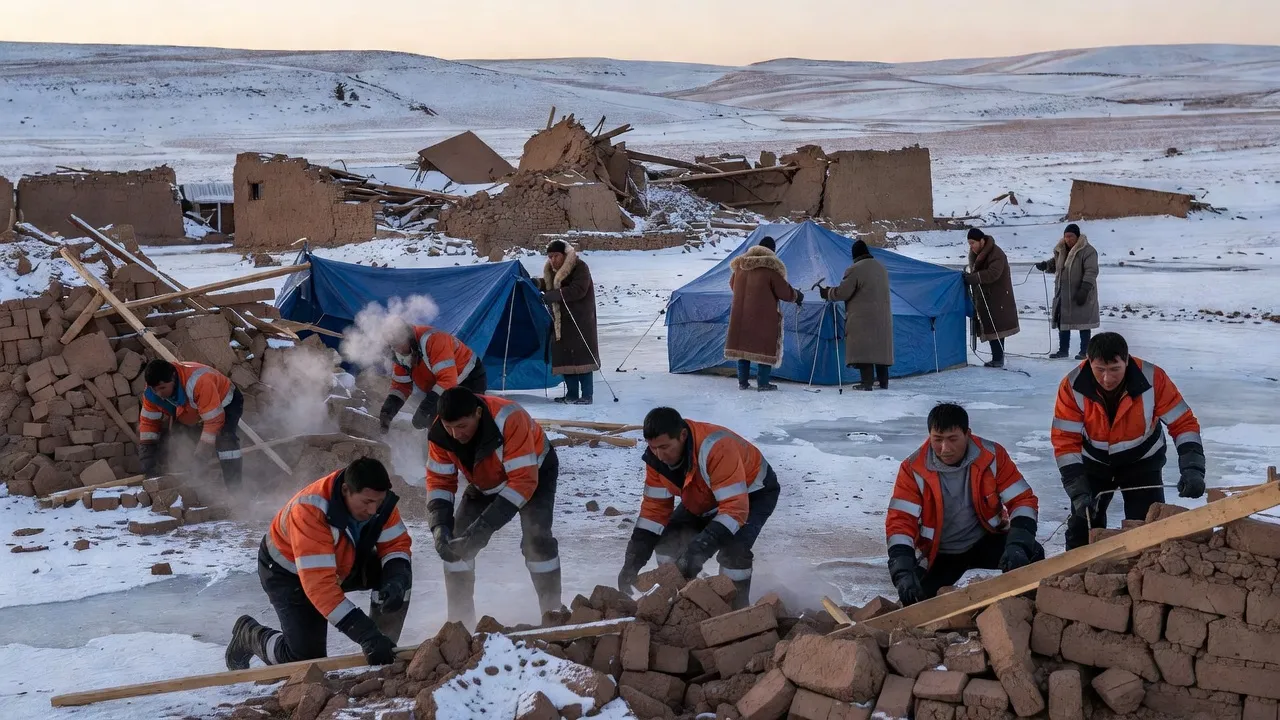
China: magnitude-7 earthquake strikes northern Tibet, killing at least 16 in the Nagqu region
published on
countries
sources
articles
More divergent than 52% of recent comparable stories (reference: 98 recent stories measured with the same method).
The toll from the Nagqu earthquake is circulating in several versions, depending on the time of the dispatch and the institution taking the measurements. The human toll figures come from Chinese state media; the seismic measurements come from Beijing and Washington, and not all of them coincide.
The toll remains provisional: 16 deaths announced, a number of injured ranging from 32 to 76 according to the media, and rescue operations underway in the cold.
Counts that follow the hour
The initial reports did not provide any toll. Sud Ouest notes that "no figure" had been released, the initial ABC News bulletin reported neither damage nor casualties, and Reuters, cited by Helsingin Sanomat, mentioned at least two injured in a village near the epicentre. La Libre Belgique published a toll of 16 dead on Thursday, 22 October 2026 at 23:07.
The number of injured then varies from one title to another. Khabarhub and GMA News, according to Xinhua and the Nagqu emergency management office, count 32 injured at 2:25 am on Friday, including 11 serious and 21 minor cases. Le Temps, ANSA, and CBC report 46, attributed to CCTV. ECNS writes that the Ministry of Emergency Management announced 54 injured on Friday morning. El Nacional cites 65, and the Nagqu municipal government announces 76 injured at 1 pm, according to The Rising Nepal and the Chinese press.
These values answer the same question, the number of injured, and correspond to different stages. The articles in the corpus do not always explain this: Among Nepalese titles, Khabarhub reports 32 injured when the later Xinhua dispatch published by The Rising Nepal counts 76, without the articles explaining the discrepancy. The death toll, on the other hand, does not vary: 23 out of 24 corpus give it as 16. This figure measures the coverage of the corpus, not an independent verification; the Colombian corpus, published before any toll, does not report any.
Tibet is a restricted area for foreign press. The Express Tribune writes that the region is "largely inaccessible to foreign journalists" and that Chinese authorities are the only official source of information.
Magnitude, depth and aftershocks
The measurement institutes give close but not identical values. The Chinese Seismological Center retains a magnitude of 7 and a depth of 10 kilometers. The USGS, cited by the Guardian and the Globe and Mail, locates the epicenter at a depth of 18 kilometers, 191 kilometers east-northeast of Nagqu. RIA Novosti reports that the EMSC reported a magnitude of 7.1. Mediafax adds that the Indian Seismological Center indicates a depth of 173 kilometers, compared to 10 for the CENC.
« located at high altitude, in cold weather »
On the aftershocks, Chinese and American sources do not provide the same data. According to the Chinese press, the National Seismological Center counts 501 by Friday noon, including 27 of magnitude 3.0 or more; the strongest reaches 4.3 and none reach 5.0. The USGS, reported by the BBC, the Guardian, and CBC, counts at least seven aftershocks of magnitude 4.3 to 5.2. G1 mentions an aftershock of 5.2 less than an hour after the quake.
Several headlines situate the quake by comparison. ABC News Australia and PerthNow, Folha and Agência Brasil say it is the strongest in China since January 2024; Agência Brasil specifies that the 7.1 magnitude earthquake in Xinjiang on that date caused three deaths. The same sources recall Yushu in 2010, magnitude 7.1, with at least 2,698 deaths. La República cites the USGS: 29 earthquakes of magnitude greater than 7.0 on the Tibetan Plateau and its margins since 1900, including the one in 1950, with a magnitude of 8.6, which caused more than 4,000 deaths.
The detail of the rescue device
The inventory of equipment differs according to the source and time. ECNS writes that the first relief supplies that arrived in Baqen at 4:30 include 1,000 prefabricated houses, 3,239 tents, 2,821 folding beds, 4,280 quilts, and 200 stoves. ABC News reports the words of Nagqu's acting mayor, Dunzhu: 2,000 prefabricated houses, about 3,400 tents, and 2,000 folding beds on site, and more than 5,000 people from three districts mobilized. The Guardian, for its part, counts more than 1,600 people from the county engaged in the search.
« relief operations are proceeding in an orderly manner »
The Chinese press also reports on the restoration of networks. According to the Xizang communications administration, the 628 mobile stations that were out of service, or 8.5% of the city's total, were restored in 12 hours. According to Jiemian, the Ministry of Transport inspected 2,377 kilometers of roads and found damage on sections of the G345 and S301, with traffic restricted to rescue vehicles. The Rising Nepal, citing Xinhua, mentions 1,700 kilometers of roads, 201 bridges, and 324 buses inspected, with debris cleared from seven sections. CBC, citing Xinhua, reports intermittent snow expected for three days.
On the financial side, El Nacional reports that the Ministries of Finance and Emergency Management have allocated 50 million yuan for relief, evacuation, and accommodation, and that the National Development and Reform Commission has added 30 million for emergency relief. The same newspaper and RTP indicate that Premier Li Qiang has asked to strengthen seismic monitoring and prevent secondary disasters, and that the team sent to the site is led by Wang Kun, director of the China Earthquake Administration.
What each press highlights
The coverage retains different elements, without this translating to a disagreement. RIA Novosti leads with the Russian embassy, which indicates that no foreigners, including Russians, are among the victims. The Express Tribune features in a secondary headline the condolences of President Zardari and Prime Minister Shehbaz. Últimas Noticias reports the message from Venezuelan Foreign Minister Félix Plasencia, on behalf of President Delcy Rodríguez.
The BBC specifies that the county is located in what China calls the Tibet Autonomous Region, which it annexed in the 1950s, and SRF refers to the "chinesisch kontrollierte Region Tibet". Colombia and Romania place the event in a broader context: La República in the seismic history of the plateau, Mediafax following the floods in the Himalayas triggered on August 26 near the border between Nepal and Tibet, which it reports has a death toll of over 1,200. G1 cites over 1,300 deaths for the same avalanche; CBS mentions hundreds of deaths.
Other corpora stick to the toll and location. The Belgian, Danish, Serbian, and Swedish articles in the corpus do not mention Xi Jinping's instructions or the 50 million yuan in aid. On the alert level, RTP and El Nacional indicate that the national response has been downgraded from IV to III; La República reports, citing Xinhua, level IV.
More than 300 police officers and 347 firefighters and rescue workers are mobilized, with a level III emergency response.
The Ministry of Transport has activated a level III emergency response for the roads in the affected area.
The Russian embassy states that no Russians were injured.
Key figures
- 16at least 16 dead, according to Chinese state media and local authorities1 source · ABC News Australia
- 339homes collapsed or damaged, according to CCTV1 source · The Guardian
Where this figure comes from
… 11 of the injured were in serious condition while 21 sustained minor injuries, Xinhua reported. At least 339 homes collapsed, the Nagqu media office said, citing city government officials. The quake is the strongest …
Source: ABC News Australia Exact passage from the article, in its original language, where this number was found during the pre-publication check.
- 12,000people relocated overnight at high altitude1 source · PerthNow
Where this figure comes from
… packing supplies in a truck in the dark and inspecting a building and rubble with flashlights. More than 12,000 people have been safely relocated, state media outlet Xinhua reported on Friday. Videos previously released …
Source: PerthNow Exact passage from the article, in its original language, where this number was found during the pre-publication check.
- 413aftershocks recorded by the China Earthquake Networks Center (CENC)1 source · PerthNow
Where this figure comes from
… and hearing the house squeaking during the tremor. The China Earthquake Networks Centre said in a post that 413 aftershocks had been recorded. In 2010, a magnitude 7.1 tremor struck Yushu in neighbouring Qinghai …
Source: PerthNow Exact passage from the article, in its original language, where this number was found during the pre-publication check.
Other figures compared across countries
Number of deaths
Basis of comparison: Dead from the Nagqu earthquake, toll cited in each corpus
Twenty-three datasets out of twenty-four give the same toll of at least 16 dead; the Colombian dataset does not report any.
Values by country (24)
- Australia · at least 16 deadABC News Australia
- Bangladesh · at least 16 deadThe Daily Star
- Belgium · at least 16 deadLa Libre Belgique
- Brazil · at least 16 deadG1 Globo
- Canada · at least 16 deadCBC News
- Switzerland · at least 16 deadLe Temps
- China · at least 16 deadECNS
- Denmark · at least 16 deadBerlingske
- Finland · at least 16 deadMTV Uutiset
- France · at least 16 deadBFMTV
- Italy · at least 16 deadANSA
- Nepal · at least 16 deadThe Rising Nepal
- Pakistan · at least 16 deadThe Express Tribune
- Peru · at least 16 deadRPP Noticias
- Philippines · at least 16 deadGMA News
- Portugal · at least 16 deadRTP Notícias
- Romania · at least 16 deadDigi24
- Serbia · at least 16 deadBlic
- Russia · 16 deadTASS
- Sweden · at least 16 deadSvenska Dagbladet
- United Kingdom · at least 16 deadBBC
- United States · at least 16 deadABC News
- Venezuela · 16 deadEl Nacional
- Colombia · not reported in this corpus
Number of injured
Basis of comparison: Injured from the Nagqu earthquake, latest count cited by each corpus; the counts evolve with updates
The numbers range from 30 to 76 depending on the time the report was picked up by each media outlet, as the tally of injured people was updated throughout the day.
Values by country (24)
- Australia · 65 injuredABC News Australia
- Bangladesh · 46 injuredThe Daily Star
- Belgium · 32 injuredLa Libre Belgique
- Brazil · 32 injuredG1 Globo
- Canada · 46 injuredCBC News
- Switzerland · 46 injuredLe Temps
- China · 54 injuredECNS
- Denmark · 32 injuredBerlingske
- Finland · more than 30 injuredMTV Uutiset
- France · 32 injuredBFMTV
- Italy · 46 injuredANSA
- Nepal · 76 injuredThe Rising Nepal
- Peru · 54 injuredRPP Noticias
- Philippines · 32 injuredGMA News
- Portugal · 54 injuredRTP Notícias
- Romania · more than 50 injuredDigi24
- Serbia · 54 injuredBlic
- Russia · 32 injuredTASS
- Sweden · around thirty injuredSvenska Dagbladet
- United States · 54 injuredABC News
- Venezuela · 65 injuredEl Nacional
- Colombia · not reported in this corpus
- Pakistan · not reported in this corpus
- United Kingdom · not reported in this corpus
What the comparison reveals
Common ground and differences in coverage across the media analysed.
What the media report in common
An earthquake with a magnitude of 7 struck on Thursday at 22:33 local time in the Nagqu region of northern Tibet.
The human toll of at least 16 dead is attributed to Xinhua, the Chinese state media, or local authorities, as the foreign press does not have its own access to the area.
Relief operations are underway in a high-altitude and sparsely populated area, where houses have collapsed.
Where media coverage diverges
Number of injured
Regarding the number of injured, the reports cite successive counts: 32 in the initial dispatches, 46 or 54 later, 65 to 76 in the latest updates.
Emergency alert level
On the level of emergency response activated by Beijing, a majority of reports indicate level III after the upgrade; the Colombian report states level IV, that of the previous stage.
Reported Chinese political response
On the response of the Chinese leadership (Xi Jinping's instructions, emergency aid in yuan), some reports mention it; others stick to the toll and local relief efforts.
This grouping describes the publications analysed, not the position of these countries’ populations or of their governments.
How each country frames the event
- humanitarian
- AustraliaBelgiumBrazilCanadaUnited StatesNepalPeruPhilippinesPakistanPortugalRomaniaSerbiaRussiaVenezuela
- sovereignty
- BangladeshSwitzerlandItalyDenmarkFinlandFranceSwedenUnited Kingdom
- domestic politics
- China
- health and environment
- Colombia
4 different framings across 24 countries · 14 of 24 countries share the same framing
Pair by pair: same frame or different frames
Each square pairs two countries. Filled: both countries' coverage uses the same frame. Empty: their frames differ. The map describes framings without evaluating them.
Pairs with the same frame: 119 of 276
- same frame
- different frames
Blind spots
What the coverage of each country leaves aside, while others put it forward.
 Serbia
- Xi Jinping's instructions
- emergency aid of 50 million yuan
 Belgium
- altitude and cold complicating rescue efforts
Geopolitical context
Tibet is a region with restricted access to foreign journalists: the global press therefore relies on Xinhua, CCTV, and local authorities for the toll, which most reports specify. The earthquake occurs less than two months after deadly floods on the border between Nepal and Tibet, and nearly eighteen months after the Tingri earthquake, which killed at least 126 people in January 2025. The BBC recalls the region's disputed status, while Caracas and Islamabad publish messages of solidarity with Beijing.
Understand the context
- OCT 22, 2026Magnitude 7 earthquake in Nagqu, northern Tibet, at 22:33 local time
- OCT 23, 2026Xi Jinping orders rescue efforts; first rescue convoys arrive
How each country reads it
Preview: 3 of 24 media perspectives. Syntheses of the media analysed — not direct quotations. Method & limitations
 Australia
Canberra retains from the Tibetan earthquake the urgency of relief efforts: tents, police deployed and displaced people rehoused at high altitude, with the toll attributed to official Chinese sources.
2 sources · View sources
 Bangladesh
Dhaka is relaying the toll of the Tibetan earthquake as reported by Chinese state media, attributing each figure to Xinhua, CCTV or the Chinese seismic center.
2 sources · View sources
- Belgium
Brussels soberly relays the human toll of the Tibetan earthquake: two Belgian media outlets take up the Xinhua figures, 16 dead and 32 injured, and follow the ongoing rescue efforts.
2 sources · View sources
The full text, country by country
Australia
DOMINANT ANGLE
Canberra retains from the Tibetan earthquake the urgency of relief efforts: tents, police deployed and displaced people rehoused at high altitude, with the toll attributed to official Chinese sources.
KEY POINTS
- Magnitude 7 earthquake on Thursday at around 22:33 in Nagqu: 16 dead and 339 houses collapsed, according to Xinhua and the Nagqu media office (ABC).
- The number of injured has risen from 32 to 65 and more than 12,000 people have been relocated; the CENC recorded 413 aftershocks (PerthNow).
- More than 300 police officers have been sent to the epicentre, located at an altitude of around 4,864 metres and 400 km from Lhasa (PerthNow, ABC).
ANALYSIS
Canberra, October 23, 2026. Australian media are treating the earthquake in northern Tibet as a wire service dispatch focused on the human toll and relief efforts. ABC News Australia, which credits Reuters, AP, and AFP, reports that a magnitude 7 earthquake struck on Thursday at 22:33 local time in the Nagqu region, killing 16 people. The initial toll lists 32 injured, including 11 in serious condition at 2:25 Friday, according to the state-run Xinhua agency, citing the city's emergency management office.
The account emphasizes the terrain. The epicenter is located in a high-altitude, sparsely populated county, at a depth of 10 kilometers; the average altitude within a 5 km radius is approximately 4,864 meters, according to the China Earthquake Center (CENC), and the epicenter is about 400 km from Lhasa. At least 339 houses have collapsed, according to the Nagqu media office. ABC describes residents fleeing their homes to take shelter outside or in their cars, and one of them being awoken by the quake, with their house "creaking" under the tremors. Police and emergency teams are setting up tents for the displaced.
PerthNow, which picks up an updated dispatch from AP, indicates that the number of injured has risen to 65, while the death toll remains at 16. More than 300 police officers, including traffic and community officers, have been sent to the epicenter, according to the Nagqu police on WeChat, to assess damage to homes and help residents move to safer areas. A video posted on Douyin shows officers loading supplies into a truck and inspecting rubble with flashlights. Xinhua mentions more than 12,000 people relocated to safety, and the CENC reports 413 aftershocks.
The two articles situate the event through historical comparison: the January 2025 earthquake in Tingri, which killed at least 126 people, and the 2010 earthquake in Yushu (magnitude 7.1, at least 2,698 dead). They present it as the strongest in China since January 2024. Earthquakes are described as "relatively common" there.
The coverage includes no special correspondent report, no independent testimony, and no reaction from the Australian government. It also does not mention Xi Jinping's instructions or the emergency aid announced by Beijing, and leaves out the landslides on National Highway 317 or communication outages. The information comes almost entirely from Xinhua, the CENC, and local authorities, relayed through official media videos.
Bangladesh
DOMINANT ANGLE
Dhaka is relaying the toll of the Tibetan earthquake as reported by Chinese state media, attributing each figure to Xinhua, CCTV or the Chinese seismic center.
KEY POINTS
- The 7.0-magnitude earthquake struck Tibet on Thursday at 22:33 local time (14:33 GMT) and left at least 16 dead and 46 injured, including 11 in serious condition, according to Chinese state media.
- CCTV reports 339 houses collapsed or damaged; Xinhua mentions over 300 police and 347 firefighters and rescuers mobilized, and a level-III emergency response.
- The epicenter is located about 190 km east-northeast of Nagqu and 390 km northeast of Lhasa, according to the USGS, at a depth of 10 km, at an altitude of around 4,864 m, according to the CENC.
ANALYSIS
Dacca, 23 October 2026. The Daily Star and The Business Standard (TBS) report on the earthquake that struck northern Tibet on Thursday, 22 October at 22:33 local time (14:33 GMT), immediately citing the source of the toll: Chinese state media.
According to The Daily Star, which quotes these media outlets citing local authorities, "a strong earthquake killed at least 16 people and injured 46" in this "remote" Chinese region. CCTV television reports that 11 of the injured are in critical condition and that 339 houses have collapsed or been damaged. The Xinhua agency indicates that officials are still assessing the damage and that rescue operations are ongoing.
The newspaper locates the epicentre in a mountainous area approximately 190 kilometres east-northeast of Nagqu and 390 kilometres northeast of Lhasa, according to the US Geological Survey (USGS), at a depth of around 10 kilometres. The Maru township in Baqen county is designated as the epicentre. The vice-head of the township, Lhawang Dagpo, told Xinhua that the shock was strongly felt and that the walls of the township government building cracked. Electricity and telecommunications were disrupted in the county seat.
The rescue operation is described by Xinhua: over 300 police officers were dispatched, and 347 regional firefighters and rescuers were mobilized. A level III emergency response was activated, according to CCTV, whose images show employees fleeing restaurants, objects falling from supermarket shelves, and rescuers making their way through buildings with collapsed roofs.
TBS, more brief, sticks to the data from the China Earthquake Networks Center (CENC): magnitude 7, epicentre in a high-altitude county of Nagqu, at a depth of 10 kilometres, the average altitude within a 5-kilometre radius reaching approximately 4,864 metres. It locates the epicentre about 400 kilometres from Lhasa.
Both articles note the limited nature of the information: the figures come from Chinese official sources, and the toll is presented as provisional. The Daily Star adds that earthquakes are relatively common in China, without further developing the regional context.
Belgium
DOMINANT ANGLE
Brussels soberly relays the human toll of the Tibetan earthquake: two Belgian media outlets take up the Xinhua figures, 16 dead and 32 injured, and follow the ongoing rescue efforts.
KEY POINTS
- According to Xinhua, cited by La Libre Belgique, the magnitude 7 earthquake left 16 dead and 32 injured in Tibet.
- The earthquake struck Thursday at 22:33 local time (16:33 in Brussels); more than 300 houses collapsed.
- VRT NWS located the epicentre about 390 km northeast of Lhasa and recalled the 126 deaths in Tingri in January 2025.
ANALYSIS
Brussels, 23 October 2026. The Belgian press is treating the earthquake in northern Tibet as a wire service dispatch, sober and focused on the human toll. La Libre Belgique headlines "Earthquake in Tibet: 16 dead and 32 injured" and specifies that sixteen people were killed and 32 injured during a magnitude 7 quake, "as reported Friday morning by the official Xinhua news agency, citing local officials". The daily published the information on Thursday, 22 October at 23:07, just a few hours after the disaster.
The newspaper gives the time of the quake in both time zones: Thursday at 22:33 in China, or 16:33 in Brussels. This conversion reflex brings the Belgian reader closer to a distant event. More than 300 houses have collapsed, it adds, and the authorities are assessing the damage as rescue operations continue, according to the agency.
VRT NWS, on the Dutch-speaking side, reports the same toll, a minimum of 16 dead and 32 injured, also attributing it to Xinhua. It adds geographical details: the epicentre was located in a mountainous area of northern Tibet, about 390 kilometres northeast of Lhasa. More than 300 homes have collapsed and many buildings have cracks in their walls.
The channel also reports that electricity and telecommunications services are disrupted. The authorities are still mapping the damage and rescue operations are "still underway", according to official sources cited. VRT recalls that earthquakes are frequent in the region.
Both media outlets place the earthquake in recent memory: in January 2025, at least 126 people had died in the Tingri canton, Tibet, during a magnitude 6.8 earthquake. This comparison gives the scale of the drama without speculating on its evolution.
In these two articles, all the figures come from Xinhua and local officials; no witnesses, humanitarian organisations, or independent experts are cited. The Belgian coverage therefore remains brief and factual, without commentary on Beijing's response or the conditions of rescue efforts at high altitude.
 Brazil
DOMINANT ANGLE
Brasília is particularly mindful of the scale of the relief operation launched by Beijing after the earthquake in Nagqu, at an altitude of more than 4,800 meters, and the human toll as reported by Xinhua.
KEY POINTS
- Magnitude 7 earthquake in Nagqu, northern Tibet, at 22:33 local time on Thursday, October 22, approximately 400 km from Lhasa and at an average altitude of 4,864 m (Cenc, via Folha and Agência Brasil).
- Death toll of 16 attributed to Xinhua; injured increased from 32 to 76 according to Veja, with 339 houses collapsed or damaged and over 12,000 people put to safety.
- Xi Jinping ordered intensive rescue operations, emphasizing the altitude and cold; more than 300 agents, including police, were sent (Veja, according to Xinhua).
ANALYSIS
Brasília, October 23, 2026. Brazilian media are treating the earthquake in northern Tibet as a high-mountain rescue disaster, documented almost exclusively by Chinese sources. Folha, Veja, Agência Brasil, and G1 report that a 7-magnitude quake struck the Nagqu region at 22:33 local time on Thursday, October 22, or 11:33 in Brasília, according to the China Earthquake Networks Center (Cenc).
The death toll is attributed to the state-run Xinhua agency: 16 dead, initially 32 injured, then 76 according to Veja after a press conference by authorities on Friday, October 23. Agência Brasil specifies, based on the Nagqu emergency management department, that 11 injured were in serious condition and 21 were lightly affected. Veja and Xinhua mention 339 houses collapsed or damaged and over 12,000 people put to safety.
Relief efforts are taking center stage. Folha and Agência Brasil locate the epicenter in a sparsely populated county, about 400 km from Lhasa, where the average altitude within a 5 km radius reaches 4,864 meters. Folha recalls that the region is exposed to the collision of the Indian and Eurasian plates. G1, citing the USGS, highlights the shallow depth of 10 km, which worsens the effects, and a 5.2-magnitude aftershock less than an hour later.
Veja headlines an "enormous rescue operation": Xi Jinping ordered intensive search and rescue operations, emphasizing the altitude and cold, and over 300 agents, including traffic police, were sent. State media images show residents outside or in their cars, and rescuers searching through rubble with flashlights.
The headlines put the event into perspective: Folha and Agência Brasil say it is the strongest in China since January 2024, when a 7.1-magnitude quake in Xinjiang killed three people. Agência Brasil also recalls Yushu in 2010, with at least 2,698 dead. G1, published earlier, still notes the absence of recorded victims and mentions the August avalanche on the Nepal-China border, which reportedly killed over 1,300 people.
The angle remains factual and largely apolitical: there is no debate about the Chinese state's preparedness or access for independent journalists to the area, with accounts following official statements.
 Canada
DOMINANT ANGLE
Ottawa is relaying the toll of the Tibetan earthquake through Chinese state media and relief logistics, without its own on-site reporting.
KEY POINTS
- Magnitude 7 earthquake on Thursday at 22:33 local time near Nagqu: at least 16 dead, 339 homes collapsed (Nagqu media office).
- More than 1,600 rescue workers mobilized; 1,000 prefabricated homes and around 3,000 tents and folding beds sent.
- Section of National Highway 317 closed due to landslides, trains halted, communications cut off in some areas and intermittent snow expected for three days (Xinhua).
ANALYSIS
Ottawa, October 23, 2026. The Globe and Mail and CBC News are publishing the same report: a magnitude 7 earthquake struck the Tibet region on Thursday evening, killing at least 16 people in the city of Nagqu, according to Chinese official media. The Nagqu media office, cited by the two media outlets, reports 339 homes and 20 livestock shelters collapsed. CBC details the injured: 46, including 11 in critical condition and 35 lightly injured, while The Globe and Mail reports 54.
The two articles rely on the United States Geological Survey (USGS) for the location: the quake occurred at 22:33 local time, 191 kilometers east-northeast of Nagqu, in a sparsely populated high-altitude area, at a depth of 18 kilometers. The USGS recorded at least seven aftershocks of magnitude 4.3 to 5.2. CBC adds that Nagqu is located more than 300 kilometers north of Lhasa, the capital of Tibet.
The logistical aspect takes center stage. More than 1,600 people from the county have been mobilized for rescue efforts. 1,000 prefabricated homes, about 3,000 tents and folding beds, as well as flashlights and winter clothing, have arrived on site. According to Xinhua, communications are cut off in some areas, railway authorities have stopped trains in the region, and landslides have closed a section of National Highway 317, reserved for rescue vehicles and official vehicles. Intermittent snow is expected for three days.
The Globe and Mail reports that President Xi Jinping has called for maximum efforts for rescue and medical care, and that CCTV describes the quake as the strongest in the region in five years. The Canadian account remains highly attributed: "official media said", Xinhua, CCTV, and the Nagqu office are named in turn, without testimony from survivors or independent reporting. Neither article mentions a reaction from the Canadian government or an offer of international aid. Both media outlets place the event in the context of a high-mountain region where access remains difficult: The Globe and Mail and CBC both emphasize that only rescue and official vehicles can use the closed section of National Highway 317, until teams clear the debris.
 Switzerland
DOMINANT ANGLE
Bern relays a report that comes almost exclusively from Chinese state media: the Swiss press reports the Tibet earthquake, specifying at each stage who provides the figures.
KEY POINTS
- **Magnitude 7 earthquake on Thursday at 22**: 33 local time (16:33 in Switzerland): at least 16 dead, according to Chinese state media cited by Le Temps and SRF.
- Le Temps reports 46 injured, including eleven serious cases, and 339 collapsed buildings, according to CCTV; SRF mentions 350 rescuers and 83 vehicles sent.
- The epicenter, located by the USGS at shallow depth in Maru County (Baqen District), is at an average altitude of about 4,800 meters, according to Xinhua.
ANALYSIS
Berne, October 23, 2026. Switzerland's capital is following the aftermath of a magnitude 7 earthquake that struck a remote mountainous region of Tibet on Thursday at 22:33 local time (16:33 in Switzerland), resulting in at least 16 deaths. The information comes from Chinese state media. The region affected is described as a "Chinese-controlled region" by Swiss media.
The number of injured is reported to be 46, with eleven in critical condition and 35 less severely affected, according to CCTV citing local officials, and 339 buildings have collapsed. Alternatively, reports indicate more than 50 injured, eleven in critical condition according to Xinhua, over 330 houses damaged, and 20 stables destroyed. Both sources report that the government has sent 350 firefighter-rescuers and 83 vehicles, according to the available data.
Regarding the location, the epicentre is reported to be at a shallow depth, in the Maru county, Baqen district, approximately 190 kilometres from Nagchu and 390 kilometres northeast of Lhasa. Alternatively, it is reported to be around 180 kilometres northeast of Nagqu, at a depth of ten kilometres, in a sparsely populated area with an average altitude of 4,800 metres according to Xinhua. Several aftershocks have been recorded.
Both media outlets are following the directives from Beijing. Xi Jinping has called for "maximum relief efforts", and for searches to be carried out "with all available forces" and to minimize the number of victims. Images from CCTV show people fleeing restaurants and merchandise falling off shelves, as well as rescuers searching for signs of life in the rubble.
Additionally, the deputy head of the county, Lhawang Dagpo, is reported to have said that the quake was strongly felt in offices, where cracks appeared on the walls. It is also indicated that communication links are cut off in certain parts of the region. Both accounts remain factual and do not mention any independent verification on the ground.
 China
DOMINANT ANGLE
Beijing presents the Baqen earthquake as a demonstration of state mobilization: Xi Jinping's instructions, an increase in the level of emergency, relief efforts counted by the truck and tent.
KEY POINTS
- Magnitude 7.0 earthquake in Baqen (Nagqu) Thursday at 22:33: 16 dead and 76 injured as of 13:00 Friday, according to the Nagqu municipal government.
- The emergency response level has been raised from IV to III; 350 firefighters and 83 vehicles have been mobilized.
- The 628 out-of-service mobile stations (8.5% of the city) were restored in 12 hours; 501 aftershocks recorded by noon, the strongest at 4.3.
ANALYSIS
Beijing, October 23, 2026. In the Chinese press, the 7.0-magnitude earthquake that struck Thursday at 22:33 in Baqen County, Nagqu City (Xizang Autonomous Region), is first and foremost a story of state mobilization. The Ministry of Emergency Management reported 16 deaths and 54 injuries on Friday morning; at 13:00, the Nagqu Municipal Government announced 76 injuries and 339 households whose homes were destroyed or damaged.
The instruction from Xi Jinping opens the story. According to ECNS, the President ordered all-out search and rescue efforts and rapid medical treatment for the injured. The SCMP quotes his warning: the area is "located at high altitude, in cold weather", and it is necessary to monitor seismic activity and weather to prevent secondary disasters. China has raised its emergency response level from IV to III.
Most of the dispatches detail the logistics. 350 firefighters and 83 vehicles were mobilized; at 6:30, 120 personnel and 27 vehicles were on site, with 230 more from the Xizang Corps en route. The first responders, who arrived in Baqen at 4:30, included 1,000 prefabricated houses, 3,239 tents, 2,821 folding beds, 4,280 quilts, and 200 stoves. An air force drone from the Western Theater Command flew over the area shortly after midnight, and the Chinese Red Cross allocated 3,800 relief items.
Infrastructure is being treated as recovery projects. The 628 mobile stations that were out of service, accounting for 8.5% of the city's total, were restored in 12 hours, according to the Xizang Communications Administration. According to Jiemian, the Ministry of Transport activated a level-III response; 2,377 kilometers of roads were inspected, with damage found on certain sections of the G345 and S301, and traffic is restricted to rescue vehicles.
The National Seismological Center reported 501 aftershocks by noon, including 27 with a magnitude of 3.0 or higher; the strongest reached 4.3, with none exceeding 5.0. The tone remains one of control, without estimating material damage beyond homes: according to the Nagqu Party Committee's communication service, "relief operations are proceeding in an orderly manner".
 Italy
DOMINANT ANGLE
Rome is relaying the toll of the Tibet earthquake, systematically attributing it to Chinese state media, and relying on the American Geological Institute to locate the epicentre.
KEY POINTS
- The 7.0-magnitude earthquake killed at least 16 people and injured 46, including 11 seriously, according to state television CCTV.
- 339 buildings collapsed or were damaged; more than 300 police officers and 347 firefighters were deployed, according to Xinhua.
- The USGS located the epicenter about 190 km east-northeast of Nagqu and 390 km northeast of Lhasa, at a depth of 10 km.
ANALYSIS
Rome, October 23, 2026. The Italian press is treating the Tibet earthquake as a wire report, built on official Chinese sources. ANSA writes that a strong earthquake caused "at least 16 deaths and 46 injuries" in the Chinese region of Tibet, "according to state media citing local authorities." The quake, with a magnitude of 7.0, occurred on Thursday, October 22 at 22:33, according to Adnkronos, and caused the collapse of more than 300 homes.
The detailed toll is based on state television CCTV: 46 injured, including 11 in serious condition, and 339 buildings collapsed or damaged. ANSA also relays Xinhua, according to which officials are still assessing the damage and rescue operations are underway. More than 300 police officers have been dispatched to the scene and the regional fire department has mobilized 347 units. CCTV announced the activation of a level III emergency plan.
The location, on the other hand, comes from a foreign source. According to the American Geological Institute, the epicenter is located in a mountainous area, about 190 kilometers east-northeast of Nagqu and 390 kilometers northeast of Lhasa, at a depth of about 10 kilometers. ANSA places it in the municipality of Maru, in the county of Baqen. A local official quoted by Xinhua said he distinctly felt the quake in his offices, where cracks appeared in the walls; the agency also reports power and telecommunications outages in the county seat.
Adnkronos adds geological insight by citing CNN: China already experiences strong earthquakes in its southwestern regions, where the Eurasian plate meets the Indian plate, a collision that gave rise to the Himalayas and the Tibetan Plateau. The media outlet specifies that this earthquake is the strongest to hit China since January 2024, according to the CENC.
Libero Quotidiano picks up the story in a brief video, mentioning "door-to-door" rescue operations in Xizang, the Chinese name for Tibet. Italian articles do not mention Xi Jinping's instructions, Beijing's emergency aid, or the cold conditions: attention is focused on the toll and the origin of each piece of data, whether from official Chinese or American sources.
 Colombia
DOMINANT ANGLE
Bogotá analyzes the Tibet earthquake through its geology and altitude: a magnitude 7 shock at nearly 4,800 meters, in a sparsely populated area, set against the seismic history of the Tibetan plateau.
KEY POINTS
- Earthquake of magnitude 7 at 22:33 local time Thursday, at a depth of 10 km, in northern Tibet, about 400 km from Lhasa according to the CENC (La República).
- The USGS records 29 earthquakes of magnitude greater than 7.0 on the Tibetan plateau since 1900; the 1950 earthquake (magnitude 8.6) killed more than 4,000 people (La República).
- According to Xinhua, houses collapsed, electricity and telecommunications were disrupted in Baqen, and a magnitude 4.3 earthquake followed in Zadoi (El Colombiano).
ANALYSIS
Bogotá, October 23, 2026. The Colombian press treats the Tibet earthquake first as a seismological event, based on Xinhua dispatches, measurements from the China Earthquake Networks Center (CENC) and those from the United States Geological Survey (USGS).
The Republic indicates that a magnitude 7 earthquake shook Chinese Tibet at 22:33 local time, Thursday. The epicenter, located in a district of Nagqu, in northern Tibet, was at a depth of 10 km and about 400 km from Lhasa. The newspaper specifies that the average altitude within a 5 km radius around the epicenter reaches about 4,864 meters, according to the CENC, and that the area is "escasamente poblada", meaning very sparsely populated. It adds that this would be the strongest magnitude earthquake reported in China since January 2024.
The daily puts the earthquake into historical perspective. The USGS records 29 earthquakes of magnitude greater than 7.0 on the Tibetan Plateau and its margins since 1900. The most powerful, in 1950, reached 8.6 and caused more than 4,000 deaths. The text also notes that the Chinese Ministry of Emergency Management has activated the national emergency response level IV and sent a working team to the site.
El Colombiano places more emphasis on local damage. Citing Xinhua, it reports that victims have been reported, but no precise toll had been communicated. The USGS locates the epicenter about 190 km east-northeast of Nagqu and 390 km northeast of Lhasa. The China Earthquake Administration has triggered a level II emergency response. The epicenter is located in the Maru township, Baqen district. The vice-governor of the township, Lhawang Dagpo, stated that the shock was clearly felt and had caused cracks in some buildings.
The newspaper also reports house collapses, as well as disruptions to electricity and telecommunications in the district capital. It finally mentions a magnitude 4.3 earthquake in Zadoi, in Qinghai Province, at 23:12, in a district bordering Baqen, with cracks in homes.
The two newspapers rely on Chinese and American sources. They report no independent field data. At the time of their publication, human tolls are absent, which leaves the Colombian reading focused on the geophysical scope and the announced Chinese institutional response.
 Denmark
DOMINANT ANGLE
Copenhagen relays the Tibet earthquake as reported by Chinese state media, citing Xinhua, Reuters and CGTN as filters of a restricted access region.
KEY POINTS
- A 7.0-magnitude earthquake struck northern Tibet on Thursday at 22:33 local time (16:33 Danish time), with at least 16 dead and 32 injured, including 11 seriously, according to Xinhua (Berlingske).
- At least 339 houses have collapsed, rail traffic is suspended, and a level two alert has been activated, according to CGTN cited by CNN (DR Nyheder).
- The epicentre is located in a sparsely populated mountainous area, about 400 km northeast of Lhassa according to Berlingske, 183 km northeast of Nagqu according to the USGS cited by DR.
ANALYSIS
Copenhagen, October 23, 2026. The Danish press is covering the earthquake in northern Tibet in the form of a factual dispatch, very attentive to the origin of each figure. Berlingske opens with the toll: "At least 16 people died" after a 7.0 magnitude earthquake occurred on Thursday at 22:33 local time, or 16:33 Danish time. The information comes from the Chinese agency Xinhua, which cites the rescue services of the city of Nagqu.
The two titles give the same count: 16 dead and 32 injured, including 11 in a serious condition and 21 less seriously affected. DR Nyheder adds that at least 339 houses have collapsed and that the authorities "are still assessing the extent of the damage". A rescue detachment has been sent to the epicenter, train traffic is suspended in the affected areas, and the Chinese seismological authority has activated a level two alert, the second highest, according to CGTN cited by CNN.
Geography plays an important role. Berlingske describes a mountainous and sparsely populated area, about 400 kilometers northeast of Lhasa, and recalls that Tibet, an autonomous region in southwestern China, is frequently shaken by earthquakes. DR cites the American Geological Institute (USGS), which locates the epicenter 183 kilometers northeast of Nagqu. The Chinese Earthquake Networks Center (Cenc) measures a depth of ten kilometers and reports aftershocks of magnitude 3 to 4.
Berlingske also provides a touch of testimony: videos from local state media show residents leaving their homes and seeking refuge outside or in cars. A resident recounts being awakened and hearing his house crack. Cracks are reported in several villages close to the epicenter.
On the extent of the phenomenon, the two articles rely on Reuters but diverge slightly. Berlingske reads it as the strongest earthquake in China in over two years, while DR says it is the strongest since January 2024. Neither of the two reports any political reaction from Beijing nor any aid figure, and neither mentions the 2025 Tingri earthquake. The account remains that of an event known mainly through Chinese official channels and international agencies, without a Danish correspondent on site.
 Finland
DOMINANT ANGLE
Helsinki is tracking the Tibet earthquake through international agencies, then through the state agency Xinhua's tally, attributing each figure to its source.
KEY POINTS
- Magnitude 7.0 earthquake on Thursday at 22:33 local time in northern Tibet, about 400 km from Lhasa and 10 km deep (HS, YLE, MTV).
- According to Xinhua, cited by MTV, at least 16 dead, more than 30 injured and more than 300 houses collapsed, with power and phone outages.
- YLE recalls that in January 2025 an earthquake in the Tingri district killed at least 126 people.
ANALYSIS
Helsinki, October 23, 2026. The Finnish press is treating the earthquake in northern Tibet as a news agency dispatch that is becoming clearer by the hour, and it names the source of the information at each stage.
The first articles, published by Helsingin Sanomat and YLE, quote Reuters and AFP: a 7.0-magnitude earthquake struck on Thursday evening, at 22:33 local time, in northern Tibet. HS locates the epicentre in a mountainous area "with a sparse population", about 190 kilometres northeast of the city of Nagqu and some 400 kilometres from Lhasa, at a depth of about ten kilometres, according to the Chinese seismic centre. At this stage, the toll is modest: at least two injured in a village near the epicentre, according to Reuters.
HS describes houses collapsing according to the Xinhua agency, cracks in the walls of neighbouring villages, disruptions to electricity and communications in the district capital of Baqên. Residents have fled into the streets and into their cars. Rescue workers have been sent to assess the extent of the damage, and the authorities have begun to inspect the surrounding villages. Several aftershocks of magnitude 3 to 4 have been recorded.
YLE, more brief, quotes seismologists and recalls the precedent of January 2025: at least 126 dead in the Tingri district, in the Tibetan countryside. The article ends with a list of its sources, AFP, AP, and Reuters.
MTV Uutiset then publishes the revised toll: at least 16 dead and more than 30 injured, more than 300 houses collapsed, power and phone outages. The media specifies that the information comes from the state agency Xinhua, which obtained it from local authorities. The magnitude of 7.0 and the location less than 400 kilometres from Lhasa, in the Baqên district, are attributed to the US Geological Institute (USGS).
This treatment leaves little room for commentary. The articles do not develop Beijing's political response, nor the conditions for rescue efforts at high altitude, nor the seismic context of the plateau. The Finnish reader primarily receives a chronology of figures, with their sources, in a region where independent information remains difficult to obtain.
 France
DOMINANT ANGLE
Paris relays the Tibetan earthquake through the prism of the Xinhua agency, the sole source of the toll, and treats it in a brief dispatch: figures, location, 2025 precedent.
KEY POINTS
- According to Xinhua, the magnitude 7 earthquake killed 16 people and injured 32, and more than 300 houses collapsed.
- The epicentre is located about 190 km east-northeast of Nagchu and 390 km northeast of Lhasa, in Maru township (Baqen district), at 22:33 local time, or 16:33 in Paris.
- In January 2025, a magnitude 6.8 earthquake in Tingri county, Tibet, killed at least 126 people.
ANALYSIS
Paris, October 23, 2026. The French press is treating the magnitude 7 earthquake that struck Tibet on Thursday, October 22, as a wire report, entirely based on the official Chinese news agency Xinhua's releases, which cite local authorities.
The toll is given right from the start in the headlines. BFMTV announces "16 dead and 32 injured"; Le Monde writes that the earthquake "has killed at least 16 people and injured dozens". Both media outlets specify that more than 300 houses have collapsed and that "the authorities are assessing the damage", while "rescue operations are ongoing", according to Xinhua. Sud Ouest, whose text is briefer, repeats the first alert from the agency: victims are reported, but "no figure" has been given at this stage.
The location is the subject of particular attention, with the time reported in the Paris time zone: the shock occurred at 22:33 local time, or 16:33 in Paris. The epicenter is located about 190 kilometers east-northeast of Nagchu and 390 kilometers northeast of Lhasa, in the Maru canton, Baqen district, Le Monde specifies. BFMTV describes a mountainous region.
The damage described remains that reported by Xinhua. The deputy head of the canton, Lhawang Dagpo, said the shock was clearly felt in the canton offices, where cracks appeared in the walls. The electricity and telecommunications services were disrupted in the district capital; employees were sent to the scene to coordinate the response and local officials were checking the situation in the surrounding villages.
The two most detailed articles put the event into recent seismic history by recalling that "earthquakes are frequent in the region". In January 2025, at least 126 people had been killed in a magnitude 6.8 earthquake in the Tingri canton, not far from the Sino-Nepalese border.
The texts contain no testimony from survivors, no images from the field, or international reaction: the French coverage remains at this stage that of an event known only through official Chinese channels, without direct access to the affected area.
 United States
DOMINANT ANGLE
The United States is measuring the catastrophe by the scale of relief efforts: the American press is detailing the race against the cold, altitude, and aftershocks around Nagqu, based on the tolls from the Xinhua agency.
KEY POINTS
- Magnitude 7 earthquake at 22:33 local time Thursday near Nagqu, Tibet: at least 16 dead, 54 injured and 339 houses collapsed, according to Chinese state media cited by ABC News.
- More than 5,000 people from three districts are mobilized for rescue efforts; 2,000 prefabricated homes, about 3,400 tents and 2,000 folding beds have arrived, according to Nagqu's acting mayor.
- The USGS recorded at least seven aftershocks of magnitude 4.3 to 5.2; CCTV reports this as the strongest earthquake in the region in five years.
ANALYSIS
Washington, October 23, 2026. The US media are treating the earthquake in northern Tibet as a rescue operation in a hostile environment, first documented by the Chinese state media and corroborated by the US Geological Survey (USGS).
According to ABC News, quoting a dispatch from Beijing, rescuers searched an isolated area on Friday after a magnitude 7 earthquake killed at least 16 people, injured 54, and destroyed hundreds of homes. The quake struck the Nagqu region, a city located at an altitude of approximately 4,800 meters, north of Lhasa, on Thursday. At least 339 homes collapsed, and authorities fear further collapses due to aftershocks, as well as victims of landslides.
The account emphasizes logistics. Operations are complicated, officials say, by geography and low temperatures. Nagqu's acting mayor, Dunzhu, indicated at a press conference that three search parties had visited each household and village, and that more than 5,000 people from three districts were mobilized. Some 2,000 prefabricated homes, about 3,400 tents, and 2,000 folding beds, along with flashlights and winter clothing, have arrived on site. Xinhua also reported that communications were cut off in certain areas.
US sources carefully distinguish their information. The USGS located the event at 22:33 local time, 191 kilometers east-northeast of Nagqu, at a depth of 18 kilometers, and recorded at least seven aftershocks of magnitude 4.3 to 5.2. Xinhua, citing the Chinese Seismic Network Center, reported a depth of 10 kilometers. CBS noted a discrepancy of the same order and specified that, according to CCTV, this was the strongest earthquake in the region in five years.
CBS places the episode in a series: less than two months earlier, a border area between Nepal and Tibet had suffered devastating flash floods, which killed hundreds, attributed to the collapse of a glacier. ABC's initial report, published on Thursday evening, did not mention any damage or immediate victims, highlighting the slow access to information from a sparsely populated region.
The two media outlets report the facts without political commentary: neither judgment on China's crisis management nor diplomatic perspective. The toll remains presented as provisional and attributed to local authorities.
 Nepal
DOMINANT ANGLE
Kathmandu is relaying the earthquake in northern Tibet through Chinese dispatches and Reuters, prioritizing the updated tolls and the relief device deployed in Nagqu.
KEY POINTS
- Magnitude 7 earthquake on Thursday at 22:33 in Baqen County: 16 dead, 32 injured at 2:25 Friday according to Khabarhub, 76 at 13:00 according to Xinhua.
- More than 5,000 people mobilized for rescue efforts, 1,700 km of roads and 201 bridges inspected, 3,800 sets of supplies from the Chinese Red Cross (Xinhua via The Rising Nepal).
- Epicenter at a depth of 10 km, average altitude of 4,864 meters, about 400 km from Lhasa; over 300 houses collapsed (Kathmandu Post, Khabarhub).
ANALYSIS
Katmandou, 23 October 2026. Nepalese media are reporting on the magnitude 7 earthquake that occurred on Thursday at 22:33 local time in Baqen County, Nagqu City, in northern Tibet, mainly through Xinhua and Reuters dispatches. The Kathmandu Post, quoting Reuters, describes a "sparsely populated" high-altitude area, about 400 km from Lhasa, where the average altitude within a 5 km radius of the epicenter reaches 4,864 meters, at a depth of 10 km, according to the Chinese Seismological Center.
The toll varies from one title to another depending on the time of the source. Khabarhub, citing the local emergency management office, reports 16 dead and 32 injured, including 11 seriously injured, and more than 300 houses collapsed at 2:25 am on Friday. The Rising Nepal, which publishes a Xinhua dispatch dated October 23, updates to 16 dead and 76 injured at 1:00 pm on Friday, according to a press conference by the Nagqu municipal government.
The relief effort takes center stage. Khabarhub reports more than 300 police officers mobilized and 347 regional firefighters and rescuers deployed. The dispatch relayed by The Rising Nepal mentions more than 5,000 people on the ground, an emergency command post set up on the front line, continuous monitoring of slopes, reservoirs, and power plants, as well as the repair of damaged telecommunications and power networks. Police and transportation have inspected more than 1,700 kilometers of roads, 201 bridges, and 324 buses, and cleared debris from seven sections. The Chinese Red Cross has dispatched a team and allocated 3,800 sets of supplies, including family kits, hygiene kits, and heating equipment.
The Kathmandu Post adds details from the field: at least two injured people found in a village near the epicenter, cracks in houses, residents taking shelter outside or in their cars, and a series of aftershocks of magnitude 3 to 4. It presents the earthquake as the strongest in China since January 2024 and recalls the 2010 earthquake in Yushu, with a magnitude of 7.1, in the neighboring province of Qinghai.
The articles contain no reaction from the Nepalese government and no mention of a direct impact on Nepal, despite being a neighbor of the affected Himalayan region. The tone remains factual and focused on the relief effort announced by the Chinese authorities.
 Peru
DOMINANT ANGLE
Lima is relaying the toll of the Tibetan earthquake through Xinhua and AFP dispatches, highlighting the relief efforts being carried out in the cold and amidst aftershocks at 4,800 meters altitude.
KEY POINTS
- Magnitude 7 earthquake on Thursday at 22:33 local time (9:33 in Peru), at least 16 dead according to Xinhua
- 54 injured, including at least 11 seriously (RPP), and more than 300 homes destroyed or severely damaged
- In January 2025, an earthquake in Tingri, Tibet, killed at least 126 people (AFP via Andina)
ANALYSIS
Lima, October 23, 2026. The Peruvian press reports on the magnitude 7 earthquake that struck Tibet on Thursday, October 22 at 22:33 local time, or 9:33 in Lima according to RPP Noticias. The provisional toll is at least 16 dead. RPP, citing Xinhua, reports 54 injured, including at least 11 seriously; Andina and El Comercio, which pick up an AFP dispatch, count 32 in their first version. More than 300 homes have collapsed or are severely damaged.
The three media outlets locate the epicenter in the canton of Maru, Baqen district, at a depth of about ten kilometers. The USGS places it about 190 kilometers east-northeast of Nagqu. RPP specifies that the area, at 4,800 meters above sea level, is a zone of high seismic activity on the Tibetan plateau, and that rescue teams are working despite aftershocks and low temperatures.
Regarding the damage, the accounts are based on the Chinese official agency. In Maru, 70 kilometers from the district capital, residential houses have collapsed; the district administrative headquarters has lost all electricity and telecommunications. The vice-governor of the canton, Lhawang Dagpo, cited by Xinhua via AFP, indicates that the shock was felt in local offices and cracked certain buildings. The authorities, the dispatch specifies, are assessing the damage and continuing rescue operations, announced again on Friday, October 23.
RPP relays the instructions of President Xi Jinping, who has asked to "concentrate efforts" to safeguard the population's lives. The articles in the corpus do not detail the amount of emergency aid, the state of the roads, or the situation of the trains.
The historical reminder comes from the AFP dispatch: "earthquakes are relatively frequent in China", and in January 2025, at least 126 people died in the earthquake in the rural district of Tingri, Tibet. The Peruvian treatment remains factual: figures, rescue efforts, weather conditions, and comparison with 2025, without political commentary or questioning of the Chinese authorities.
 Philippines
DOMINANT ANGLE
Manila is closely monitoring the relief efforts in Tibet: the Philippine press, through news agency dispatches, first focuses on the humanitarian emergency, with reports of casualties, injuries, and makeshift shelters at high altitude.
KEY POINTS
- Magnitude 7 earthquake at 22:33 Thursday in northern Tibet: 16 dead and 32 injured according to Xinhua (GMA News)
- Average altitude of 4,864 meters less than 5 km from the epicenter, about 400 km from Lhasa (CENC data)
- Over 300 houses collapsed according to Xinhua and 65 injured according to CCTV; China orders an "all-out" relief effort (Cebu Daily News)
ANALYSIS
Manille, October 23, 2026. The Philippine press is relaying the catastrophe through agency dispatches. GMA News, quoting Reuters, reports that a magnitude 7 earthquake struck Tibet around 22:33 Thursday (14:33 GMT), leaving 16 dead and 32 injured according to Xinhua, which cites the emergency management office of Nagqu city. At 2:25 Friday, 11 injured were in critical condition and 21 more lightly affected.
The account emphasizes the geography. The epicenter is located in a sparsely populated high-mountain district in northern Tibet, at a depth of 10 kilometers and about 400 kilometers from Lhasa. According to data from the Chinese Earthquake Networks Center (CENC), the average altitude within 5 kilometers of the epicenter reaches 4,864 meters. A series of magnitude 3 and 4 aftershocks were recorded in the area.
The focus is on relief efforts. Videos released by local media under official control show residents leaving their homes or taking refuge in their cars; a resident recounts being awakened by the shock and hearing her house creak. Local fire and rescue teams have mobilized to the affected area, and houses in the villages closest to the epicenter show cracks.
The Cebu Daily News, which picks up a dispatch from Beijing, headlines an "all-out" relief effort ordered by China on Friday. It describes rescuers equipped with torches making their way through the dark among the more than 300 houses that collapsed, according to Xinhua, and quotes CCTV, which reports 65 injured, more than Xinhua's initial toll.
The two media outlets put the event into China's seismic history: GMA recalls the magnitude 7.1 earthquake in Yushu, in neighboring Qinghai, in 2010, which killed at least 2,698 people and left nearly 300 missing. GMA presents the shock as the strongest to hit China since January 2024. Neither of the two texts contains a reaction from a Philippine official or information about possible Philippine nationals in the area; the coverage remains that of a distant event, reported almost exclusively through Chinese official sources.
 Pakistan
DOMINANT ANGLE
Islamabad is relaying the Chinese relief efforts in Tibet, based on Xinhua and CCTV reports, and is also expressing solidarity from its leaders towards Beijing.
KEY POINTS
- Magnitude 7 earthquake at 22:33 local time Thursday near Nagqu: at least 16 dead, according to Xinhua citing Nagqu's emergency bureau (Business Recorder, Geo News).
- 339 homes and 20 livestock shelters collapsed, over 1,600 rescuers deployed, and National Highway 317 closed due to landslides (Daily Times).
- President Zardari and Prime Minister Shehbaz expressed their grief after the earthquake (Express Tribune).
ANALYSIS
Islamabad, October 23, 2026. The Pakistani press reports on the magnitude 7 earthquake that occurred on Thursday at 22:33 local time near Nagqu, in northern Tibet, almost entirely from Xinhua, CCTV, and Reuters dispatches. Geo News and Business Recorder reproduce Xinhua's initial toll, citing Nagqu's emergency management office: 16 dead and 32 injured, including 11 in critical condition at 2:25 Friday. Daily Times mentions 54 injured, The Express Tribune 65 according to CCTV: the numbers vary from one title to another as updates are released.
The account highlights the scale of China's mobilization. According to The Express Tribune, Beijing has ordered an "all-out" relief effort, and CCTV images show rescuers equipped with headlamps in more than 300 collapsed houses. Daily Times specifies that 339 homes and 20 animal shelters have collapsed, that more than 1,600 rescuers have been deployed, and that thousands of tents, prefabricated houses, and folding beds have been transported.
The terrain conditions occupy an important place. Business Recorder and Geo indicate that the average altitude around the epicenter reaches approximately 4,864 meters, about 400 kilometers from Lhasa. Daily Times counts at least seven strong aftershocks of magnitude 4.3 to 5.2, landslides that have closed National Highway 317, suspended trains, and damaged communications. The Express Tribune reports residents sleeping in tents or in their cars, fearing to return home.
The diplomatic proximity dimension is evident in The Express Tribune, which headlines the condolences of President Zardari and Prime Minister Shehbaz, expressing their "deep grief" over the human losses. This reflex reflects the close relationship between Islamabad and Beijing.
The headlines put the event into China's seismic history: Geo recalls the January 2025 earthquake in Tingri (at least 126 dead), Business Recorder that of Yushu in 2010 (at least 2,698 dead). The Express Tribune finally notes that Tibet is largely inaccessible to foreign journalists and that Chinese authorities remain the only official source of information.
 Portugal
DOMINANT ANGLE
Lisbon is particularly focused on the relief operation in Tibet, which it presents through the assessment and instructions relayed by the official Xinhua agency.
KEY POINTS
- Earthquake of magnitude 7 on Thursday at 22:33 local time (15:33 in Lisbon), at least 16 dead according to Xinhua.
- The number of injured has risen from 32 to 54, including 11 serious cases; more than 1,600 people are participating in operations in the Baqing district, according to RTP.
- The Ministry of Emergency Management has raised the national response from level IV to level III and sent a team led by Wang Kun.
ANALYSIS
Lisbon, October 23, 2026. The Portuguese press, with RTP Notícias and SAPO Notícias, is treating the Tibet earthquake as an ongoing relief operation, almost entirely relayed from the official Chinese agency Xinhua's press releases.
The magnitude 7 earthquake struck on Thursday evening at 22:33 local time, or 15:33 in Lisbon, specifies SAPO. The epicenter is located in a mountainous area of the Maru canton, about 190 kilometers east-northeast of Nagchu and 390 kilometers northeast of Lhasa. According to Xinhua, at least 16 people have died. The number of injured has risen from 32 in the early hours to 54 according to the latest report cited by RTP, including 11 in a serious condition. More than 300 families have seen their homes destroyed or damaged, and SAPO mentions more than 300 houses collapsed.
RTP details the ramping up of the response. The Ministry of Emergency Management has raised the national response level from IV to III, on a four-level scale where I designates maximum severity, and sent a team led by Wang Kun, director of the China Earthquake Administration. More than 1,600 people are participating in the operations in the Baqing district, according to local press; tents, blankets, and essential goods have been transported. SAPO, on its part, indicates that the China Earthquake Administration has activated the level II emergency response.
President Xi Jinping has ordered efforts to be focused on searching for survivors and assisting the injured, ensuring the housing of residents and repairing infrastructure, highlighting the difficulties related to altitude, cold, and the risk of aftershocks. Premier Li Qiang has called for strengthened seismic surveillance and prevention of secondary disasters.
SAPO also gives the floor to a local official: the vice-chief of the canton, Lhawang Dagpo, clearly felt the shock in his offices and reported cracks in the walls, according to Xinhua. Electricity and telecommunications are disrupted in the district capital. The site recalls that earthquakes are frequent in the region and that in January 2025, at least 126 people had lost their lives.
 Romania
DOMINANT ANGLE
Bucharest is relaying the toll of the Tibet earthquake through the scope of the relief efforts and resources mobilized, linking it to the Himalayan floods of a few weeks earlier.
KEY POINTS
- Magnitude 7 earthquake in Nagqu, northern Tibet: at least 16 dead, more than 50 injured and at least 339 houses collapsed (Digi24, according to the Chinese state press).
- More than 1,600 people mobilized for rescue efforts; 1,000 prefabricated homes and around 3,000 tents and folding beds transported (Digi24).
- Mediafax links the earthquake to the Himalayan floods of August 26, with more than 1,200 dead and thousands missing reported on the Nepalese side.
ANALYSIS
Bucharest, October 23, 2026. The Romanian press is covering the Tibet earthquake mainly through intermediary agencies. Digi24 relies on the Chinese state press "cited by The Guardian": a magnitude 7 earthquake killed at least 16 people, injured more than 50 people, and caused hundreds of houses to collapse in Nagqu. The city's press office reports at least 339 homes destroyed, and more than 1,600 people are involved in search and rescue operations.
The Romanian account emphasizes the logistics of the relief efforts. Digi24 lists the supplies that have arrived in the region: 1,000 units of prefabricated housing, around 3,000 tents and folding beds, lanterns, and winter clothing. It adds that more than 300 police officers have been sent, that the regional fire and rescue corps has mobilized nearly 350 people, and that Xinhua reports disrupted communications in some affected areas, while railway authorities have stopped trains crossing the region.
The technical data comes from foreign sources. According to the American Geological Institute (USGS), cited by Digi24, the quake occurred on Thursday at 22:33 local time, at a depth of 18 km, in a sparsely populated and high-altitude area; at least seven aftershocks of magnitude 4.3 to 5.2 have been recorded. G4Media, citing Reuters and the Chinese Earthquake Networks Center (CENC), reports a depth of 10 km, an average altitude of around 4,864 meters around the epicenter, located about 400 kilometers from Lhasa.
Mediafax gives the subject a broader context. Its title links the earthquake to the "devastating Himalayan floods", triggered by an avalanche of ice and rocks on August 26 near the border between Nepal and Tibet. The text recalls a death toll of over 1,200 and thousands missing on the Nepalese side, as well as the statement by Nepalese Prime Minister Balendra Shah on the link to climate change. Mediafax also notes a discrepancy in measurement: the Indian seismological center indicates a depth of 173 km, compared to 10 km for the CENC.
The three media outlets thus report the same event without a correspondent on the ground, referring to Reuters, The Guardian, the USGS, or Xinhua. The initial dispatches, such as Mediafax's, specified that no information about potential victims had yet been released; the numerical toll only appears in Digi24's article.
Serbia
DOMINANT ANGLE
Belgrade is reporting the human toll of the Tibetan earthquake in a brief dispatch: dead, injured, homes destroyed, and rescue teams deployed, without any political commentary.
KEY POINTS
- At least 16 dead; 32 injured according to N1 Serbia, 54 according to Blic (Tanjug dispatch), based on Chinese state media.
- 339 houses collapsed in Nagqu according to the local press office cited by N1; Blic mentions more than 300 houses and a largely power-deprived area.
- According to Blic, the authorities have declared a state of emergency, China has activated level 3 of geological disaster response, and more than 1,600 people from the district have been mobilized.
ANALYSIS
Belgrade, October 23, 2026. Serbian coverage of the magnitude 7 earthquake that occurred in Tibet is limited to two short articles, published by N1 Serbia and Blic, the latter reproducing a dispatch from the Tanjug agency. The tone is that of an immediate assessment: no editorials, no political perspective.
N1 reports on "16 dead" and "hundreds of houses destroyed". The site indicates that the tremor occurred at 22:33 local time, that the epicenter is located 191 kilometers northeast of Nagqu, a "sparsely populated" area situated at high altitude, about 300 kilometers from Lhasa. The earthquake, at a depth of about 18 kilometers, would be the strongest in the Tibetan Plateau region in five years, according to the Chinese public service CCTV. The local press office has recorded 339 houses collapsed in the city, where rescue and search operations "are underway". Among the injured, 11 people are in a serious condition. Rescue teams are setting up tents to house residents whose homes have collapsed.
Blic, via Tanjug, provides a slightly different assessment: at least 16 dead and 54 injured, as reported by Chinese state media. The dispatch specifies that the authorities have declared a state of emergency and deployed rescue teams, that China has activated level 3 of its response to geological disasters, according to China Daily, and that more than 1,600 people from the local district are mobilized, according to the Guardian. More than 300 houses have collapsed and a large part of the affected area is without electricity.
The two articles diverge on certain factual points: the number of injured (32 in N1, 54 in Blic), the distance to Lhasa (about 300 versus about 400 kilometers), the depth (18 versus 10 kilometers) and the historical comparison. Blic writes that it is the strongest earthquake in China since January 2024, while N1 reproduces CCTV's formula of five years in the region. Blic also locates the epicenter in the "southwest" of Tibet, while naming the Nagqu district in the north.
The articles do not mention Xi Jinping's instructions, the aid of 50 million yuan, the landslides on National Highway 317, or the Tingri earthquake of January 2025. No official Serbian reaction is included.
 Russia
DOMINANT ANGLE
Moscow is relaying the Chinese toll from the Tibetan earthquake and is first addressing it as a consular matter: no Russians among the victims, according to the embassy in Beijing.
KEY POINTS
- TASS, citing Xinhua: at least 16 dead and 32 injured after a 7.0 magnitude earthquake in Tibet
- RIA Novosti: the Russian embassy in Beijing says no foreigners, including Russians, are among the victims
- RIA Novosti, citing local authorities: 16 dead, 65 injured and nearly 12,500 evacuated; epicenter at a depth of 10 km in Baqên (Nagqu) district
ANALYSIS
Moscow, October 23, 2026. The Russian press is covering the Tibet earthquake in brief reports, based on official Chinese sources. TASS, from Beijing, published an alert on October 22 titled "at least 16 dead" after a 7.0 magnitude earthquake in the Tibet Autonomous Region, citing the Xinhua agency. It also reports 32 injured. The agency does not provide details on the exact location or rescue operations: the text is only two sentences, repeated.
RIA Novosti, on October 23, provides the most detailed angle. Its article opens with consular information: the Russian embassy in China told the agency on Friday that no foreigners, including Russians, are among the victims. It relies on the foreign affairs office of the Tibet Autonomous Region, cited in the text: "at this stage, no foreign citizens have been identified among the victims."
The same article then reports the technical data. The European-Mediterranean Seismological Centre (EMSC) reported a magnitude of 7.1 on the evening of October 22. The Chinese Seismological Centre reports a magnitude of 7 for the Baqên district, in the Nagqu prefecture, with a focal depth of 10 kilometres. The differences in magnitude between institutions are reported as is, without commentary.
The human toll is that of the local Chinese authorities: 16 dead, 65 injured, and nearly 12,500 people evacuated, according to RIA. The number of injured differs between the two Russian agencies (32 at TASS, citing Xinhua, 65 at RIA, citing local authorities), which likely corresponds to different stages of the toll, without the articles explaining.
The coverage remains factual and without editorialization. Neither of the two texts mentions Beijing's reactions, the state of the roads, aftershocks, or weather conditions. The focus is on tracking the toll and protecting Russian nationals, a usual function of an agency report intended for the national public. The two media outlets, leading news agencies in Russia, stick to the chain of attribution: Xinhua, local authorities, seismological centres, embassy.
 Sweden
DOMINANT ANGLE
Stockholm is relaying the Tibet earthquake through a news agency dispatch: a death toll of 16 attributed to the Chinese state press, with authorities still assessing the damage.
KEY POINTS
- At least 16 dead and around 30 injured, according to Chinese state media cited by TT (Svenska Dagbladet), following a magnitude 7 earthquake.
- More than 300 houses collapsed; the epicentre is in Nagqu, about 400 km from Lhasa, at a depth of 10 km according to the CENC (Aftonbladet).
- In January of last year, at least 126 people were killed in a hard-to-reach region of Tibet (Aftonbladet).
ANALYSIS
Stockholm, October 23, 2026. Sweden's coverage of the earthquake that struck northern Tibet is brief, but careful about the origin of the information. In its continuous news feed, Svenska Dagbladet writes that "at least 16 people have died in an earthquake in Tibet, according to Chinese state media, via TT," the Swedish news agency. The newspaper adds that about 30 people are believed to have been injured and that the earthquake had a magnitude of 7. The information appears amidst other news briefs of the day, including Vladimir Putin's statements on potential three-way talks and the long lines at Copenhagen Airport.
Aftonbladet, under the title "Several dead in Tibet after earthquake," provides more details. About 30 other people are believed to have been injured and over 300 houses are reported to have collapsed. The newspaper specifies that the authorities "are still getting a sense of the situation" and that rescue workers are on site. It relies on the Chinese geological organization CENC: the epicenter was located in Nagqu, in northern Tibet, about 40 Swedish miles (400 kilometers) from the regional capital Lhasa, at a depth of 10 kilometers.
The newspaper also reports the testimony of Lhawang Dagpo, a representative of the rural commune of Maru, located near the epicenter. He told the New China agency that the shock was clearly felt in the local administration building, which cracked.
Aftonbladet puts the event into a broader context by recalling that earthquakes are "relatively frequent" in China. It mentions the precedent from last January, when at least 126 people were killed in a hard-to-reach region of the Himalayas in Tibet.
The Swedish press does not dwell on Beijing's political response, nor on the conditions of the survivors, nor on access to the area. The death toll remains provisional, based on official Chinese sources relayed by an agency, without a special correspondent or independent verification.
 United Kingdom
DOMINANT ANGLE
London is reporting the earthquake toll in Tibet, explicitly attributing it to Chinese state media, and cross-checking these figures with data from the US Geological Survey.
KEY POINTS
- **Magnitude 7 earthquake in Baqên (Nagqu), Thursday at 22**: 33: at least 16 dead, 339 houses collapsed, more than 12,400 people relocated (BBC).
- The USGS locates the epicenter 191 km east-northeast of Nagqu and records at least seven aftershocks of magnitude 4.3 to 5.2 (Guardian).
- More than 1,600 people from the county, nearly 350 firefighters and more than 300 police officers mobilized; 1,000 prefabricated houses and 3,000 tents delivered (Guardian).
ANALYSIS
London, 23 October 2026. The British press is reporting on the magnitude 7 earthquake that occurred on Thursday, 22 October at 22:33 local time in northern Tibet, initially relying on Chinese state media. The BBC writes that it killed at least 16 people and injured dozens, "according to Chinese state media reports", according to the Xinhua agency, which cites the local emergency management office. The epicentre of the earthquake is located in Baqên County, Nagqu region, 400 km northeast of Lhasa.
The BBC provides the political context: the county is located in what China calls the Tibet Autonomous Region, after annexing it in the 1950s. The reported toll includes 65 injured, 11 of them seriously, 339 houses collapsed, and more than 12,400 people relocated. The power was cut off, partially restored on Friday morning, and rockfalls have closed roads, complicating access for rescuers to high-altitude areas.
The Guardian details the mobilisation: more than 1,600 people from the county are involved in the search, around 350 regional firefighters and rescuers, more than 300 police officers, as well as 1,000 prefabricated houses and some 3,000 tents and folding beds being transported. It notes that communications are cut off in some areas, trains have been stopped, and a section of National Highway 317 is only open to rescue teams and official vehicles.
The two publications supplement the Chinese information with independent data from the US Geological Survey. The survey locates the epicentre 191 km east-northeast of Nagqu, in a sparsely populated high-altitude area, at a depth of 18 km according to The Guardian. It has recorded at least seven aftershocks, with magnitudes ranging from 4.3 to 5.2. The BBC recalls that shallow earthquakes are more destructive than deep ones.
The account relies heavily on images from CCTV television, showing employees fleeing restaurants and collapsed roofs, and on testimonies collected by local press, such as that of a Nagqu resident quoted by Tibet Daily, who left her home barefoot. The coverage remains factual and without comment on the authorities' management.
 Venezuela
DOMINANT ANGLE
Caracas highlights the mobilization of Chinese relief efforts and the fraternal solidarity of its government, two aspects of a shared humanitarian reading of the Tibet earthquake.
KEY POINTS
- At least 16 dead, 65 injured including 11 seriously, and 12,489 people evacuated, according to the latest local count cited by El Nacional.
- Beijing has allocated 50 million yuan (around 7.4 million dollars) for relief, plus 30 million yuan for emergency recovery.
- Minister Félix Plasencia expressed solidarity on behalf of President Delcy Rodríguez.
ANALYSIS
Caracas, October 23, 2026. For the Venezuelan press, the magnitude 7 earthquake that occurred on Thursday in the Nagqu region of Tibet is first and foremost an emergency relief effort and a moment of diplomatic solidarity towards China.
El Nacional reports that Chinese authorities continued operations on Friday after the previous day's shock. According to "the latest count released by local officials," the toll is at least 16 dead and 65 injured, including eleven in serious condition, while 12,489 people have been evacuated. More than 300 homes have collapsed or been damaged, according to the emergency coordination center of the city of Nagqu. The number of injured exceeds the 54 reported earlier in the morning.
The daily details the response of the Chinese state: the Ministry of Emergency Management has raised the national response level from IV to III, on a scale of four where I is the most severe, and dispatched a team led by Wang Kun, director of the Seismological Administration. The Ministries of Finance and Emergency Management have allocated 50 million yuan (approximately $7.4 million) to relief, evacuation, and shelter efforts, and the National Development and Reform Commission an additional 30 million for emergency recovery.
El Nacional quotes Xinhua: Xi Jinping has ordered efforts to focus on searching for survivors and caring for the injured, highlighting the difficulties related to altitude, cold, and possible aftershocks. Premier Li Qiang has called for strengthened seismic monitoring and prevention of secondary disasters.
On the diplomatic front, Últimas Noticias, a media outlet close to the government, reports that the Bolivarian government expressed its "firm solidarity and fraternal support" to the Chinese people and government on Friday, October 23. In a message on X, Foreign Minister Félix Plasencia conveyed condolences on behalf of President Delcy Rodríguez and the Venezuelan people, referring to "the brotherly Chinese people in this difficult time."
The Venezuelan account thus remains focused on official Chinese figures and the bilateral relationship, without any firsthand testimony or analysis of the region's seismic vulnerability.
Explore every perspective on this subject across 24 countries.
Compare viewpoints and see where they diverge.