
DOMINANT ANGLE
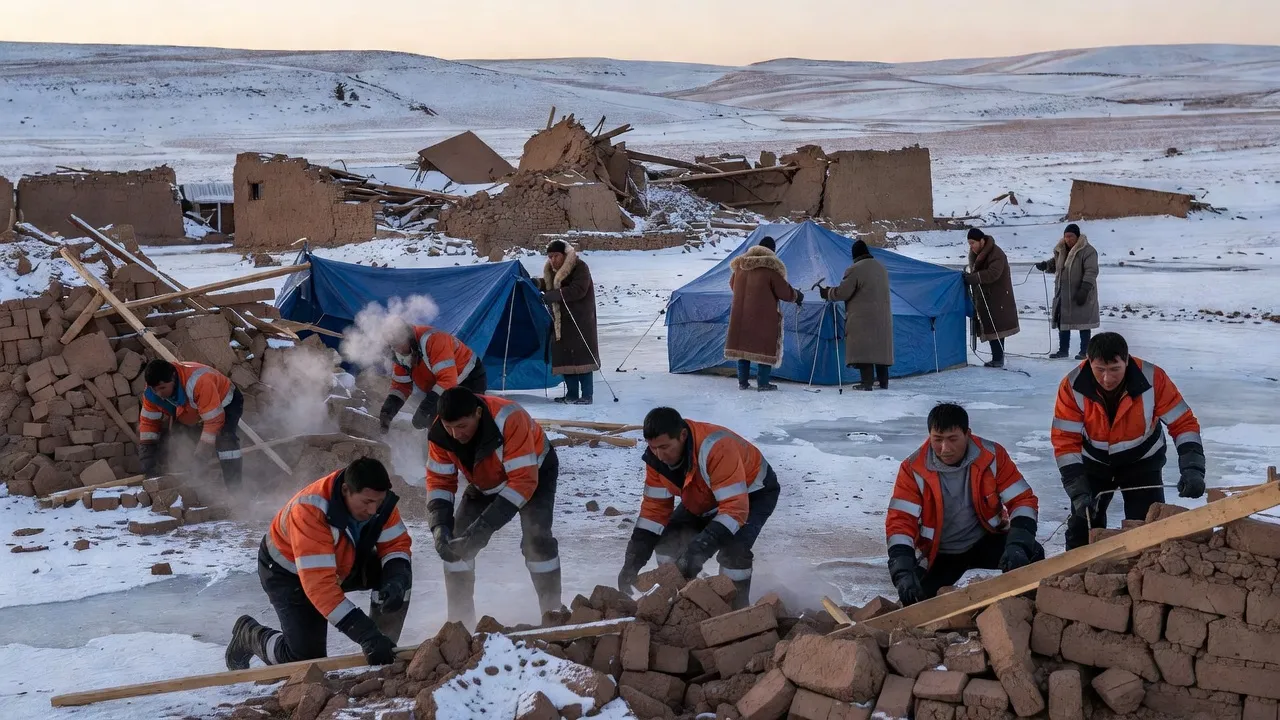
Canberra retains from the Tibetan earthquake the urgency of relief efforts: tents, police deployed and displaced people rehoused at high altitude, with the toll attributed to official Chinese sources.
Dominant angle identified — does not reflect unanimity of this country’s media
KEY POINTS
- 01
Magnitude 7 earthquake on Thursday at around 22:33 in Nagqu: 16 dead and 339 houses collapsed, according to Xinhua and the Nagqu media office (ABC).
- 02
The number of injured has risen from 32 to 65 and more than 12,000 people have been relocated; the CENC recorded 413 aftershocks (PerthNow).
- 03
More than 300 police officers have been sent to the epicentre, located at an altitude of around 4,864 metres and 400 km from Lhasa (PerthNow, ABC).
ANALYSIS
Canberra, October 23, 2026. Australian media are treating the earthquake in northern Tibet as a wire service dispatch focused on the human toll and relief efforts. ABC News Australia, which credits Reuters, AP, and AFP, reports that a magnitude 7 earthquake struck on Thursday at 22:33 local time in the Nagqu region, killing 16 people. The initial toll lists 32 injured, including 11 in serious condition at 2:25 Friday, according to the state-run Xinhua agency, citing the city's emergency management office.
The account emphasizes the terrain. The epicenter is located in a high-altitude, sparsely populated county, at a depth of 10 kilometers; the average altitude within a 5 km radius is approximately 4,864 meters, according to the China Earthquake Center (CENC), and the epicenter is about 400 km from Lhasa. At least 339 houses have collapsed, according to the Nagqu media office. ABC describes residents fleeing their homes to take shelter outside or in their cars, and one of them being awoken by the quake, with their house "creaking" under the tremors. Police and emergency teams are setting up tents for the displaced.
PerthNow, which picks up an updated dispatch from AP, indicates that the number of injured has risen to 65, while the death toll remains at 16. More than 300 police officers, including traffic and community officers, have been sent to the epicenter, according to the Nagqu police on WeChat, to assess damage to homes and help residents move to safer areas. A video posted on Douyin shows officers loading supplies into a truck and inspecting rubble with flashlights. Xinhua mentions more than 12,000 people relocated to safety, and the CENC reports 413 aftershocks.
The two articles situate the event through historical comparison: the January 2025 earthquake in Tingri, which killed at least 126 people, and the 2010 earthquake in Yushu (magnitude 7.1, at least 2,698 dead). They present it as the strongest in China since January 2024. Earthquakes are described as "relatively common" there.
The coverage includes no special correspondent report, no independent testimony, and no reaction from the Australian government. It also does not mention Xi Jinping's instructions or the emergency aid announced by Beijing, and leaves out the landslides on National Highway 317 or communication outages. The information comes almost entirely from Xinhua, the CENC, and local authorities, relayed through official media videos.