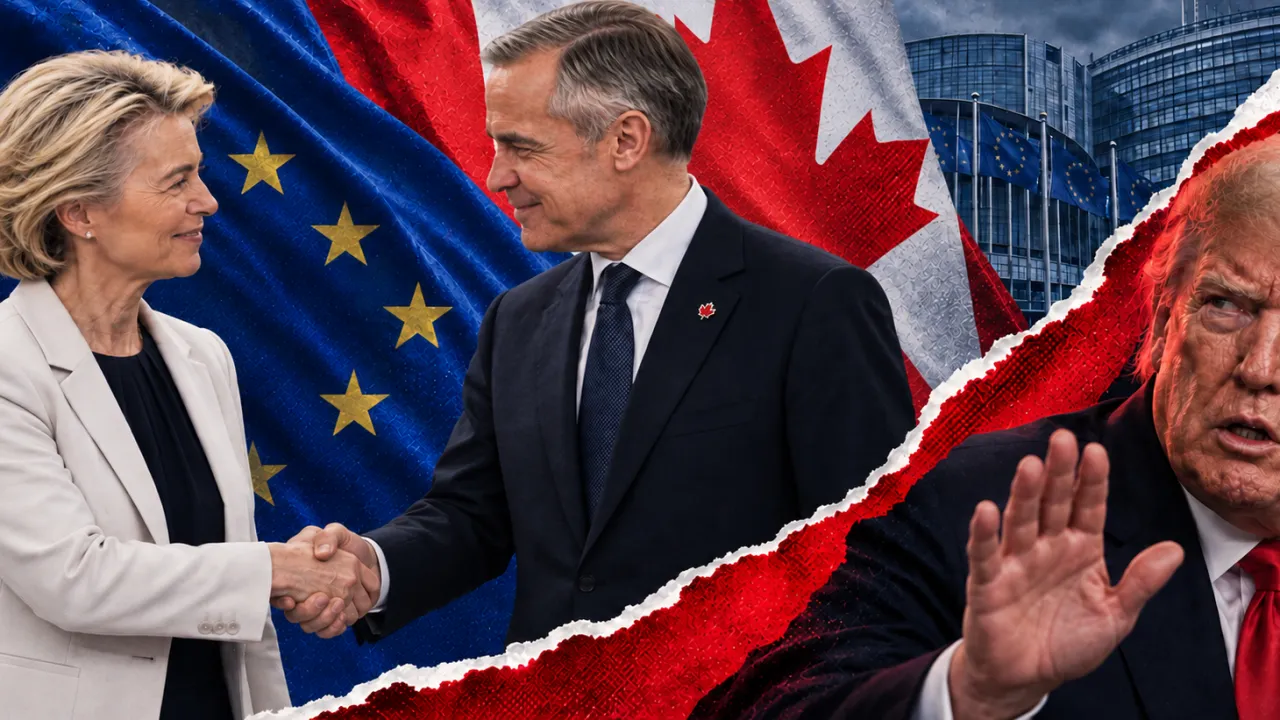
Von der Leyen proposes making Canada the EU's first 'associate member'; Trump threatens to cut off trade with Europe
published on
countries
sources
articles
The gesture from Strasbourg did not occur in isolation. On the same Wednesday, Ottawa also formally requested to join a North European defense coalition, while a similar concept of "associated membership" proposed a few months earlier for another country had already received a cool reception in its capital.
The precise content of the new status has not been determined; its adoption will require the unanimous agreement of the twenty-seven member states.
A precedent already attempted
The term "associate member" was not born with Canada. According to German and French media, Chancellor Friedrich Merz had used it in May for Ukraine: participation in summits and certain ministerial meetings, an associate commissioner, representatives in Parliament, but no voting rights. The formula had then received a cool reception in Kiev, which demands full membership.
« This is a new category »
Questioned by the French press, German MEP Tobias Cremer acknowledged that he did not precisely know what the term covers for Canada. Another German MEP, René Repasi, suggested to Deutsche Welle a model close to a "European Economic Area plus": strong integration into the single market combined with observer status, comparable to that of Iceland.
On the Canadian side, European Commissioner for Competitiveness Teresa Ribera summed up the same caution to the National Post: what the status concretely means remains to be built over time.
Two fronts opened at the same time
On the same Wednesday, according to Indian and South African press, Canada formally requested to join the Joint Expeditionary Force, the North European defense coalition of ten NATO countries led by the United Kingdom, following talks in Liverpool between Mark Carney and his British counterpart Andy Burnham. The Indian press recalls that Ottawa had declined a first invitation to this framework during the NATO summit in Wales in 2014, a period of budget restrictions for the Canadian armed forces.
On the commercial front, the French and Spanish press notes that the CETA, provisionally in force since 2017, has still not been ratified by ten member states nine years after its signature, including France and Italy, while Spain has already done so.
The British press also reports that Mark Carney aims to double Canadian trade outside the United States in ten years, and presents his country as a "safe haven" capable of attracting 1,000 billion Canadian dollars in investments in five years.
A contested membership in Ottawa
The lack of clarity surrounding the new status is fueling domestic opposition. According to Global News, Conservative leader Pierre Poilievre claims, without any details from Carney or von der Leyen to support him, as reported by the media, that such a partnership could force Canadians to contribute to the European budget, accept regulations written in Brussels, or relinquish control over immigration.
Canadian Ambassador to the EU Jonathan Wilkinson, on the other hand, refused on Wednesday to endorse the term "associate member": "We are not seeking to become a member of the European Union, as this is a sovereignty issue," he told journalists, according to the Canadian press, adding that he wants to move closer without giving up "important areas" of Canadian sovereignty.
Le Monde finally reports a protocol blunder that was kept quiet: Ursula von der Leyen had initially planned to return to Brussels without attending Mark Carney's speech to EU lawmakers, before backtracking under pressure from critics.
What Brussels has not settled
The uncertainty does not stop at third-party capitals: in Brussels itself, a European diplomat quoted by Reuters and relayed by the South African press admitted to not knowing what the term concretely covers.
« nobody really knows what it means »
The areas of cooperation cited by Ursula von der Leyen include defense industrial bases, critical raw materials, batteries, artificial intelligence, quantum computing, and cybersecurity, according to several Colombian and German perspectives.
The Spanish and Italian press indicates that a EU-Canada summit is expected in October in Montreal to clarify the actual scope of the proposal.
Article 49 of the EU treaties reserves full membership for European states only.
Without full membership, Canada would follow the single market rules without voting rights, like Iceland or Norway.
Spain has already ratified the CETA, the EU-Canada trade agreement signed in 2017.
Conservative Pierre Poilievre mentions, without proof according to the media, a possible loss of Ottawa's sovereignty.
How each country reads it
21 perspectives, each in the voice of that country's press.
 Canada
Ottawa carefully distinguishes the "unique alliance" claimed by Mark Carney from the "associate member" status advanced by Brussels, a distinction that the Canadian press deems decisive in the face of accusations of loss of sovereignty wielded by the Conservative opposition.
4 sources
 Australia
Canberra takes away from this episode less the diplomatic breakthrough than its origin: the commercial collapse between Canada and the United States, marked by months of cross tariffs, which pushed Ottawa towards Brussels — a precedent that Australia, also exposed to Washington's tariff fluctuations, scrutinizes closely.
2 sources
 Bangladesh
Dhaka takes away from this Strasbourg speech less the diplomatic gesture towards Ottawa than the symptom of a global commercial order that is cracking, a direct risk for exporting economies like its own, caught between closing blocs.
2 sources
 Brazil
Brasília sees in von der Leyen's offer the commercial price of a break with Washington: a partnership already sealed by the CETA, elevated to a diplomatic level in the face of Trump's tariff war.
2 sources
 Colombia
Bogotá is examining a diplomatic label that still lacks a legal definition, born out of pressure from the American president rather than a formal European treaty.
2 sources
 Germany
Berlin recognizes in the proposal made to Canada the concept of associate membership that Chancellor Friedrich Merz had himself formulated this year for Ukraine, where Kiev had received it coolly, calling for full membership instead.
3 sources
 Denmark
Copenhagen is scrutinizing Mark Carney's formula for enhanced "mutual sovereignty" through rapprochement with the EU, more than the ovation he received on Wednesday in Strasbourg.
2 sources
 Spain
SpainMadrid claims to be ahead on this issue: Spain has already ratified the CETA trade agreement that ten member states have been dragging on for nine years, and retains in von der Leyen's proposal for "associate member" the extension of an economic partnership already sealed with Ottawa.
4 sources
 Finland
Helsinki is weighing the risk of an open transatlantic trade rupture sparked by the proposal for a "associate member" status for Canada, as Washington threatens to cease all trade with Europe as a whole.
3 sources
 France
Paris is deciphering a spectacular but legally empty announcement and recalls that the rapprochement with Ottawa is already running into a concrete obstacle: the CETA, which France itself has still not ratified.
6 sources
 Hungary
Budapest is dissecting the legal vacuum of von der Leyen's announcement, a "associate member" status that does not exist in any European treaty and which several capitals, according to the Hungarian press, discovered with surprise.
2 sources
 India
IndiaNew Delhi is deciphering an unprecedented legal proposition, where Ottawa claims a "unique alliance" rather than membership, and where the final decision will rest with the Twenty-Seven.
2 sources
 Italy
ItalyRome is weighing von der Leyen's proposal in light of Trump's immediate tariff retaliation, more so than its still unclear institutional scope for Canada.
2 sources
 Mexico
Mexico City sees in Trump's threat a direct echo of its own trade dependence on Washington, as revealed by the Canadian case.
2 sources
 Pakistan
Islamabad sees the European announcement as the result of a trade rupture between Ottawa and Washington, rather than a gesture of political allegiance.
4 sources
 Portugal
Lisbon is analyzing von der Leyen's proposal in light of its institutional mechanics: an "associated member" status that does not exist in any treaty and will need to receive the approval of the Twenty-Seven, including Portugal.
2 sources
 Qatar
QatarDoha is dissecting the legal vacuum behind the term "associate member", a status that European treaties do not provide for and that Ursula von der Leyen herself has not clarified.
2 sources
 Sweden
Stockholm sees von der Leyen's announcement as a strong gesture but legally vague: the European treaties provide for no "associate member" status, and the idea, borrowed from the German project for Ukraine, had already received a cool reception in Kiev.
4 sources
 United Kingdom
London sees Brussels' move as a risky economic gamble: Ottawa is seeking to break its dependence on Washington by tying itself to the European single market, even if it means provoking the anger of its largest trading partner.
3 sources
 United States
The United States government rejects the idea of a Canada tied to the EU as a commercial provocation and wields the threat of crushing tariffs to deter Ottawa and Brussels.
6 sources
 South Africa
Pretoria is deciphering a "associate member" status that even European diplomacy says it does not understand, and the precedent it sets for Ukraine without offering it full membership.
3 sources
What the comparison reveals
Common ground and differences in coverage across the media analysed.
What the media report in common
On Wednesday, September 16, in her State of the Union address in Strasbourg, Ursula von der Leyen proposed making Canada the first 'associate member' of the European Union, an announcement met with a standing ovation from MEPs and followed by a hug with Mark Carney.
The 'associate member' status does not exist in the European Union's current treaties.
This proposal comes as trade relations between Canada and the United States have deteriorated since the summer, with cross-border tariffs between the two countries.
Where media coverage diverges
Origin of the rapprochement
Part of the coverage presents the European offer as an extension of the economic cooperation already undertaken by the CETA, while another part reads it first as a defensive reaction to the deterioration of trade between Canada and the United States.
Coverage that diverges
Scope of the Ukrainian precedent
Part of the coverage links the proposed status to the concept of associated membership already put forward in May for Ukraine, which was met with a cool reception in Kiev, and sees this as a reason for caution regarding the actual scope of the gesture towards Canada, while another part does not mention this precedent and presents the announcement as an unprecedented deepening of economic ties.
This grouping describes the publications analysed, not the position of these countries’ populations or of their governments.
The full text, country by country
Canada
DOMINANT ANGLE
Ottawa carefully distinguishes the "unique alliance" claimed by Mark Carney from the "associate member" status advanced by Brussels, a distinction that the Canadian press deems decisive in the face of accusations of loss of sovereignty wielded by the Conservative opposition.
KEY POINTS
- European Commissioner for Competitiveness Teresa Ribera describes the "associated member" status as non-existent in the treaties: "It's a new category".
- EU Ambassador Jonathan Wilkinson rules out full membership, calling it a "sovereignty issue".
- Donald Trump signed a memorandum removing Canadian products from US federal public markets and threatens Europe with "very heavy customs duties".
ANALYSIS
Ottawa, September 17, 2026. On Wednesday, in the European Parliament's hemicycle in Strasbourg, Mark Carney stood to applaud the ovation that followed European Commission President Ursula von der Leyen's announcement: she "would like to work" with the Canadian Prime Minister "to open the door" for Canada to become the first "associate member" of the European Union. Carney joined the podium to hug her. But the Canadian press immediately emphasizes that this status does not exist in any EU treaty. "It's a new category," summarized European Commissioner for Competitiveness Teresa Ribera, specifying that what being an associate member could mean today will have to be developed and detailed over time. The result of the negotiations is to be announced at a Canada-EU summit scheduled to take place in Montreal at the end of October.
Ottawa insists on the distinction with full membership. As early as Sunday, Carney had denied seeking to make Canada an EU member, instead evoking a "unique alliance." Canadian Ambassador to the EU Jonathan Wilkinson refused on Wednesday to endorse the term "associate member": "We are not seeking to become a member of the European Union, as it is a sovereignty issue," he told journalists, adding that he wants to get closer "without giving up important parts of our sovereignty." The Prime Minister's office was content with a statement welcoming the invitation, without mentioning the term "associate member."
This ambiguity is already fueling opposition. Conservative leader Pierre Poilievre claims, without proof according to Global News, that such a partnership could force Canadians to contribute to the European budget, accept regulations dictated by Brussels, or give up control over immigration.
On the same day, Donald Trump, from North Carolina, called the idea "laughable" and warned that if it were pursued with "bad intentions," he would impose "very heavy tariffs" on Europe. He also signed a memorandum removing all Canadian-origin products from US federal public markets and repeated that Canada had been "a terrible trading partner." For conservative columnist Jesse Kline (National Post), the context justifies the European bet: with nearly two-thirds of Canadian exports directed towards the United States, diversifying "opens up a world of possibilities" without renouncing the American relationship. Carney is to address the European Parliament on Thursday.
Australia
DOMINANT ANGLE
Canberra takes away from this episode less the diplomatic breakthrough than its origin: the commercial collapse between Canada and the United States, marked by months of cross tariffs, which pushed Ottawa towards Brussels — a precedent that Australia, also exposed to Washington's tariff fluctuations, scrutinizes closely.
KEY POINTS
- Von der Leyen proposed making Canada the first "associate member" of the EU in her State of the Union speech in Strasbourg, a status that SBS News Australia describes as "not set out in the bloc's treaties".
- Carney's office welcomed a "far stronger, more ambitious" alliance based on "strategic autonomy", without ever using the term "associate member"; Carney had said earlier in the week that he was seeking a "unique alliance", not membership.
- The rapprochement comes after a "historic collapse of Canada-United States relations", the failure of trade negotiations the previous month having triggered cross-border tariffs between Ottawa and Washington.
ANALYSIS
Canberra, September 17, 2026. Ursula von der Leyen proposed on Wednesday to make Canada the first "associate member" of the European Union, a status that does not exist in any European treaty. Before the European parliamentarians gathered in Strasbourg for her annual speech on the state of the Union, the President of the Commission received a standing ovation before going to hug Canadian Prime Minister Mark Carney, who was present in the hemicycle. "I say that we need to urgently reinvent our partnerships. I would therefore like to work with you to open the door for Canada to become the first associate member of the EU," she declared, invoking "the cold fragility of today's world".
The Australian press first retains what this gesture reveals by implication: Carney's European move comes after what agencies describe as a "historic collapse of Canada-US relations", triggered by the failure of trade negotiations last month and a series of cross-border tariffs. Ottawa and Brussels, noted the dispatches reprinted in Sydney, "see the world with the same eyes, from AI to climate, from the Arctic to geopolitics", in the face of commercial rivalry coming from both the Trump administration and a more assertive China.
Carney himself was more cautious than von der Leyen. His office welcomed an alliance "much stronger and more ambitious in the future", with Canada and Europe having to "guarantee their strategic autonomy through in-depth cooperation on all strategic capabilities" - without ever repeating the term "associate member". Earlier in the week, the Prime Minister had said he was seeking a "unique alliance" with the EU, not membership. He is to address the European parliamentarians himself on Thursday.
Von der Leyen left the definition of the status open, recalling that it will be up to the twenty-seven member states, and not just her, to decide - a reminder all the more clear since the same proposal, formulated in May by Germany for Ukraine as a step towards full membership, had then received a lukewarm reception from the capitals. For Canberra, whose own exchanges with Washington remain exposed to the same tariff fluctuations, the Canadian episode is worth less as an institutional precedent than as a signal: even a historical commercial partner of North America is now seeking to diversify its support.
Bangladesh
DOMINANT ANGLE
Dhaka takes away from this Strasbourg speech less the diplomatic gesture towards Ottawa than the symptom of a global commercial order that is cracking, a direct risk for exporting economies like its own, caught between closing blocs.
KEY POINTS
- Von der Leyen proposed on September 16 in Strasbourg to make Canada the first "associate member" of the EU, a status absent from European treaties.
- Mark Carney claims to be seeking a "unique alliance" with the EU, rather than full membership.
- A collapse of Canada-US trade talks last month triggered a series of reciprocal tariff measures between the two countries.
ANALYSIS
Dhaka, September 17, 2026. Ursula von der Leyen proposed on Wednesday, in her annual speech on the state of the Union before the European Parliament in Strasbourg, to make Canada the first "associate member" of the European Union, a status that does not exist in any treaty of the bloc. The European parliamentarians gave her a standing ovation before she went to greet Canadian Prime Minister Mark Carney, who came specially to listen to her speech. "We need to reinvent our partnerships urgently," she declared, invoking "the cold fragility of today's world" to justify this unprecedented rapprochement.
For the press in Dhaka, which relays the analysis of international agencies, the episode is read above all as a sign of the recomposition of trade blocs, at a time when Europe and Canada are "facing increased trade rivalry" from both Washington and Beijing. Canada, whose Prime Minister claims to be seeking a "unique alliance" and not full membership, is acting after the collapse of trade talks with the United States last month, which has already triggered a series of reciprocal tariff measures between Ottawa and Washington.
This context speaks directly to an economy like Bangladesh, whose textile exports depend largely on the trade preferences granted by the European Union. If a G7 partner like Canada deems it necessary to secure a special status in the face of American tariff instability, the fragility it exposes is that of all preferential access to a major Western market, a concern shared by more modest exporting economies, without the same negotiating weight. Von der Leyen detailed the sectors targeted by this future "space of common prosperity": smart manufacturing, technological alliance, industrial defense bases, the Arctic, artificial intelligence, energy, and critical minerals - all supply chains that Asian exporting economies also depend on.
The articles relayed in Dhaka also note that this "associate" status remains legally vague: Berlin had proposed a comparable mechanism for Ukraine in May, as a step before full membership, without obtaining the agreement of several European capitals. Von der Leyen's proposal will therefore have to be validated by the member states, and not by her alone. Carney is due to speak in turn on Thursday before the European parliamentarians.
Brazil
DOMINANT ANGLE
Brasília sees in von der Leyen's offer the commercial price of a break with Washington: a partnership already sealed by the CETA, elevated to a diplomatic level in the face of Trump's tariff war.
KEY POINTS
- Ursula von der Leyen proposed making Canada the first "associate member" of the EU during the State of the Union speech in Strasbourg, Wednesday, September 16, 2026 (G1).
- The CETA, an agreement signed in 2017, has increased transatlantic trade by 76%, with an annual volume of 130 billion euros (Folha).
- EU rules reserve membership for European countries only, but Brussels and the Parliament would have found a way to enhance existing collaboration without amending the treaties (Folha).
ANALYSIS
Brasília, September 17, 2026. The Brazilian press sees Ursula von der Leyen's proposal as less of a protocol gesture and more as the logical follow-up to a trade rupture sealed since 2017. On Wednesday, September 16, in her annual speech on the state of the Union before the European Parliament in Strasbourg, the President of the European Commission invited Canada to become the first "associate member" of the 27-nation bloc, a membership that Folha describes as "unthinkable before". According to the daily, this offer stems directly from "the aggressive diplomacy and trade war that the United States under Donald Trump is waging against two of its largest partners".
Without ever mentioning Washington, von der Leyen justified the rapprochement by citing a world that is "openly hostile", marked by war on Europe's borders, the multiplication of hybrid attacks, and increasing competition from the United States and China. She promised to elevate the relationship with Ottawa "to the highest possible level", to build a space of common prosperity and economic security covering industry, technology, energy, artificial intelligence, defense, and the Arctic. Mark Carney stood up to applaud her, under a standing ovation from the European parliamentarians; she repeated that "this is not a partnership against anyone, but for our common strengthening". G1 notes that, without being named, the United States remains implicit in the entire speech: as Canada's neighbors, they also maintain trade tensions with Ottawa and with the EU itself.
The Brazilian coverage emphasizes the existing economic anchor: signed in 2017, the CETA has increased transatlantic trade by 76%, for an annual volume of 130 billion euros. The EU's rules reserve membership for European countries only, but Brussels and the Parliament would have found a way to elevate this collaboration without touching the founding treaties.
Neither of the two articles reports on Donald Trump's response nor Canada's request to integrate the Joint Expeditionary Force announced on the same day: the Brazilian reading remains focused on the European gesture and its commercial anchor, leaving out of scope the North European security aspect and the immediate American reaction.
Colombia
DOMINANT ANGLE
Bogotá is examining a diplomatic label that still lacks a legal definition, born out of pressure from the American president rather than a formal European treaty.
KEY POINTS
- Ursula von der Leyen proposed on Wednesday, September 16, in Strasbourg, to make Canada the first "associate member" in EU history, before the European Parliament.
- Mark Carney was the first non-European leader ever invited to attend the State of the Union address, according to Portafolio.
- La Republica highlights that this new label still has no legal definition or details on the benefits and obligations it would imply.
ANALYSIS
Bogotá, September 17, 2026. The Colombian economic press first notes what this new status does not yet contain: no legal definition, no details on the rights or obligations it would imply. On Wednesday, in Strasbourg, European Commission President Ursula von der Leyen proposed to Canadian Prime Minister Mark Carney that his country become the first "associate member" in the history of the bloc, before the European Parliament. Carney, Portafolio emphasizes, was the first non-European leader ever invited to attend the State of the Union address. Von der Leyen addressed him directly: "I said that we must urgently reimagine our partnerships. I would therefore like to work with you to open the door for Canada to become the EU's first associate member."
La Republica stresses the context that led to this offer: the pressure from Donald Trump "is driving the community bloc and Canada to bring their positions closer together than ever before." Von der Leyen herself justified the move by refusing to depend on a single partner: "For some, the answer is to act alone. But that's not an option for us (...). We can no longer depend on him as the only means of protecting our interests."
In substance, the President of the Commission outlined a shared vision ranging "from artificial intelligence to climate change, from the Arctic to geopolitics," citing Ukraine, defense, raw materials, and supply chains. She added, addressing Carney: "Above all, dear Mark, Europe and Canada believe in democracy. We believe that power belongs not to the strongest, the richest, or those who shout the loudest, but to all of us." The two parties would move towards integrating the industrial defense bases, energy, critical raw materials, batteries, artificial intelligence, quantum computing, cybersecurity, and economic security.
But La Republica repeats: the label "does not yet exist" legally, and no details have been offered on what it would imply concretely beyond the opening of a "common space for economic prosperity and security." For the Colombian press, the standing ovation reserved for the announcement in Strasbourg contrasts with the persistent vagueness of the text: a strong political gesture, a legal architecture still entirely to be written.
Germany
DOMINANT ANGLE
Berlin recognizes in the proposal made to Canada the concept of associate membership that Chancellor Friedrich Merz had himself formulated this year for Ukraine, where Kiev had received it coolly, calling for full membership instead.
KEY POINTS
- Von der Leyen proposed on Wednesday in Strasbourg to make Canada the "first associated member of the EU", a status not provided for in the European treaties.
- SPD MEP René Repasi mentions a model similar to a "European Economic Area plus", with an observer status comparable to that of Iceland.
- According to The Local Germany, the concept of associated membership was first formulated this year by Chancellor Friedrich Merz regarding Ukraine, which had given it a cool reception.
ANALYSIS
Berlin, September 17, 2026. The state of the Union speech delivered on Wednesday in Strasbourg by Ursula von der Leyen is prompting a reading in Germany that goes beyond the sole Canadian case. The President of the Commission proposed making Canada "the first associated member of the EU", a status intended to take the relationship "to the highest possible level" in the face of "the cold and fragile reality of today's world". She cited the defense industry, energy, critical raw materials, batteries, artificial intelligence, quantum computing, and cybersecurity, with the CETA agreement set to evolve into a "alliance for the future". Mark Carney, present in the hemicycle, received a standing ovation; he says he is seeking a "unique alliance", not membership.
The German press is highlighting a fact that foreign comments are overlooking: the term "associated member" does not exist in European treaties. Asked by Deutsche Welle, socialist MEP René Repasi suggests it could be a model similar to an "extended European Economic Area": integration into the single market combined with observer status, comparable to that of Iceland. According to The Local Germany, this concept was not born with Canada: it was Chancellor Friedrich Merz who first formulated it this year, regarding Ukraine, where Kiev would have attended summits and had a representative on the Commission, without full voting rights. The idea had then received a cool reception in Kiev, which is demanding full membership.
Die Tagesschau is taking a more reserved tone on the method: the public channel recalls that von der Leyen has made numerous announcements - a plan to combat heat waves, a banking package, a European society for critical raw materials, a new Security Council, dialogue with AI companies - and notes that "only a part" of this type of announcement usually materializes. The EU-Canada summit scheduled for next month in Montreal is expected to clarify the real scope of the proposal.
The response from Donald Trump, who finds the idea "laughable" and threatens to "stop trading" with Europe, confirms for Berlin that Washington perceives this rapprochement as an act of power politics, not just a simple commercial adjustment.
Denmark
DOMINANT ANGLE
Copenhagen is scrutinizing Mark Carney's formula for enhanced "mutual sovereignty" through rapprochement with the EU, more than the ovation he received on Wednesday in Strasbourg.
KEY POINTS
- Mark Carney wrote on X that Canada and the EU are "natural partners" and that the partnership aims to strengthen their "mutual sovereignty", without explicitly saying yes to the associate member offer.
- The discussions focus on critical minerals, energy, defense, research and development, and advanced technologies, according to Carney's office.
- Von der Leyen stated that this partnership "is not against anyone", a phrase read by DR Nyheder as a veiled allusion to the United States, in an "open trade war" with Canada.
ANALYSIS
Copenhagen, September 17, 2026. The Danish press is less focused on the standing ovation given to Mark Carney in Strasbourg than on the phrase chosen by the Canadian Prime Minister to describe what this rapprochement changes for his country. On Wednesday, after European Commission President Ursula von der Leyen proposed, in her State of the Union speech, making Canada the first "associated member" of the EU — and the first country outside Europe to receive this status —, Mark Carney wrote on X that "Canada and the EU are natural partners, united by common values". He added that the meeting with von der Leyen and European Parliament President Roberta Metsola aimed at "the next step: a closer partnership that strengthens our mutual sovereignty and creates more opportunities and prosperity for our populations". DR Nyheder and Berlingske both note that he does not explicitly say yes to the associated membership offer.
Carney's office specifies that discussions are about critical minerals, energy, defense, research and development, and advanced technologies. According to his services, "in a more dangerous and divided world, Canada is building stronger relationships with reliable partners to gain more strategic autonomy".
Von der Leyen took care to specify that "this is not a partnership against anyone", a phrase that DR Nyheder reads as a barely veiled allusion to the United States, with which Canada is engaged in "an open trade war". She also stated that the EU "will always be at the forefront of the rules-based order". Carney was welcomed on Wednesday morning in Strasbourg with hugs from von der Leyen and Metsola, becoming the first head of government of a non-EU country to attend the State of the Union speech in person.
For Denmark, an EU member engaged in the Arctic, the mention of Arctic cooperation and defense among the discussed areas touches on direct regional interests, even if the Danish media consulted so far limit themselves to noting that Carney is seeking a tailored status rather than full membership, and that the "mutual sovereignty" he claims remains to be defined legally.
Spain
DOMINANT ANGLE
Madrid claims to be ahead on this issue: Spain has already ratified the CETA trade agreement that ten member states have been dragging on for nine years, and retains in von der Leyen's proposal for "associate member" the extension of an economic partnership already sealed with Ottawa.
KEY POINTS
- Von der Leyen proposed making Canada the EU's first "associate member" to Mark Carney, under a standing ovation from MEPs in Strasbourg on September 16
- Spain has already ratified the CETA EU-Canada trade agreement, while ten member states still have not done so nine years after its signing, according to Carney as quoted by the Financial Times
- EU-Canada goods exchanges reached 82 billion euros in 2025, making the EU Ottawa's second-largest trading partner
ANALYSIS
Madrid, September 17, 2026. The state of the Union speech delivered on Wednesday, September 16, in Strasbourg by Ursula von der Leyen is occupying the Spanish press, which first notes the unprecedented scope of the gesture towards Ottawa. According to Expansión, the President of the Commission proposed to Canadian Prime Minister Mark Carney, who was present in the hemicycle, to make his country the first "associate member" in the history of the Union, under a standing ovation from MEPs. "We see the world in the same way: from artificial intelligence to climate change," she stated, before listing the areas of cooperation envisioned: defense industry, critical raw materials, batteries, AI, quantum computing, cybersecurity.
HuffPost España emphasizes that this status does not exist in any European treaty: the idea had first been put forward this year by German Chancellor Friedrich Merz for Ukraine, before receiving a cold reception in Kiev, which is demanding full membership. The Local Spain recalls the immediate response from Donald Trump, from North Carolina, describing the initiative as "laughable" and threatening, if it constituted a "hostile act", to impose heavy tariffs or cease all trade with Europe.
But it is ElDiario.es that provides the most Spanish angle on the issue: Spain is among the member states that have already ratified the EU-Canada trade agreement, while ten countries in the bloc have still not done so nine years after its signing, according to Mark Carney himself, cited by the Financial Times. The newspaper recalls that in 2025, trade in goods between the EU and Canada reached 82 billion euros, making the European bloc Ottawa's second-largest trading partner. Carney's visit to Strasbourg is intended to serve as a catalyst before a EU-Canada summit scheduled for next month in Montreal.
The Spanish press also notes that Australia has already hinted that it could follow Canada's path if its relations with Washington continue to deteriorate. For Madrid, which is already in compliance with the CETA, this new status appears less like an institutional novelty than the consecration of a commercial relationship already sealed, while ten European partners are still dragging their feet on ratification.
Finland
DOMINANT ANGLE
Helsinki is weighing the risk of an open transatlantic trade rupture sparked by the proposal for a "associate member" status for Canada, as Washington threatens to cease all trade with Europe as a whole.
KEY POINTS
- Trump has threatened to impose very heavy tariffs or completely halt trade with Europe if Canada's associated membership materializes and he deems it hostile.
- Von der Leyen proposed the status of "associate member" for Canada in her State of the Union speech in Strasbourg on Wednesday, without specifying its content, to a standing ovation from MEPs.
- The United States and Canada have imposed heavy tariffs on each other since summer, after the failure of their trade negotiations, according to Helsingin Sanomat.
ANALYSIS
Helsinki, September 17, 2026. In Strasbourg, on Wednesday, European Commission President Ursula von der Leyen proposed in her annual speech on the state of the Union to make Canada the first "associated member" of the twenty-seven EU states, without detailing what this status would concretely entail before the hemicycle. Canadian Prime Minister Mark Carney, exceptionally present in the room, listened with a smile, while the MEPs gave von der Leyen a standing ovation. She then hailed the common future of the EU and Canada on social media. Carney is set to speak in turn to the MEPs on Thursday.
The Finnish press is mainly focusing on Donald Trump's immediate response. From North Carolina, the US President deemed the idea "naurettavaa" ("ridiculous") and warned, in essence: if he considers the move a hostile act, he will impose very heavy tariffs or simply cease trade with Europe. He repeated this threat to journalists on the same day, a few months after already proposing to make Canada the "51st American state".
Helsingin Sanomat links this outburst to the trade war already underway between Washington and Ottawa since the summer: the two countries have mutually imposed heavy customs tariffs after the failure of their trade negotiations, with Canada itself raising its own tariffs on American imports as of Tuesday. For an export-oriented country like Finland, whose economy closely depends on the stability of trade with both sides of the Atlantic, the prospect of a US trade rupture with the entire EU - and no longer just with Canada - constitutes a direct risk to Finnish outlets, at a time when the United States still absorbs the bulk of Canadian exports.
None of the three Finnish articles consulted mention, at this stage, Canada's application to join the Joint Expeditionary Force announced on the same day, or its implications for North European defense cooperation, in which Finland, a NATO member, is a party. The coverage remains focused on the verbal duel between von der Leyen and Trump, against the backdrop of the still unclear status of "associated member".
France
DOMINANT ANGLE
Paris is deciphering a spectacular but legally empty announcement and recalls that the rapprochement with Ottawa is already running into a concrete obstacle: the CETA, which France itself has still not ratified.
KEY POINTS
- The "associated member" status proposed by Ursula von der Leyen is not provided for in the EU treaties, according to the French press and German MEP Tobias Cremer.
- A precedent exists: in May, Germany had proposed a comparable status for Ukraine, detailed by Chancellor Friedrich Merz (participation without voting rights in summits and ministerial meetings, associate commissioner).
- Ten EU countries, including France and Italy, have still not ratified the CETA free trade agreement with Canada, which is provisionally in force.
ANALYSIS
Paris, September 17, 2026. Deciphering the announcement made on Wednesday, September 16, by Ursula von der Leyen in Strasbourg, is first and foremost about noting what it does not contain: legal content. The President of the European Commission proposed that Canada become the first "associate member" of the European Union before the European Parliament, where Canadian Prime Minister Mark Carney, an exceptional guest, received a standing ovation before being warmly embraced by Ms. von der Leyen. But this status "is not legally defined by the EU's treaties," the French press emphasizes, and German MEP Tobias Cremer conceded it bluntly: "We still don't really know what it means."
A precedent does exist, however: in May, Germany had proposed a comparable status for Ukraine, detailed by Chancellor Friedrich Merz - participation in summits and certain ministerial meetings, an associate commissioner, representatives in Parliament, but no voting rights. The proposal had then been met with a cool reception by most other member states.
This announcement comes after what Le Monde describes as a "diplomatic blunder" by Ms. von der Leyen, who was initially supposed to return to Brussels without attending Mark Carney's speech, scheduled for this Thursday, September 17, before the European Parliament, before backtracking under pressure from critics. The rapprochement also faces a very concrete obstacle that France is well aware of: the CETA free trade agreement, provisionally in force with Ottawa, has still not been ratified by ten EU countries, including France and Italy.
Donald Trump immediately called the proposal "ridiculous" and threatened, if it constituted "a hostile act," to impose "very heavy tariffs" or "cease all trade with Europe." Canada, whose exports depend 70% on the US market, is seeking, according to Ottawa, not membership but a "unique alliance." Emmanuel Macron, on the other hand, is set to receive Mark Carney in Saint-Pierre-et-Miquelon to conclude this Canadian cycle, a sign that Paris is also prioritizing its own bilateral path rather than the sole symbolic gesture in Strasbourg.
Hungary
DOMINANT ANGLE
Budapest is dissecting the legal vacuum of von der Leyen's announcement, a "associate member" status that does not exist in any European treaty and which several capitals, according to the Hungarian press, discovered with surprise.
KEY POINTS
- The status of "associate member" does not exist in EU law: Article 49 of the treaties reserves full membership for European states, according to Telex and 444.
- 444 reports that von der Leyen's announcement "surprised several European capitals", triggering political turmoil.
- Donald Trump threatened to impose "very heavy customs duties" or cease trading with Europe if the project is deemed "a hostile act".
ANALYSIS
Budapest, September 17, 2026. The Hungarian press first notes the legal vacuum in the announcement made on Wednesday by Ursula von der Leyen in Strasbourg. Telex and 444 recall that the European treaties, based on the jurisprudence of the Court of Justice, reserve full membership for European states in the sense of Article 49, and that the "associate member" status proposed for Canada simply does not exist in EU law. Von der Leyen herself, the two titles note, did not detail in her speech what this status would mean concretely, contenting herself with evoking a "Alliance for the future" extending the already existing free trade agreement towards technological, industrial, and defense cooperation, including the Arctic, critical materials, artificial intelligence, and cybersecurity. "This partnership is not aimed at anyone else," she insisted, without convincing Washington.
According to 444, the announcement surprised "several European capitals", triggering political turmoil that Budapest, often at odds with the Commission, observes with particular interest: a precedent created without prior consultation of the Twenty-Seven raises the question of who should approve such a de facto expansion of the European club. The future Canadian ambassador to the EU, Jonathan Wilkinson, himself tempered expectations, stating that they are not yet at that point. Carney, Telex and 444 recall, is not seeking membership but a "unique alliance", and had tasked his special European envoy with evaluating the most ambitious options outside of full membership, according to the Wall Street Journal.
Donald Trump immediately described the idea as "ridiculous" and threatened, if it constituted a "hostile act", to impose very heavy customs duties or cease trading with Europe in several sectors, while leaving a door open: "If the intention is good, it's acceptable." 444 also cites an analysis by the Guardian according to which Canada has rare earths that the EU wants to reduce its dependence on China for, and is seeking in return an outlet for exports that the trade war with Washington is closing off. Carney is to speak on Thursday before the European parliamentarians.
India
DOMINANT ANGLE
New Delhi is deciphering an unprecedented legal proposition, where Ottawa claims a "unique alliance" rather than membership, and where the final decision will rest with the Twenty-Seven.
KEY POINTS
- No "associate member" status exists in EU treaties; Berlin had already proposed it for Ukraine as an intermediate step, to no avail (The Hindu Business Line)
- Mark Carney claims to be seeking a "unique alliance" with the EU, not membership (The Hindu Business Line)
- Canada has formally asked to join the Joint Expeditionary Force, a defense coalition of ten North European NATO countries led by the United Kingdom, after talks in Liverpool with Andy Burnham (Free Press Journal)
ANALYSIS
New Delhi, September 17, 2026. The Indian economic press is deciphering with caution the announcement made on Wednesday by Ursula von der Leyen to open to Canada the path to a "associate member" status of the European Union, a first for the bloc. The Hindu Business Line recalls that no such status exists today in European treaties. Berlin had already suggested an associate membership for Ukraine, an intermediate step before full accession, a project that remained without follow-up in the face of the reluctance of several capitals.
The newspaper emphasizes that the President of the Commission made the proposal as the head of the community executive: it is the Twenty-Seven who will decide on its feasibility. She mentioned a "common space of prosperity and economy", including industrial cooperation, technological alliance, integration of defense bases, the Arctic, artificial intelligence, energy and critical minerals.
Mark Carney, present in Strasbourg, reframed the initiative: Canada, he says, is seeking a "unique alliance" with the EU, not membership - a nuance that reflects Ottawa's caution in the face of an unprecedented legal precedent.
On the same Wednesday, Ottawa took another step towards Northern Europe: the Free Press Journal reports that Canada has formally submitted its application to join the Joint Expeditionary Force, a defense coalition of ten NATO countries - Denmark, Estonia, Finland, Iceland, Latvia, Lithuania, Netherlands, Norway, Sweden and the United Kingdom, the framework nation. The announcement came during talks in Liverpool between Carney and his British counterpart Andy Burnham, according to a statement from the office of the Canadian Prime Minister.
The daily recalls that Ottawa had declined a first invitation to this device during the NATO summit in Wales in 2014, in the midst of a budget restriction of the Canadian armed forces. The current rapprochement, according to the Indian press, is part of a context of "repeated threats" by the American president against Canadian sovereignty. This double diplomatic and security maneuver illustrates how Ottawa is diversifying its support in the face of Washington, without commitment that would resemble full membership in the EU.
Italy
DOMINANT ANGLE
Rome is weighing von der Leyen's proposal in light of Trump's immediate tariff retaliation, more so than its still unclear institutional scope for Canada.
KEY POINTS
- Von der Leyen proposed on Wednesday, September 16, in Strasbourg to make Canada the first "associate member" of the EU, prompting a standing ovation from MEPs.
- Trump warned from North Carolina that if this constituted a "hostile act", he would "apply very heavy tariffs or interrupt trade relations with Europe".
- The status of "associate member" does not exist in any European treaty: it was first proposed by Friedrich Merz this year for Ukraine, a project that was met with a cool reception in Kiev.
ANALYSIS
Rome, September 17, 2026. The proposal by European Commission President Ursula von der Leyen to make Canada the first "associate member" of the Union, presented on Wednesday, September 16, before the European Parliament in Strasbourg, has caught the attention of the Italian press less for its diplomatic scope than for the tariff retaliation it immediately provoked in Washington.
ANSA reports that Donald Trump, having just stepped off Air Force One in North Carolina, where he was attending an election rally in Gastonia in support of Republican Senate candidate Michael Watley, deemed the idea "ridiculous" and warned: "If they were to do so, and if I were to consider it a hostile act, I would apply very heavy tariffs or interrupt trade relations with Europe." The threat directly targets European exporters, including Italy, whose trade flows to the United States remain a sensitive variable for the transalpine manufacturing industry.
The Local Italy recalls that the status of "associate member" does not exist in any European treaty: the idea was first put forward this year by German Chancellor Friedrich Merz regarding Ukraine, a project that was met with a cool reception in Kiev because it offered partial access to the budget and summits without full membership. Applied to Canada, the concept therefore remains to be invented legally, a fragility that the Italian press emphasizes more than an acquired advance.
Mark Carney, the first foreign head of government to attend the annual State of the Union address, received a standing ovation before being hugged by von der Leyen. His visit is intended to serve as a catalyst before the EU-Canada summit scheduled for next month in Montreal. Von der Leyen mentioned a technological alliance, the integration of defense industrial bases, and a joint Arctic project, citing energy, critical minerals, batteries, AI, and cybersecurity.
For Rome, the episode mainly illustrates the risk that a European initiative to bring a third-party partner closer may be immediately sanctioned by Washington on commercial grounds, a scenario that Italy, a net exporter to the United States, is following with particular caution as the US midterms approach, with Trump multiplying election rallies like the one in Gastonia, where Republican Watley remains behind in the polls (42.4% against 50.2% for Democrat Roy Cooper).
Mexico
DOMINANT ANGLE
Mexico City sees in Trump's threat a direct echo of its own trade dependence on Washington, as revealed by the Canadian case.
KEY POINTS
- Von der Leyen proposes making Canada the first "associate member" of the EU, by expanding the CETA agreement through a "Alliance for the future".
- Trump has described the proposal as a possible "hostile act" and threatened new tariffs against the European bloc.
- About 70 % of Canadian exports depend on the US market, driving the search for a "unique alliance" with the EU according to Carney.
ANALYSIS
Mexico, September 17, 2026. In her annual address on the state of the Union in Strasbourg, European Commission President Ursula von der Leyen proposed making Canada the first "associate member" of the European Union, a status built on the existing CETA free trade agreement, extended by an "Alliance for the future" intended to create, in her words, "a common space of prosperity and economic security." She presented this rapprochement as based not only on trade but on shared democratic values, saying to Canadian Prime Minister Mark Carney: "Above all, dear Mark, Europe and Canada believe in democracy." Carney, present in the hemicycle, received a standing ovation from European parliamentarians; he is to address the European Parliament on Thursday.
The Mexican press, which is following this file via AFP and AP dispatches, is reporting the immediate response from Donald Trump: from North Carolina, the American president described the proposal as a possible "hostile act" and threatened, if it were to materialize, to respond with new tariffs against the European bloc. This sequence resonates particularly in Mexico, whose economy is also exposed to the same tariff levers that Washington wields against its North American partners.
A Canadian official told the AP that Ottawa is exploring ties with the EU that could go as far as a step towards full membership, with an agreement allowing its citizens to live and work in Europe without a visa. Prime Minister Mark Carney, for his part, insists that he is seeking a "unique alliance" and not full membership, a distinction that Mexican media outlets are reporting without further comment.
The core of the issue, extensively documented in the articles consulted, is Canada's dependence: around 70% of the country's exports go to the United States, a figure that explains Ottawa's quest for diversification after Trump repeated his desire to see Canada become the "51st American state." For Mexico, linked to the United States by the USMCA North American agreement and facing the same tariff tensions, the Canadian episode illustrates a familiar pattern: a G7 partner, economically tied to Washington, seeking elsewhere the guarantees that its neighbor no longer offers. However, none of the articles in the corpus develop the direct implications for Mexico itself, or for the expanded NAFTA.
Pakistan
DOMINANT ANGLE
Islamabad sees the European announcement as the result of a trade rupture between Ottawa and Washington, rather than a gesture of political allegiance.
KEY POINTS
- On Wednesday, September 16, in Strasbourg, von der Leyen proposed making Canada the first "associate member" of the EU; MEPs gave her a standing ovation before she hugged Mark Carney
- The "associate member" status is not included in any European treaty and would require the agreement of the twenty-seven member states, according to Geo News
- Canada already has CETA with the EU; Mark Carney said he is seeking a "unique alliance" rather than membership, and is to address MEPs on Thursday, September 17
ANALYSIS
Islamabad, September 17, 2026. From Strasbourg, the announcement by Ursula von der Leyen is particularly noteworthy in the Pakistani press for what it reveals about the state of North American trade relations. On Wednesday, September 16, before the European Parliament, the President of the Commission proposed making Canada the first "associate member" of the Union, a status that does not exist in any European treaty. European parliamentarians gave her a standing ovation before she hugged Canadian Prime Minister Mark Carney, who had come to attend her speech on the state of the Union.
Von der Leyen justified the initiative by citing "the cold fragility of today's world", evoking a shared vision "from artificial intelligence to climate change, from the Arctic to geopolitics". But for Geo News, the economic context carries more weight than the rhetoric: Ottawa is seeking to move closer to Brussels after a historic rupture in relations with its primary trade partner, with negotiations with Washington having failed last month and resulting in reciprocal tariff measures applied by Canada.
In practical terms, Canada already has a free trade agreement with the EU, the CETA. Associate membership could go further by giving Canadian companies facilitated access to certain segments of the single market, in areas such as defense, artificial intelligence, energy, critical minerals, and manufacturing. But Geo News highlights the limitations: unlike France or Germany, Canada would not obtain any voting rights on the rules developed, and the free movement of people is not on the agenda.
The project remains at an early stage and would require the agreement of the twenty-seven member states, recalls Geo News, while Brussels had shown lukewarm enthusiasm for a similar German proposal for Ukraine in May. Mark Carney, who is to address the European parliamentarians himself on Thursday, September 17, had said he was seeking a "unique alliance" with the EU rather than membership, according to The Express Tribune.
The Pakistani press, largely reproducing Reuters dispatches, focuses on the institutional and commercial mechanics of the announcement rather than its symbolic scope: what the status would allow, what it would exclude, and the weight of a fractured Ottawa-Washington relationship in this shift towards Brussels.
Portugal
DOMINANT ANGLE
Lisbon is analyzing von der Leyen's proposal in light of its institutional mechanics: an "associated member" status that does not exist in any treaty and will need to receive the approval of the Twenty-Seven, including Portugal.
KEY POINTS
- The status of "associate member" is not defined in any of the EU's current treaties and would require the agreement of the 27 member states, according to the Financial Times as cited by the Jornal Económico.
- Von der Leyen proposes evolving the CETA into a "Alliance for the Future" covering trade, defense, energy, critical raw materials, technology, and cybersecurity.
- From Charlotte (North Carolina), Trump called the proposal "ridiculous" and threatened to impose "very heavy" tariffs if it constitutes a "hostile act", also calling Canada a "terrible trading partner".
ANALYSIS
Lisbon, September 17, 2026. The Portuguese press closely followed the surprise proposal by European Commission President Ursula von der Leyen, who announced on Wednesday before the European Parliament in Strasbourg that she wants to "open the door" for Canada to become the first "associated member" of the European Union. The Jornal Económico highlights, citing the Financial Times, that this status does not exist in any of the EU's current treaties and that its creation would require the agreement of the Twenty-Seven - including Portugal. According to von der Leyen, the new relationship would start with the CETA trade agreement and evolve towards an "Alliance for the Future", which would cover trade, defense, energy, critical raw materials, technology, and cybersecurity, in a context she described as marked by "the cold fragility of today's world".
The RTP reports that Canadian Prime Minister Mark Carney, who was present in the hemicycle, was warmly greeted by von der Leyen after the announcement and is set to address the European Parliament members on Thursday. He advocates for a "unique alliance" rather than full membership, while around 70% of Canada's exports still depend on the US market.
The response from Donald Trump was not long in coming. From Charlotte, North Carolina, the US President called the idea "ridiculous" and warned that if it reflected a "bad intention", Washington would impose "very heavy" customs tariffs on Europe, or even cease "trading with it on many things". He also described Canada, with which he is waging a trade war and had already suggested transforming into the "51st US state", as a "terrible trading partner".
For the Portuguese media, the key issue is the institutional mechanism: a status without a legal basis, to be negotiated by twenty-seven, and immediate American pressure that recalls the fragility of any expansion of the European circle. No article has yet detailed Lisbon's own position on this issue, nor the Canadian request, announced on the same Wednesday, to join the North European Joint Expeditionary Force led by London.
Qatar
DOMINANT ANGLE
Doha is dissecting the legal vacuum behind the term "associate member", a status that European treaties do not provide for and that Ursula von der Leyen herself has not clarified.
KEY POINTS
- The status of "associate member" does not exist in any EU treaty; Germany had already proposed a comparable status for Ukraine, without success (Gulf Times).
- Without full membership, Canada would become a "rule-taker" in the single market without voting rights, like Iceland, Norway, Switzerland, and Liechtenstein in the European Economic Area (Gulf Times).
- Donald Trump called the idea "laughable" and threatened to impose "very heavy tariffs" or stop trading with Europe "on a lot of things" (Al Jazeera).
ANALYSIS
Doha, September 17, 2026. The Qatari press first notes what the Brussels announcement does not say. On Wednesday, before the European Parliament in Strasbourg, Ursula von der Leyen proposed making Canada the first "associate member" of the European Union, to a standing ovation from MEPs, before embracing Canadian Prime Minister Mark Carney. Gulf Times immediately emphasizes that such a status "does not currently exist in any European Union treaty", even if versions of associate membership have already been discussed in the past — Germany had proposed a comparable status for Ukraine, without obtaining the agreement of all capitals.
The Qatari newspaper details what this status would imply in concrete terms: without full membership, Canada would become a "rule-taker", a country that applies the rules of the single market without participating in their drafting, similar to Iceland, Norway, Switzerland, and Liechtenstein within the European Economic Area. Canadian rules, historically calibrated to those of its first commercial partner, the United States, would then need to be realigned with those of Brussels.
This legal interpretation contrasts with the tone of the announcement in Strasbourg: von der Leyen justified the initiative by citing "the cold fragility of today's world" and the need to counter Chinese competition, promising joint work on industrial manufacturing, artificial intelligence, and critical minerals. Mark Carney, who came to listen to the speech, repeated that he was seeking a "unique alliance" with the EU, and not membership.
From North Carolina, Donald Trump immediately described the idea as "laughable" and warned that he could impose "very heavy tariffs" or cease trading with Europe "on many things" if the gesture proved hostile to Washington. He also described Canada as a "terrible trading partner". His reaction, he specified, would depend on the Europeans' actual intention.
For Doha, the episode mainly illustrates how an unprecedented status, without a defined legal definition by von der Leyen herself, is already producing a diplomatic and commercial wave of this magnitude — even before receiving the approval of the twenty-seven member states, a condition that Brussels has not yet obtained.
Sweden
DOMINANT ANGLE
Stockholm sees von der Leyen's announcement as a strong gesture but legally vague: the European treaties provide for no "associate member" status, and the idea, borrowed from the German project for Ukraine, had already received a cool reception in Kiev.
KEY POINTS
- No European treaty provides for the status of "associate member"; the concept was first proposed by German Chancellor Friedrich Merz for Ukraine, with a cool reception in Kiev (The Local Sweden)
- Von der Leyen mentions a European security council bringing together Canada, Ukraine, the United Kingdom, and Norway to discuss threats with EU leaders (Expressen)
- The EU's trade deficit with China now stands at one billion euros per day, according to von der Leyen (Dagens Nyheter)
ANALYSIS
Stockholm, September 17, 2026. The Swedish press first notes the legal uncertainty of the proposal. On Wednesday, in her annual speech on the state of the Union in Strasbourg, Ursula von der Leyen proposed making Canada the "first associated member" of the EU, to a standing ovation from MEPs, before embracing Canadian Prime Minister Mark Carney, who had come specially to attend the speech. But Expressen immediately emphasizes that what this status would imply exactly remains "högst oklart" (highly uncertain): no European treaty provides for such a category.
The Local Sweden recalls that the concept was first put forward this year by German Chancellor Friedrich Merz, for Ukraine — a project that would have allowed Kiev to attend summits and sit on the Commission, but which received a cool reception from the Ukrainian side, with Kiev demanding full membership. The formula revived for Canada is therefore part of an already tested institutional vagueness.
In substance, von der Leyen promised to raise the relationship "to the highest possible level": technological alliance, integration of industrial defense bases, common Arctic project, and development of the CETA agreement into a "alliance for the future". She also mentions a European security council bringing together countries with the same views — Canada, Ukraine, the United Kingdom, Norway — to discuss threats with EU leaders, according to Expressen.
The rest of the speech, widely covered by Dagens Nyheter, places the Canadian announcement in a broader picture of threats: the trade deficit with China, now "one billion euros per day", tensions with Washington, Russian hybrid war and climate. "Our union is stronger than it has ever been, but it seems at the same time more fragile," she said. Sveriges Radio retains the phrase "We see the world with the same eyes" to qualify the link with Ottawa.
The Swedish press does not mention the American reaction or the Canadian demand for membership in the Joint Expeditionary Force, focusing on the European speech itself and on the framework for access to social networks for minors, presented on Thursday.
United Kingdom
DOMINANT ANGLE
London sees Brussels' move as a risky economic gamble: Ottawa is seeking to break its dependence on Washington by tying itself to the European single market, even if it means provoking the anger of its largest trading partner.
KEY POINTS
- About 70 % of Canadian exports are destined for the United States, according to The Independent.
- Donald Trump described the proposal for an "associate member" as "laughable" and threatened to impose "very heavy tariffs" or cease trade with Europe if the intention behind it seemed bad.
- Mark Carney clarified that he was seeking a "unique alliance" and not EU membership; he is set to address the European Parliament this Thursday, a day after von der Leyen's speech.
ANALYSIS
London, 17 September 2026. The British press is reading Ursula von der Leyen's proposal through the prism of the trade balance of power opened between Washington and its two main historical partners, Canada and the European Union. On Wednesday, before the European Parliament in Strasbourg, the President of the Commission stated that she wants to "open the door" to an "associated member" status for Canada, a new formula built on the existing CETA free trade agreement and a future "Alliance for the future" aiming for a "common space of prosperity and economic security". She insisted: this is "not a partnership against anyone, but for our common strength".
Mark Carney, present in the hemicycle, is to address the MEPs on Thursday. The Canadian Prime Minister has taken care to distinguish his request from a full membership: he is seeking a "unique alliance" in terms of security and economy, not an entry into the Union. The nuance is important for London newspapers, as it allows Ottawa to keep control over its external relations while reducing its dependence on an American partner that has become unpredictable.
This dependence remains overwhelming: around 70% of Canadian exports go to the United States. Carney has accused the Trump administration of wanting to "break us so that America can own us" and promised to "never forget the lessons" of this "American betrayal", referring to a trade rupture estimated at 640 billion pounds. He now aims to double Canadian trade outside the United States in ten years, presenting his country as a "safe haven" capable of attracting 1,000 billion Canadian dollars in investments in five years.
Donald Trump, who arrived in North Carolina on Wednesday, has described the idea as "laughable" and threatened retaliation if the intention behind it is deemed "bad": "we will impose very heavy tariffs on Europe". He also mentioned the possibility of stopping trade with certain European sectors, recalling that "we carry European nations" on cars, wood, and food. For the British press, this sequence illustrates how "economic integration is being transformed into a pressure tool", in Carney's own words during the investment summit in Toronto on Tuesday, where tariffs now serve as a diplomatic lever as much as a commercial tool.
United States
DOMINANT ANGLE
The United States government rejects the idea of a Canada tied to the EU as a commercial provocation and wields the threat of crushing tariffs to deter Ottawa and Brussels.
KEY POINTS
- Trump, from Charlotte: "If the intention is good, that's fine. If the intention is bad, we'll impose very heavy tariffs on Europe" (ABC News)
- About 70% of Canadian exports go to the United States, which explains the dependence Ottawa is trying to reduce (NPR)
- Canada is already applying dollar-for-dollar tariffs against the 50% American ones, and Trump is still set to block some Canadian imports of dairy products, alcohol, and cars later this month (ABC News / Axios)
ANALYSIS
Washington, September 17, 2026. From North Carolina, where he spoke on Wednesday, Donald Trump described Ursula von der Leyen's proposal to make Canada the first "associate member" of the European Union as "laughable". The American president conditioned his reaction to the "intention" of the Europeans: "If the intention is good, that's fine. If the intention is bad, we will impose very heavy tariffs on Europe." He also suggested that Washington could stop trading with Europe on many things, calling Canada a "terrible trading partner" in the process.
The American response comes just hours after the European Commission president's state of the union address in Strasbourg, where Mark Carney received a standing ovation from MEPs before embracing von der Leyen. The Canadian prime minister is set to address the European Parliament himself on Thursday; his entourage insists that Ottawa is seeking a "unique alliance" with Brussels, not full membership.
For the American press, the episode is primarily seen through the lens of the trade standoff already underway between Washington and Ottawa. About 70% of Canadian exports go to the United States, NPR notes, a figure that explains why Trump treats any Canadian rapprochement with the EU as directed against him. Canada is already applying dollar-for-dollar tariffs in response to the 50% imposed by Washington, and Trump is still set to block certain Canadian imports of dairy products, alcohol, and automobiles later this month.
Axios sees this as one of the most lasting possible effects of Trump's trade war: American allies building markets and supply chains designed to reduce their dependence on Washington. The CETA agreement, in effect since 2017, had already eliminated 99% of tariff lines between the EU and Canada; the "associate member" status, unprecedented in European treaties, would go much further.
The White House has not formally responded to requests for comment, according to Axios, leaving Trump's remarks from Charlotte to stand as the official position on a file that Brussels presents as a response to "the cold fragility of today's world".
South Africa
DOMINANT ANGLE
Pretoria is deciphering a "associate member" status that even European diplomacy says it does not understand, and the precedent it sets for Ukraine without offering it full membership.
KEY POINTS
- Von der Leyen proposed on Wednesday, September 16, to make Canada the first "associate member" of the EU, without detailing what this status would entail legally.
- A European diplomat quoted by Business Day says "nobody really knows what it means", and recalls that the German proposal in May for a similar status for Ukraine received a "tepid" welcome from member states.
- Trump has threatened to impose "very heavy tariffs" or cease trading with Europe if the move is deemed hostile, while the United States absorbs around 70% of Canada's exports.
ANALYSIS
Pretoria, September 17, 2026. From Strasbourg, the South African press first notes the vagueness surrounding a new status: on Wednesday, September 16, European Commission President Ursula von der Leyen proposed making Canada the first "associate member" of the European Union, without ever specifying what this status would entail legally. "I would like to work with you on opening the door for Canada to be the first associate member of the EU," she stated before the European Parliament, before going to hug Canadian Prime Minister Mark Carney, who came to attend her speech on the state of the Union - a first for a non-European head of government. The standing ovation from the MEPs followed her announcement.
But Business Day, citing a Reuters dispatch, recalls that the final decision does not belong to Ursula von der Leyen alone: it will be up to the 27 member states to decide, and the European Union "has always resisted" this type of flexible alliance without a defined legal status. An anonymous European diplomat quoted in the same article admits his perplexity: "nobody really knows what it means." The precedent cited is even more worrying: in May, a similar German proposal for an "associate member" status for Ukraine, considered as a springboard for full membership, had received a "tepid" reception from the member states.
For Mark Carney, whose office welcomed the prospect of a "stronger and more ambitious alliance," the issue remains distinct: he claims strategic autonomy through cooperation, not institutional integration, and has never himself uttered the words "associate member." On the same Wednesday, Ottawa requested to join the North European Joint Expeditionary Force, and has been applying retaliatory tariffs against Washington since Tuesday.
Donald Trump, on a trip to North Carolina, retorted that the move was "laughable" and that he would impose "very heavy tariffs" or cease "trading with Europe on many things" if he deemed the gesture hostile. However, the United States absorbs about 70% of Canada's exports: Ottawa is therefore negotiating a European rapprochement without an immediate break with its main trading partner, in a world that von der Leyen herself has described as "cold fragility."
Explore every perspective on this subject across 21 countries.
Compare viewpoints and see where they diverge.