DOMINANT ANGLE
Stockholm sees von der Leyen's announcement as a strong gesture but legally vague: the European treaties provide for no "associate member" status, and the idea, borrowed from the German project for Ukraine, had already received a cool reception in Kiev.
Dominant angle identified — does not reflect unanimity of this country’s media
KEY POINTS
- 01
No European treaty provides for the status of "associate member"; the concept was first proposed by German Chancellor Friedrich Merz for Ukraine, with a cool reception in Kiev (The Local Sweden)
- 02
Von der Leyen mentions a European security council bringing together Canada, Ukraine, the United Kingdom, and Norway to discuss threats with EU leaders (Expressen)
- 03
The EU's trade deficit with China now stands at one billion euros per day, according to von der Leyen (Dagens Nyheter)
ANALYSIS
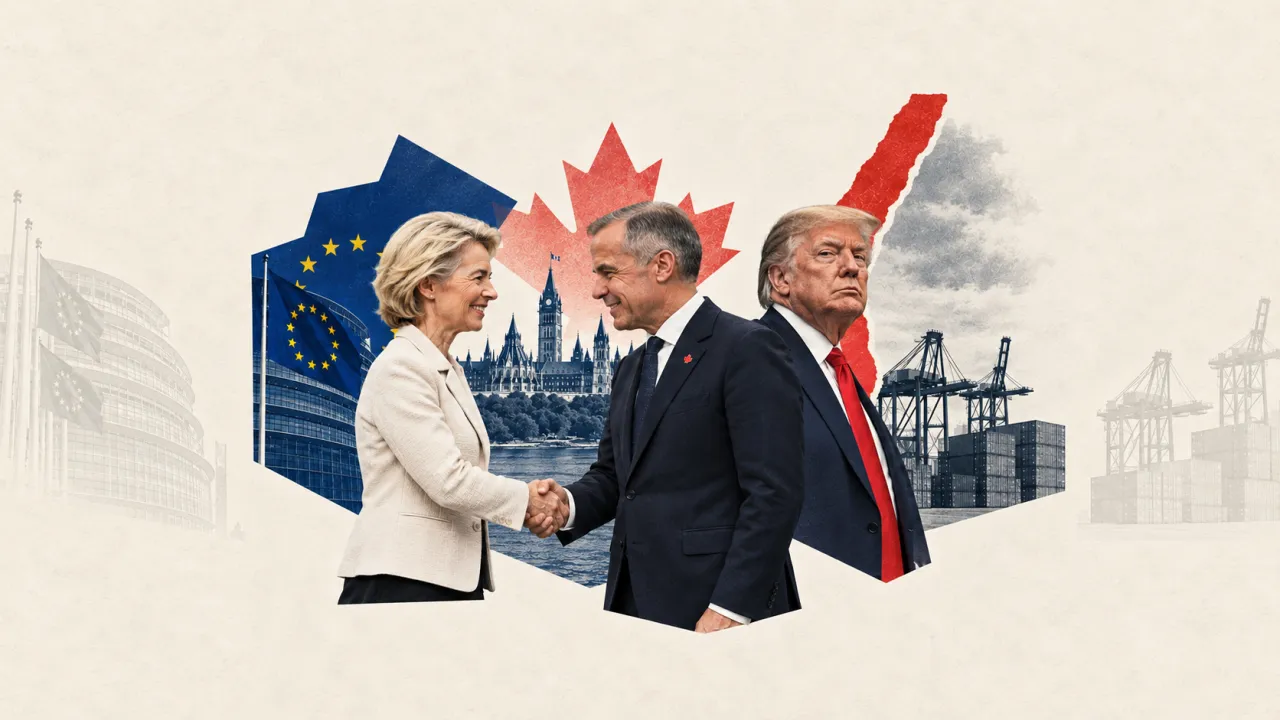
Stockholm, September 17, 2026. The Swedish press first notes the legal uncertainty of the proposal. On Wednesday, in her annual speech on the state of the Union in Strasbourg, Ursula von der Leyen proposed making Canada the "first associated member" of the EU, to a standing ovation from MEPs, before embracing Canadian Prime Minister Mark Carney, who had come specially to attend the speech. But Expressen immediately emphasizes that what this status would imply exactly remains "högst oklart" (highly uncertain): no European treaty provides for such a category.
The Local Sweden recalls that the concept was first put forward this year by German Chancellor Friedrich Merz, for Ukraine — a project that would have allowed Kiev to attend summits and sit on the Commission, but which received a cool reception from the Ukrainian side, with Kiev demanding full membership. The formula revived for Canada is therefore part of an already tested institutional vagueness.
In substance, von der Leyen promised to raise the relationship "to the highest possible level": technological alliance, integration of industrial defense bases, common Arctic project, and development of the CETA agreement into a "alliance for the future". She also mentions a European security council bringing together countries with the same views — Canada, Ukraine, the United Kingdom, Norway — to discuss threats with EU leaders, according to Expressen.
The rest of the speech, widely covered by Dagens Nyheter, places the Canadian announcement in a broader picture of threats: the trade deficit with China, now "one billion euros per day", tensions with Washington, Russian hybrid war and climate. "Our union is stronger than it has ever been, but it seems at the same time more fragile," she said. Sveriges Radio retains the phrase "We see the world with the same eyes" to qualify the link with Ottawa.
The Swedish press does not mention the American reaction or the Canadian demand for membership in the Joint Expeditionary Force, focusing on the European speech itself and on the framework for access to social networks for minors, presented on Thursday.