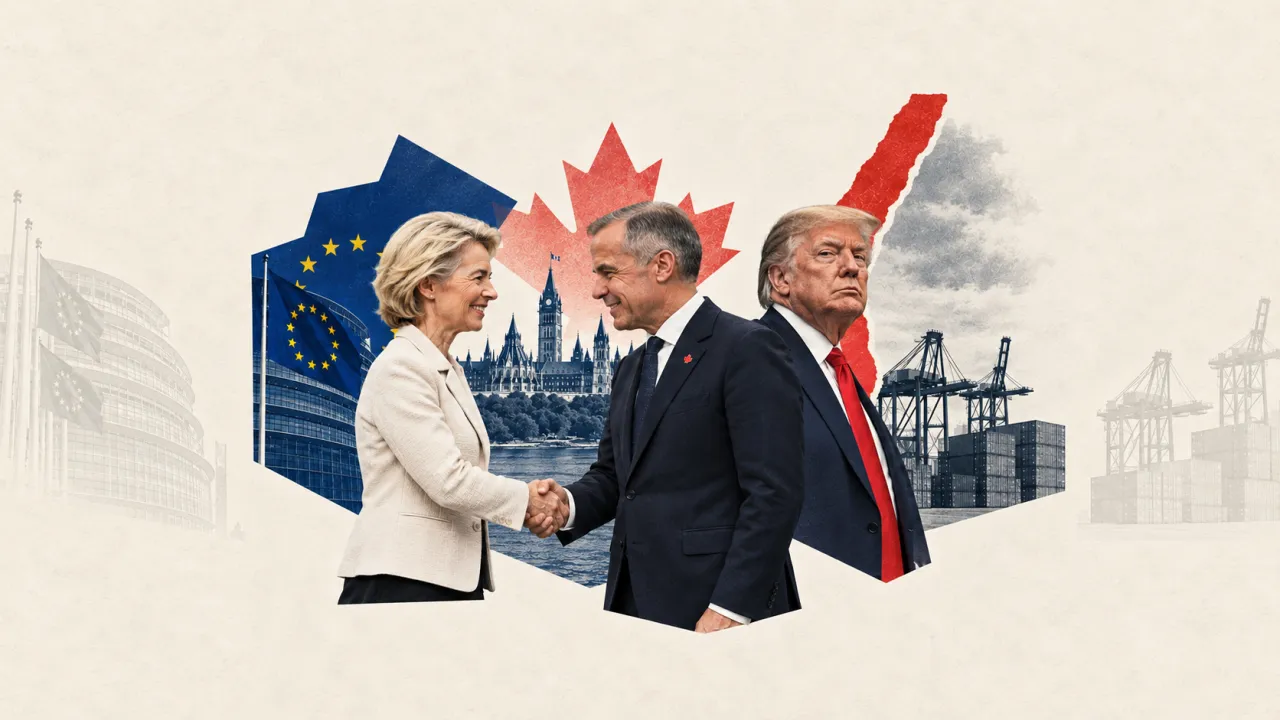

DOMINANT ANGLE
The United States government rejects the idea of a Canada tied to the EU as a commercial provocation and wields the threat of crushing tariffs to deter Ottawa and Brussels.
Dominant angle identified — does not reflect unanimity of this country’s media
KEY POINTS
- 01
Trump, from Charlotte: "If the intention is good, that's fine. If the intention is bad, we'll impose very heavy tariffs on Europe" (ABC News)
- 02
About 70% of Canadian exports go to the United States, which explains the dependence Ottawa is trying to reduce (NPR)
- 03
Canada is already applying dollar-for-dollar tariffs against the 50% American ones, and Trump is still set to block some Canadian imports of dairy products, alcohol, and cars later this month (ABC News / Axios)
ANALYSIS
Washington, September 17, 2026. From North Carolina, where he spoke on Wednesday, Donald Trump described Ursula von der Leyen's proposal to make Canada the first "associate member" of the European Union as "laughable". The American president conditioned his reaction to the "intention" of the Europeans: "If the intention is good, that's fine. If the intention is bad, we will impose very heavy tariffs on Europe." He also suggested that Washington could stop trading with Europe on many things, calling Canada a "terrible trading partner" in the process.
The American response comes just hours after the European Commission president's state of the union address in Strasbourg, where Mark Carney received a standing ovation from MEPs before embracing von der Leyen. The Canadian prime minister is set to address the European Parliament himself on Thursday; his entourage insists that Ottawa is seeking a "unique alliance" with Brussels, not full membership.
For the American press, the episode is primarily seen through the lens of the trade standoff already underway between Washington and Ottawa. About 70% of Canadian exports go to the United States, NPR notes, a figure that explains why Trump treats any Canadian rapprochement with the EU as directed against him. Canada is already applying dollar-for-dollar tariffs in response to the 50% imposed by Washington, and Trump is still set to block certain Canadian imports of dairy products, alcohol, and automobiles later this month.
Axios sees this as one of the most lasting possible effects of Trump's trade war: American allies building markets and supply chains designed to reduce their dependence on Washington. The CETA agreement, in effect since 2017, had already eliminated 99% of tariff lines between the EU and Canada; the "associate member" status, unprecedented in European treaties, would go much further.
The White House has not formally responded to requests for comment, according to Axios, leaving Trump's remarks from Charlotte to stand as the official position on a file that Brussels presents as a response to "the cold fragility of today's world".
SOURCES (6)
- NPRMEDIUM
- CNBCMEDIUM
- HuffPost WorldMEDIUM
- AxiosMEDIUM
- Bloomberg PoliticsMEDIUM
- ABC News WorldMEDIUM