
DOMINANT ANGLE
Lisbon is analyzing von der Leyen's proposal in light of its institutional mechanics: an "associated member" status that does not exist in any treaty and will need to receive the approval of the Twenty-Seven, including Portugal.
Dominant angle identified — does not reflect unanimity of this country’s media
KEY POINTS
- 01
The status of "associate member" is not defined in any of the EU's current treaties and would require the agreement of the 27 member states, according to the Financial Times as cited by the Jornal Económico.
- 02
Von der Leyen proposes evolving the CETA into a "Alliance for the Future" covering trade, defense, energy, critical raw materials, technology, and cybersecurity.
- 03
From Charlotte (North Carolina), Trump called the proposal "ridiculous" and threatened to impose "very heavy" tariffs if it constitutes a "hostile act", also calling Canada a "terrible trading partner".
ANALYSIS
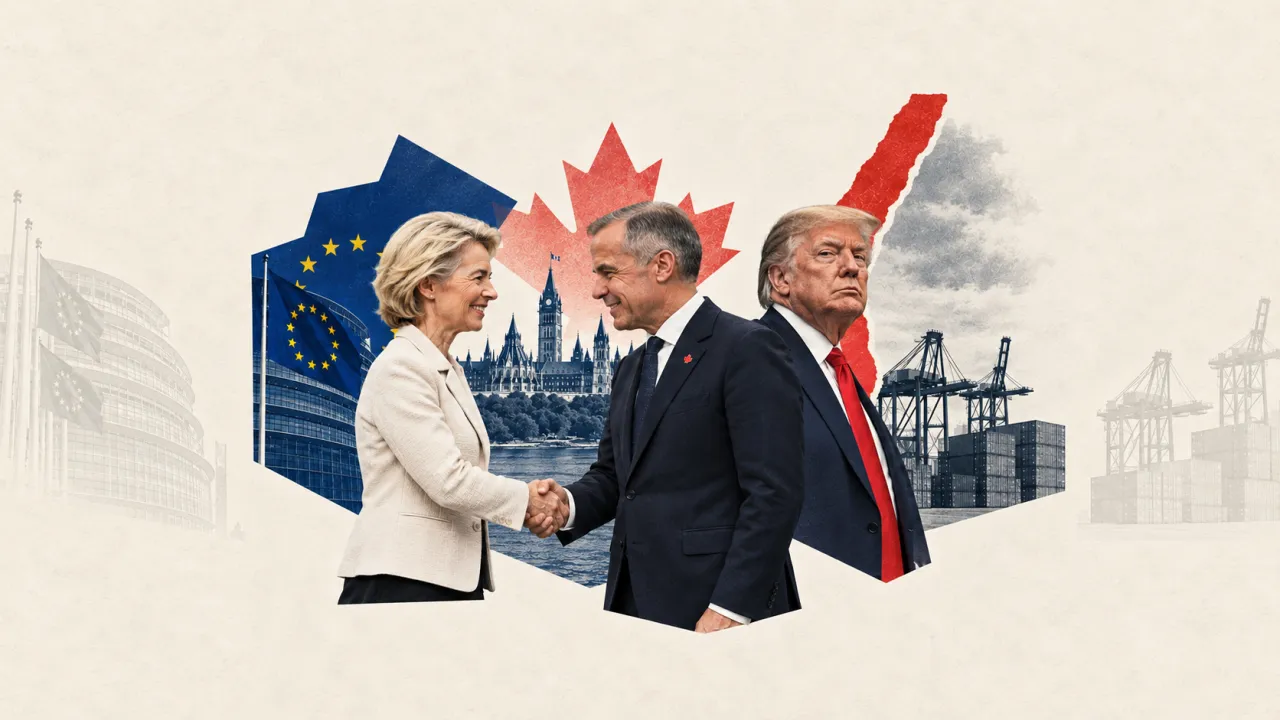
Lisbon, September 17, 2026. The Portuguese press closely followed the surprise proposal by European Commission President Ursula von der Leyen, who announced on Wednesday before the European Parliament in Strasbourg that she wants to "open the door" for Canada to become the first "associated member" of the European Union. The Jornal Económico highlights, citing the Financial Times, that this status does not exist in any of the EU's current treaties and that its creation would require the agreement of the Twenty-Seven - including Portugal. According to von der Leyen, the new relationship would start with the CETA trade agreement and evolve towards an "Alliance for the Future", which would cover trade, defense, energy, critical raw materials, technology, and cybersecurity, in a context she described as marked by "the cold fragility of today's world".
The RTP reports that Canadian Prime Minister Mark Carney, who was present in the hemicycle, was warmly greeted by von der Leyen after the announcement and is set to address the European Parliament members on Thursday. He advocates for a "unique alliance" rather than full membership, while around 70% of Canada's exports still depend on the US market.
The response from Donald Trump was not long in coming. From Charlotte, North Carolina, the US President called the idea "ridiculous" and warned that if it reflected a "bad intention", Washington would impose "very heavy" customs tariffs on Europe, or even cease "trading with it on many things". He also described Canada, with which he is waging a trade war and had already suggested transforming into the "51st US state", as a "terrible trading partner".
For the Portuguese media, the key issue is the institutional mechanism: a status without a legal basis, to be negotiated by twenty-seven, and immediate American pressure that recalls the fragility of any expansion of the European circle. No article has yet detailed Lisbon's own position on this issue, nor the Canadian request, announced on the same Wednesday, to join the North European Joint Expeditionary Force led by London.