
DOMINANT ANGLE
New Delhi is deciphering an unprecedented legal proposition, where Ottawa claims a "unique alliance" rather than membership, and where the final decision will rest with the Twenty-Seven.
Dominant angle identified — does not reflect unanimity of this country’s media
KEY POINTS
- 01
No "associate member" status exists in EU treaties; Berlin had already proposed it for Ukraine as an intermediate step, to no avail (The Hindu Business Line)
- 02
Mark Carney claims to be seeking a "unique alliance" with the EU, not membership (The Hindu Business Line)
- 03
Canada has formally asked to join the Joint Expeditionary Force, a defense coalition of ten North European NATO countries led by the United Kingdom, after talks in Liverpool with Andy Burnham (Free Press Journal)
ANALYSIS
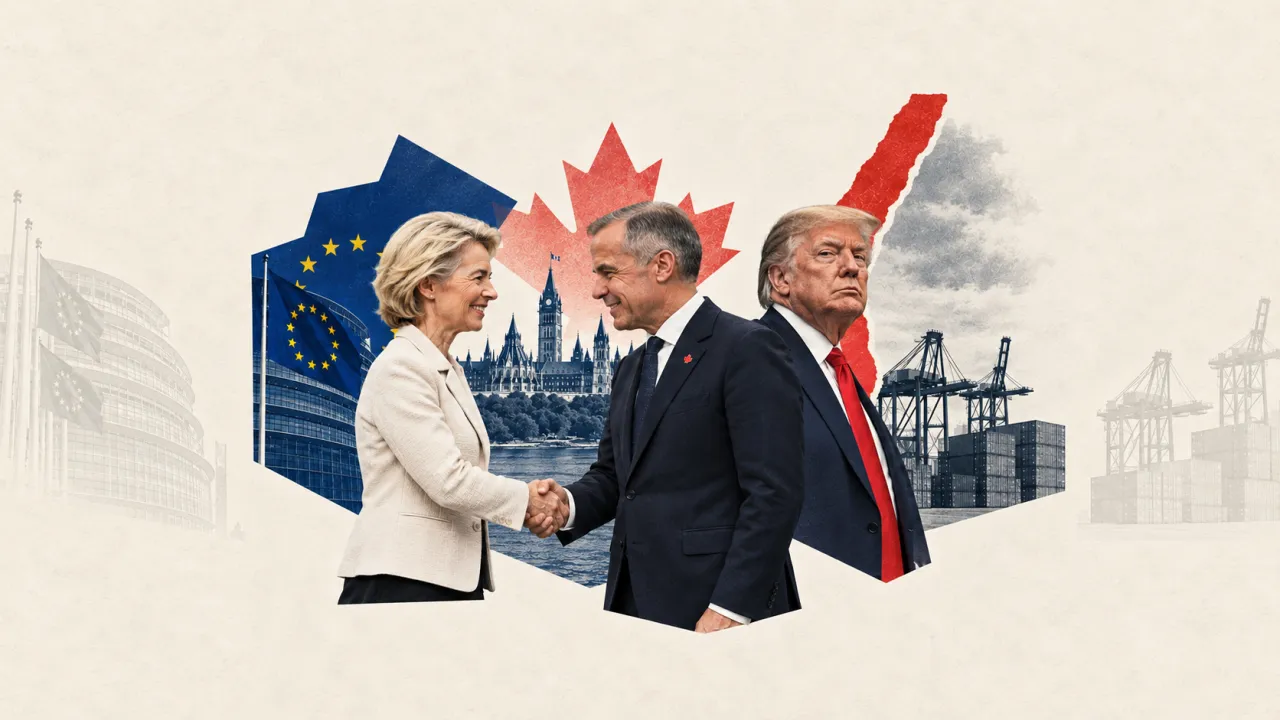
New Delhi, September 17, 2026. The Indian economic press is deciphering with caution the announcement made on Wednesday by Ursula von der Leyen to open to Canada the path to a "associate member" status of the European Union, a first for the bloc. The Hindu Business Line recalls that no such status exists today in European treaties. Berlin had already suggested an associate membership for Ukraine, an intermediate step before full accession, a project that remained without follow-up in the face of the reluctance of several capitals.
The newspaper emphasizes that the President of the Commission made the proposal as the head of the community executive: it is the Twenty-Seven who will decide on its feasibility. She mentioned a "common space of prosperity and economy", including industrial cooperation, technological alliance, integration of defense bases, the Arctic, artificial intelligence, energy and critical minerals.
Mark Carney, present in Strasbourg, reframed the initiative: Canada, he says, is seeking a "unique alliance" with the EU, not membership - a nuance that reflects Ottawa's caution in the face of an unprecedented legal precedent.
On the same Wednesday, Ottawa took another step towards Northern Europe: the Free Press Journal reports that Canada has formally submitted its application to join the Joint Expeditionary Force, a defense coalition of ten NATO countries - Denmark, Estonia, Finland, Iceland, Latvia, Lithuania, Netherlands, Norway, Sweden and the United Kingdom, the framework nation. The announcement came during talks in Liverpool between Carney and his British counterpart Andy Burnham, according to a statement from the office of the Canadian Prime Minister.
The daily recalls that Ottawa had declined a first invitation to this device during the NATO summit in Wales in 2014, in the midst of a budget restriction of the Canadian armed forces. The current rapprochement, according to the Indian press, is part of a context of "repeated threats" by the American president against Canadian sovereignty. This double diplomatic and security maneuver illustrates how Ottawa is diversifying its support in the face of Washington, without commitment that would resemble full membership in the EU.