
DOMINANT ANGLE
Islamabad sees the European announcement as the result of a trade rupture between Ottawa and Washington, rather than a gesture of political allegiance.
Dominant angle identified — does not reflect unanimity of this country’s media
KEY POINTS
- 01
On Wednesday, September 16, in Strasbourg, von der Leyen proposed making Canada the first "associate member" of the EU; MEPs gave her a standing ovation before she hugged Mark Carney
- 02
The "associate member" status is not included in any European treaty and would require the agreement of the twenty-seven member states, according to Geo News
- 03
Canada already has CETA with the EU; Mark Carney said he is seeking a "unique alliance" rather than membership, and is to address MEPs on Thursday, September 17
ANALYSIS
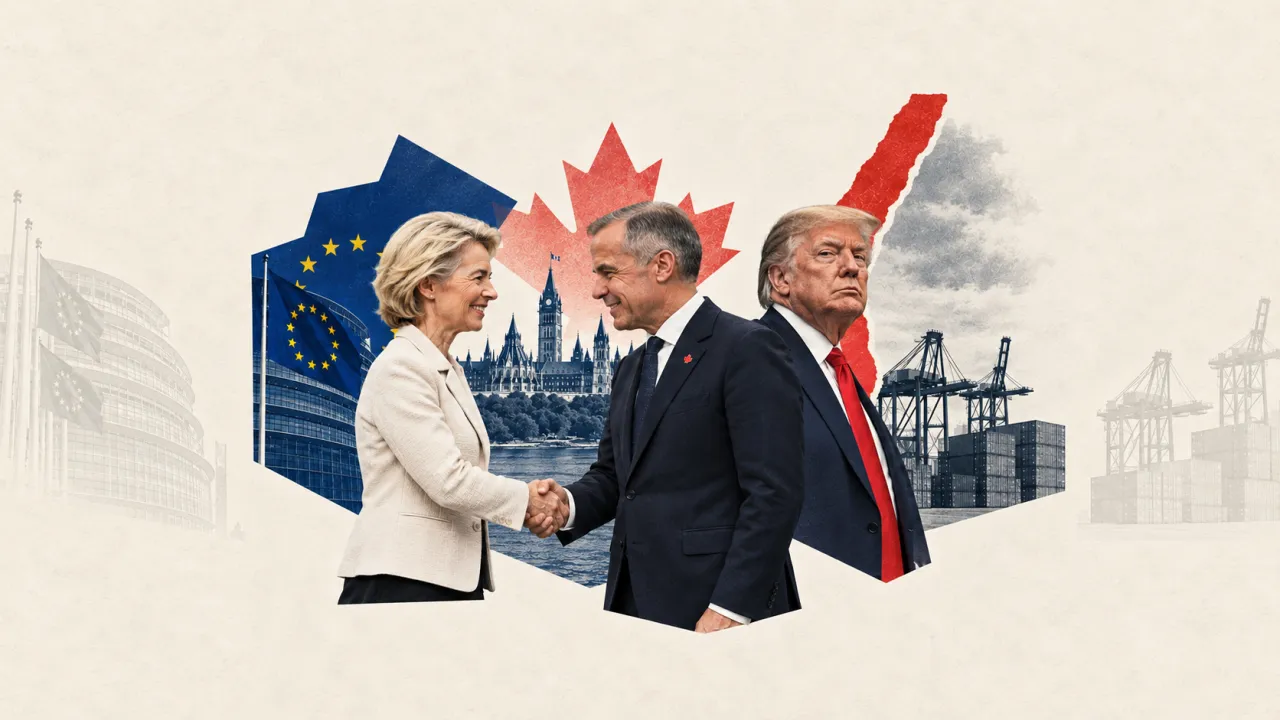
Islamabad, September 17, 2026. From Strasbourg, the announcement by Ursula von der Leyen is particularly noteworthy in the Pakistani press for what it reveals about the state of North American trade relations. On Wednesday, September 16, before the European Parliament, the President of the Commission proposed making Canada the first "associate member" of the Union, a status that does not exist in any European treaty. European parliamentarians gave her a standing ovation before she hugged Canadian Prime Minister Mark Carney, who had come to attend her speech on the state of the Union.
Von der Leyen justified the initiative by citing "the cold fragility of today's world", evoking a shared vision "from artificial intelligence to climate change, from the Arctic to geopolitics". But for Geo News, the economic context carries more weight than the rhetoric: Ottawa is seeking to move closer to Brussels after a historic rupture in relations with its primary trade partner, with negotiations with Washington having failed last month and resulting in reciprocal tariff measures applied by Canada.
In practical terms, Canada already has a free trade agreement with the EU, the CETA. Associate membership could go further by giving Canadian companies facilitated access to certain segments of the single market, in areas such as defense, artificial intelligence, energy, critical minerals, and manufacturing. But Geo News highlights the limitations: unlike France or Germany, Canada would not obtain any voting rights on the rules developed, and the free movement of people is not on the agenda.
The project remains at an early stage and would require the agreement of the twenty-seven member states, recalls Geo News, while Brussels had shown lukewarm enthusiasm for a similar German proposal for Ukraine in May. Mark Carney, who is to address the European parliamentarians himself on Thursday, September 17, had said he was seeking a "unique alliance" with the EU rather than membership, according to The Express Tribune.
The Pakistani press, largely reproducing Reuters dispatches, focuses on the institutional and commercial mechanics of the announcement rather than its symbolic scope: what the status would allow, what it would exclude, and the weight of a fractured Ottawa-Washington relationship in this shift towards Brussels.
SOURCES (4)
- The Express TribuneMEDIUM
- ARY NewsMEDIUM
- Business RecorderMEDIUM