
DOMINANT ANGLE
Berlin recognizes in the proposal made to Canada the concept of associate membership that Chancellor Friedrich Merz had himself formulated this year for Ukraine, where Kiev had received it coolly, calling for full membership instead.
Dominant angle identified — does not reflect unanimity of this country’s media
KEY POINTS
- 01
Von der Leyen proposed on Wednesday in Strasbourg to make Canada the "first associated member of the EU", a status not provided for in the European treaties.
- 02
SPD MEP René Repasi mentions a model similar to a "European Economic Area plus", with an observer status comparable to that of Iceland.
- 03
According to The Local Germany, the concept of associated membership was first formulated this year by Chancellor Friedrich Merz regarding Ukraine, which had given it a cool reception.
ANALYSIS
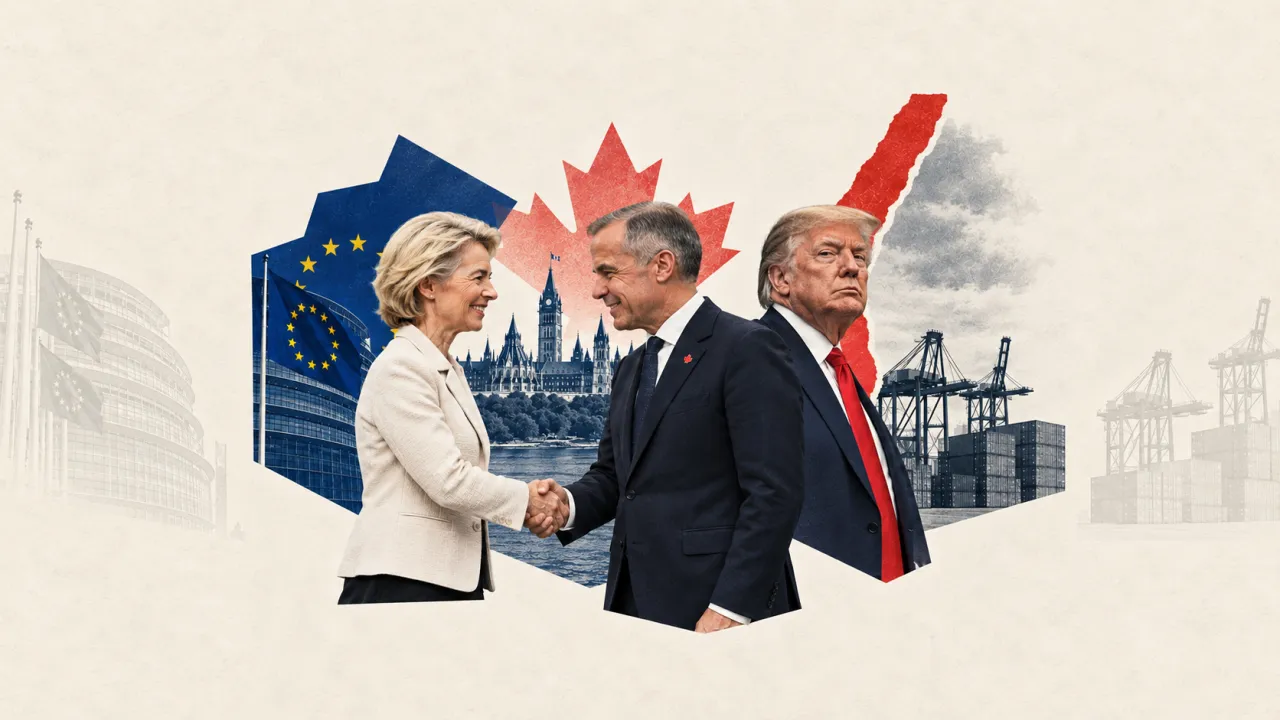
Berlin, September 17, 2026. The state of the Union speech delivered on Wednesday in Strasbourg by Ursula von der Leyen is prompting a reading in Germany that goes beyond the sole Canadian case. The President of the Commission proposed making Canada "the first associated member of the EU", a status intended to take the relationship "to the highest possible level" in the face of "the cold and fragile reality of today's world". She cited the defense industry, energy, critical raw materials, batteries, artificial intelligence, quantum computing, and cybersecurity, with the CETA agreement set to evolve into a "alliance for the future". Mark Carney, present in the hemicycle, received a standing ovation; he says he is seeking a "unique alliance", not membership.
The German press is highlighting a fact that foreign comments are overlooking: the term "associated member" does not exist in European treaties. Asked by Deutsche Welle, socialist MEP René Repasi suggests it could be a model similar to an "extended European Economic Area": integration into the single market combined with observer status, comparable to that of Iceland. According to The Local Germany, this concept was not born with Canada: it was Chancellor Friedrich Merz who first formulated it this year, regarding Ukraine, where Kiev would have attended summits and had a representative on the Commission, without full voting rights. The idea had then received a cool reception in Kiev, which is demanding full membership.
Die Tagesschau is taking a more reserved tone on the method: the public channel recalls that von der Leyen has made numerous announcements - a plan to combat heat waves, a banking package, a European society for critical raw materials, a new Security Council, dialogue with AI companies - and notes that "only a part" of this type of announcement usually materializes. The EU-Canada summit scheduled for next month in Montreal is expected to clarify the real scope of the proposal.
The response from Donald Trump, who finds the idea "laughable" and threatens to "stop trading" with Europe, confirms for Berlin that Washington perceives this rapprochement as an act of power politics, not just a simple commercial adjustment.