
DOMINANT ANGLE
Pretoria is deciphering a "associate member" status that even European diplomacy says it does not understand, and the precedent it sets for Ukraine without offering it full membership.
Dominant angle identified — does not reflect unanimity of this country’s media
KEY POINTS
- 01
Von der Leyen proposed on Wednesday, September 16, to make Canada the first "associate member" of the EU, without detailing what this status would entail legally.
- 02
A European diplomat quoted by Business Day says "nobody really knows what it means", and recalls that the German proposal in May for a similar status for Ukraine received a "tepid" welcome from member states.
- 03
Trump has threatened to impose "very heavy tariffs" or cease trading with Europe if the move is deemed hostile, while the United States absorbs around 70% of Canada's exports.
ANALYSIS
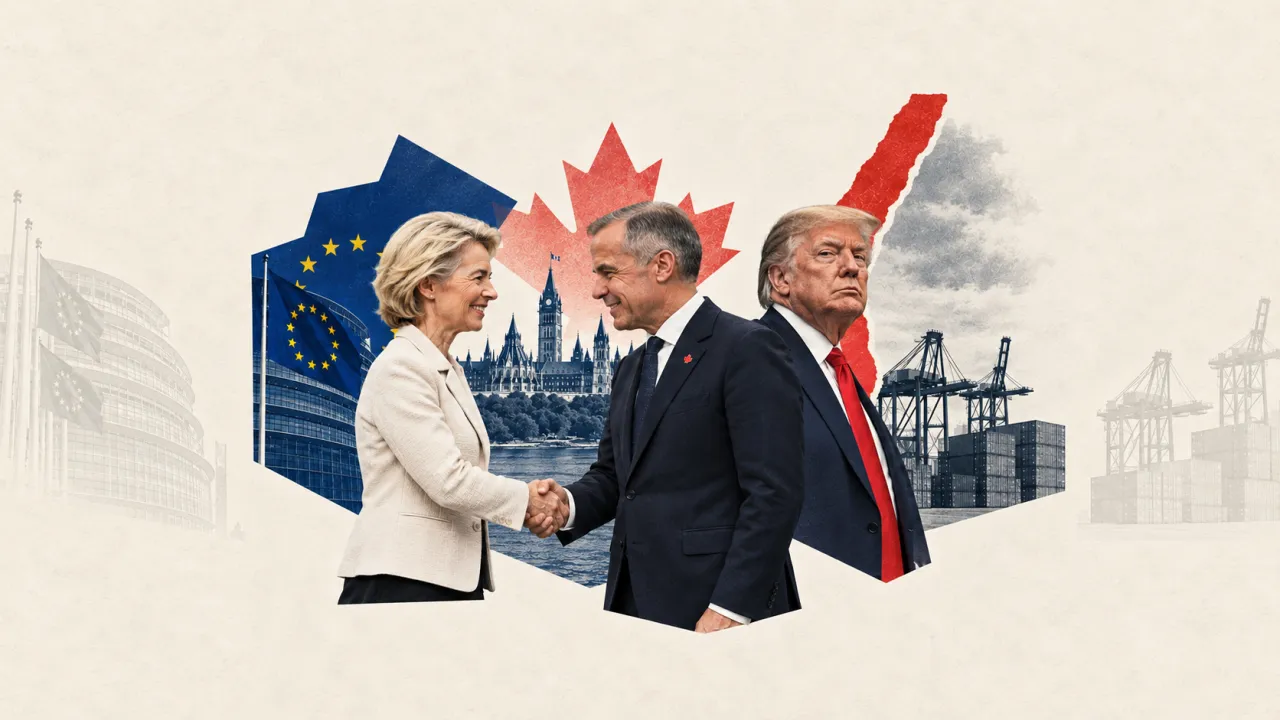
Pretoria, September 17, 2026. From Strasbourg, the South African press first notes the vagueness surrounding a new status: on Wednesday, September 16, European Commission President Ursula von der Leyen proposed making Canada the first "associate member" of the European Union, without ever specifying what this status would entail legally. "I would like to work with you on opening the door for Canada to be the first associate member of the EU," she stated before the European Parliament, before going to hug Canadian Prime Minister Mark Carney, who came to attend her speech on the state of the Union - a first for a non-European head of government. The standing ovation from the MEPs followed her announcement.
But Business Day, citing a Reuters dispatch, recalls that the final decision does not belong to Ursula von der Leyen alone: it will be up to the 27 member states to decide, and the European Union "has always resisted" this type of flexible alliance without a defined legal status. An anonymous European diplomat quoted in the same article admits his perplexity: "nobody really knows what it means." The precedent cited is even more worrying: in May, a similar German proposal for an "associate member" status for Ukraine, considered as a springboard for full membership, had received a "tepid" reception from the member states.
For Mark Carney, whose office welcomed the prospect of a "stronger and more ambitious alliance," the issue remains distinct: he claims strategic autonomy through cooperation, not institutional integration, and has never himself uttered the words "associate member." On the same Wednesday, Ottawa requested to join the North European Joint Expeditionary Force, and has been applying retaliatory tariffs against Washington since Tuesday.
Donald Trump, on a trip to North Carolina, retorted that the move was "laughable" and that he would impose "very heavy tariffs" or cease "trading with Europe on many things" if he deemed the gesture hostile. However, the United States absorbs about 70% of Canada's exports: Ottawa is therefore negotiating a European rapprochement without an immediate break with its main trading partner, in a world that von der Leyen herself has described as "cold fragility."
SOURCES (3)
- The CitizenMEDIUM
- Business DayMEDIUM