
DOMINANT ANGLE
Paris is deciphering a spectacular but legally empty announcement and recalls that the rapprochement with Ottawa is already running into a concrete obstacle: the CETA, which France itself has still not ratified.
Dominant angle identified — does not reflect unanimity of this country’s media
KEY POINTS
- 01
The "associated member" status proposed by Ursula von der Leyen is not provided for in the EU treaties, according to the French press and German MEP Tobias Cremer.
- 02
A precedent exists: in May, Germany had proposed a comparable status for Ukraine, detailed by Chancellor Friedrich Merz (participation without voting rights in summits and ministerial meetings, associate commissioner).
- 03
Ten EU countries, including France and Italy, have still not ratified the CETA free trade agreement with Canada, which is provisionally in force.
ANALYSIS
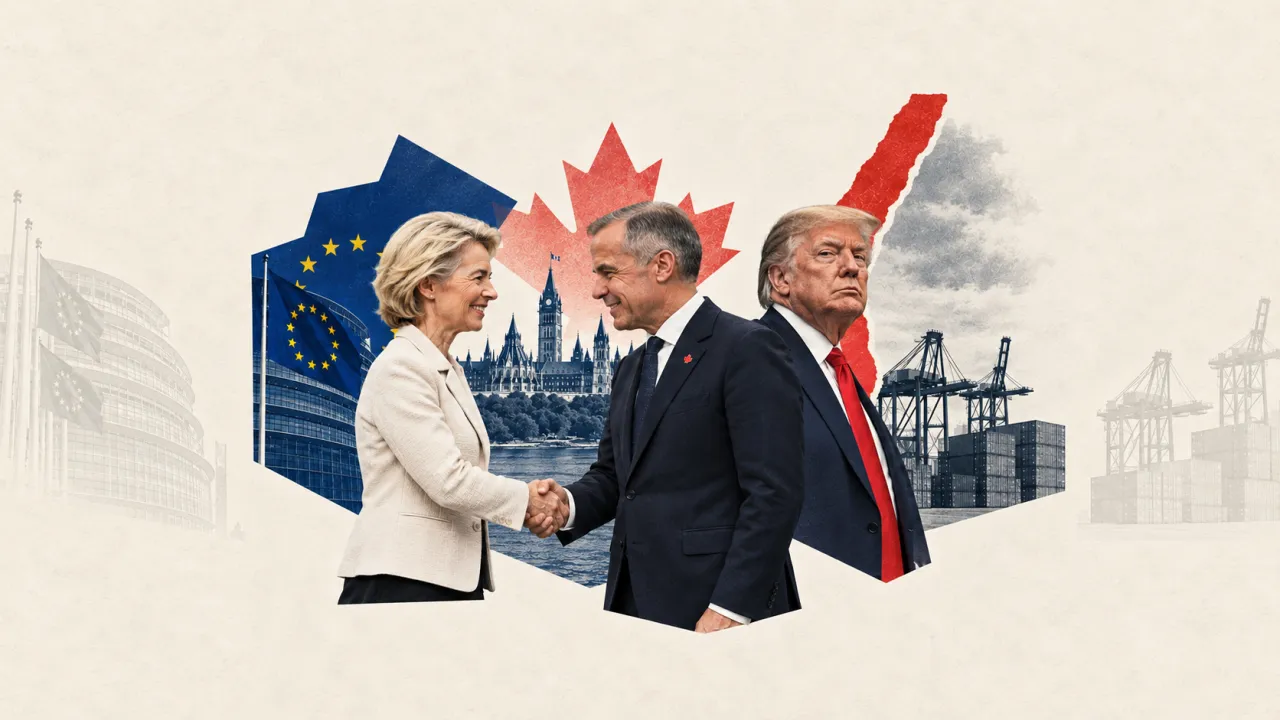
Paris, September 17, 2026. Deciphering the announcement made on Wednesday, September 16, by Ursula von der Leyen in Strasbourg, is first and foremost about noting what it does not contain: legal content. The President of the European Commission proposed that Canada become the first "associate member" of the European Union before the European Parliament, where Canadian Prime Minister Mark Carney, an exceptional guest, received a standing ovation before being warmly embraced by Ms. von der Leyen. But this status "is not legally defined by the EU's treaties," the French press emphasizes, and German MEP Tobias Cremer conceded it bluntly: "We still don't really know what it means."
A precedent does exist, however: in May, Germany had proposed a comparable status for Ukraine, detailed by Chancellor Friedrich Merz - participation in summits and certain ministerial meetings, an associate commissioner, representatives in Parliament, but no voting rights. The proposal had then been met with a cool reception by most other member states.
This announcement comes after what Le Monde describes as a "diplomatic blunder" by Ms. von der Leyen, who was initially supposed to return to Brussels without attending Mark Carney's speech, scheduled for this Thursday, September 17, before the European Parliament, before backtracking under pressure from critics. The rapprochement also faces a very concrete obstacle that France is well aware of: the CETA free trade agreement, provisionally in force with Ottawa, has still not been ratified by ten EU countries, including France and Italy.
Donald Trump immediately called the proposal "ridiculous" and threatened, if it constituted "a hostile act," to impose "very heavy tariffs" or "cease all trade with Europe." Canada, whose exports depend 70% on the US market, is seeking, according to Ottawa, not membership but a "unique alliance." Emmanuel Macron, on the other hand, is set to receive Mark Carney in Saint-Pierre-et-Miquelon to conclude this Canadian cycle, a sign that Paris is also prioritizing its own bilateral path rather than the sole symbolic gesture in Strasbourg.
SOURCES (6)
- 20 MinutesMEDIUM
- Le Monde InternationalMEDIUM
- Sud OuestMEDIUM
- HuffPost FranceMEDIUM