
DOMINANT ANGLE
Canberra takes away from this episode less the diplomatic breakthrough than its origin: the commercial collapse between Canada and the United States, marked by months of cross tariffs, which pushed Ottawa towards Brussels — a precedent that Australia, also exposed to Washington's tariff fluctuations, scrutinizes closely.
Dominant angle identified — does not reflect unanimity of this country’s media
KEY POINTS
- 01
Von der Leyen proposed making Canada the first "associate member" of the EU in her State of the Union speech in Strasbourg, a status that SBS News Australia describes as "not set out in the bloc's treaties".
- 02
Carney's office welcomed a "far stronger, more ambitious" alliance based on "strategic autonomy", without ever using the term "associate member"; Carney had said earlier in the week that he was seeking a "unique alliance", not membership.
- 03
The rapprochement comes after a "historic collapse of Canada-United States relations", the failure of trade negotiations the previous month having triggered cross-border tariffs between Ottawa and Washington.
ANALYSIS
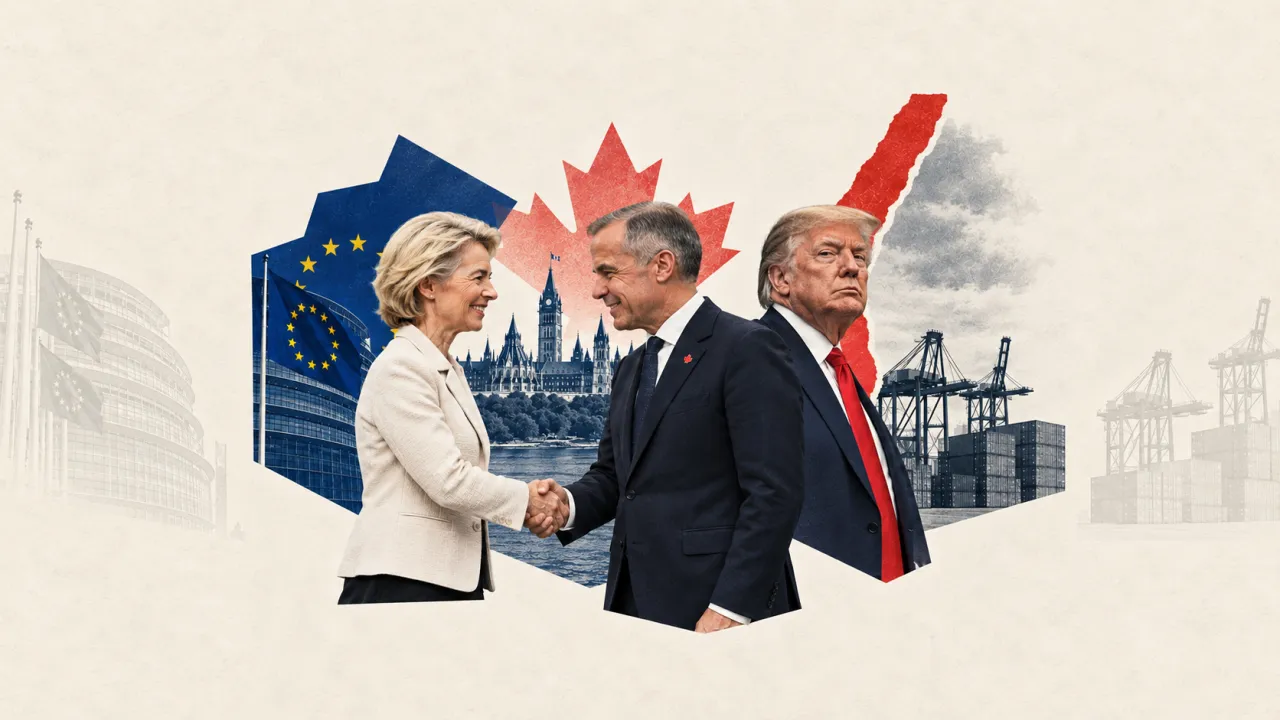
Canberra, September 17, 2026. Ursula von der Leyen proposed on Wednesday to make Canada the first "associate member" of the European Union, a status that does not exist in any European treaty. Before the European parliamentarians gathered in Strasbourg for her annual speech on the state of the Union, the President of the Commission received a standing ovation before going to hug Canadian Prime Minister Mark Carney, who was present in the hemicycle. "I say that we need to urgently reinvent our partnerships. I would therefore like to work with you to open the door for Canada to become the first associate member of the EU," she declared, invoking "the cold fragility of today's world".
The Australian press first retains what this gesture reveals by implication: Carney's European move comes after what agencies describe as a "historic collapse of Canada-US relations", triggered by the failure of trade negotiations last month and a series of cross-border tariffs. Ottawa and Brussels, noted the dispatches reprinted in Sydney, "see the world with the same eyes, from AI to climate, from the Arctic to geopolitics", in the face of commercial rivalry coming from both the Trump administration and a more assertive China.
Carney himself was more cautious than von der Leyen. His office welcomed an alliance "much stronger and more ambitious in the future", with Canada and Europe having to "guarantee their strategic autonomy through in-depth cooperation on all strategic capabilities" - without ever repeating the term "associate member". Earlier in the week, the Prime Minister had said he was seeking a "unique alliance" with the EU, not membership. He is to address the European parliamentarians himself on Thursday.
Von der Leyen left the definition of the status open, recalling that it will be up to the twenty-seven member states, and not just her, to decide - a reminder all the more clear since the same proposal, formulated in May by Germany for Ukraine as a step towards full membership, had then received a lukewarm reception from the capitals. For Canberra, whose own exchanges with Washington remain exposed to the same tariff fluctuations, the Canadian episode is worth less as an institutional precedent than as a signal: even a historical commercial partner of North America is now seeking to diversify its support.