
DOMINANT ANGLE
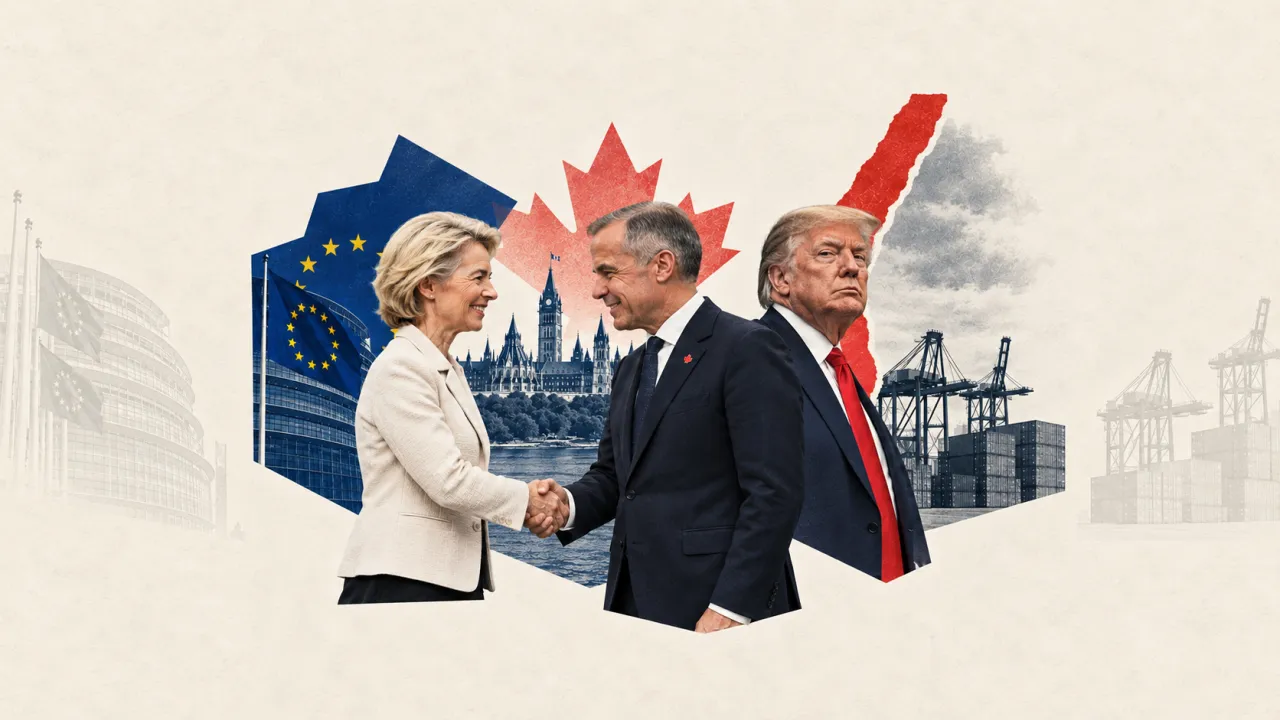
Brasília sees in von der Leyen's offer the commercial price of a break with Washington: a partnership already sealed by the CETA, elevated to a diplomatic level in the face of Trump's tariff war.
Dominant angle identified — does not reflect unanimity of this country’s media
KEY POINTS
- 01
Ursula von der Leyen proposed making Canada the first "associate member" of the EU during the State of the Union speech in Strasbourg, Wednesday, September 16, 2026 (G1).
- 02
The CETA, an agreement signed in 2017, has increased transatlantic trade by 76%, with an annual volume of 130 billion euros (Folha).
- 03
EU rules reserve membership for European countries only, but Brussels and the Parliament would have found a way to enhance existing collaboration without amending the treaties (Folha).
ANALYSIS
Brasília, September 17, 2026. The Brazilian press sees Ursula von der Leyen's proposal as less of a protocol gesture and more as the logical follow-up to a trade rupture sealed since 2017. On Wednesday, September 16, in her annual speech on the state of the Union before the European Parliament in Strasbourg, the President of the European Commission invited Canada to become the first "associate member" of the 27-nation bloc, a membership that Folha describes as "unthinkable before". According to the daily, this offer stems directly from "the aggressive diplomacy and trade war that the United States under Donald Trump is waging against two of its largest partners".
Without ever mentioning Washington, von der Leyen justified the rapprochement by citing a world that is "openly hostile", marked by war on Europe's borders, the multiplication of hybrid attacks, and increasing competition from the United States and China. She promised to elevate the relationship with Ottawa "to the highest possible level", to build a space of common prosperity and economic security covering industry, technology, energy, artificial intelligence, defense, and the Arctic. Mark Carney stood up to applaud her, under a standing ovation from the European parliamentarians; she repeated that "this is not a partnership against anyone, but for our common strengthening". G1 notes that, without being named, the United States remains implicit in the entire speech: as Canada's neighbors, they also maintain trade tensions with Ottawa and with the EU itself.
The Brazilian coverage emphasizes the existing economic anchor: signed in 2017, the CETA has increased transatlantic trade by 76%, for an annual volume of 130 billion euros. The EU's rules reserve membership for European countries only, but Brussels and the Parliament would have found a way to elevate this collaboration without touching the founding treaties.
Neither of the two articles reports on Donald Trump's response nor Canada's request to integrate the Joint Expeditionary Force announced on the same day: the Brazilian reading remains focused on the European gesture and its commercial anchor, leaving out of scope the North European security aspect and the immediate American reaction.