
DOMINANT ANGLE
Ottawa carefully distinguishes the "unique alliance" claimed by Mark Carney from the "associate member" status advanced by Brussels, a distinction that the Canadian press deems decisive in the face of accusations of loss of sovereignty wielded by the Conservative opposition.
Dominant angle identified — does not reflect unanimity of this country’s media
KEY POINTS
- 01
European Commissioner for Competitiveness Teresa Ribera describes the "associated member" status as non-existent in the treaties: "It's a new category".
- 02
EU Ambassador Jonathan Wilkinson rules out full membership, calling it a "sovereignty issue".
- 03
Donald Trump signed a memorandum removing Canadian products from US federal public markets and threatens Europe with "very heavy customs duties".
ANALYSIS
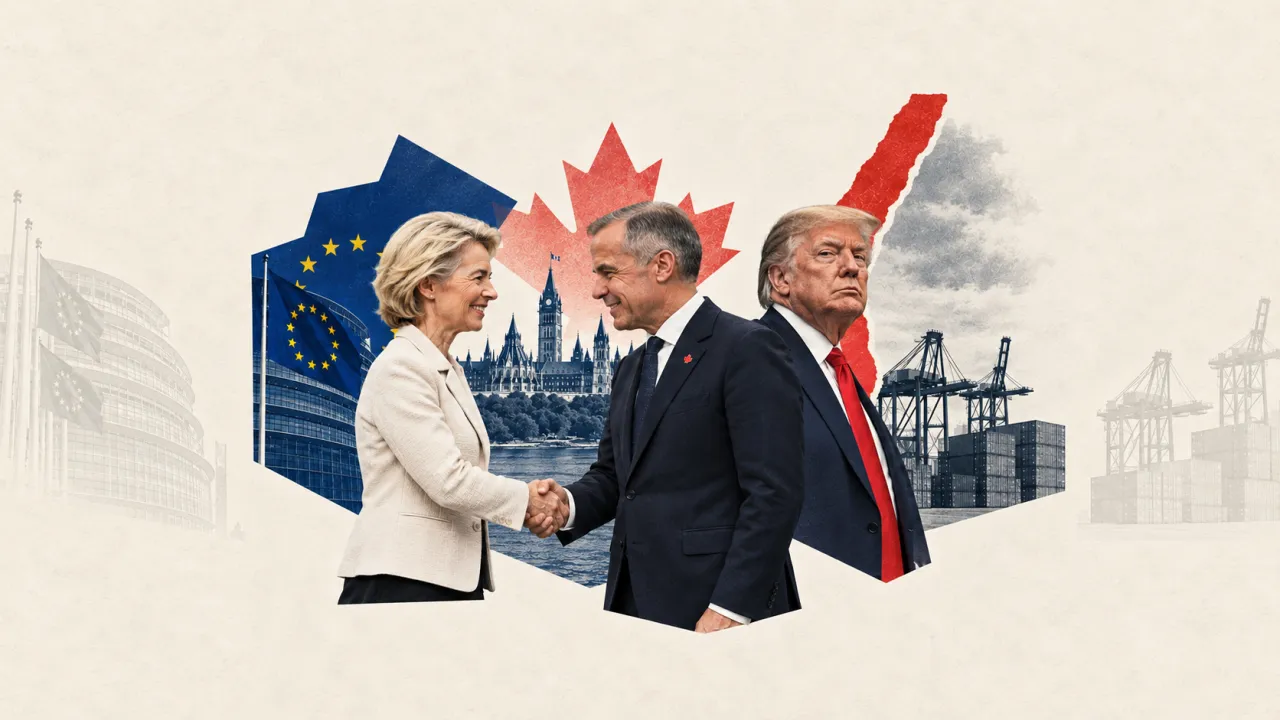
Ottawa, September 17, 2026. On Wednesday, in the European Parliament's hemicycle in Strasbourg, Mark Carney stood to applaud the ovation that followed European Commission President Ursula von der Leyen's announcement: she "would like to work" with the Canadian Prime Minister "to open the door" for Canada to become the first "associate member" of the European Union. Carney joined the podium to hug her. But the Canadian press immediately emphasizes that this status does not exist in any EU treaty. "It's a new category," summarized European Commissioner for Competitiveness Teresa Ribera, specifying that what being an associate member could mean today will have to be developed and detailed over time. The result of the negotiations is to be announced at a Canada-EU summit scheduled to take place in Montreal at the end of October.
Ottawa insists on the distinction with full membership. As early as Sunday, Carney had denied seeking to make Canada an EU member, instead evoking a "unique alliance." Canadian Ambassador to the EU Jonathan Wilkinson refused on Wednesday to endorse the term "associate member": "We are not seeking to become a member of the European Union, as it is a sovereignty issue," he told journalists, adding that he wants to get closer "without giving up important parts of our sovereignty." The Prime Minister's office was content with a statement welcoming the invitation, without mentioning the term "associate member."
This ambiguity is already fueling opposition. Conservative leader Pierre Poilievre claims, without proof according to Global News, that such a partnership could force Canadians to contribute to the European budget, accept regulations dictated by Brussels, or give up control over immigration.
On the same day, Donald Trump, from North Carolina, called the idea "laughable" and warned that if it were pursued with "bad intentions," he would impose "very heavy tariffs" on Europe. He also signed a memorandum removing all Canadian-origin products from US federal public markets and repeated that Canada had been "a terrible trading partner." For conservative columnist Jesse Kline (National Post), the context justifies the European bet: with nearly two-thirds of Canadian exports directed towards the United States, diversifying "opens up a world of possibilities" without renouncing the American relationship. Carney is to address the European Parliament on Thursday.
SOURCES (4)
- Globe and MailMEDIUM
- National PostMEDIUM
- Toronto SunMEDIUM
- Global NewsMEDIUM