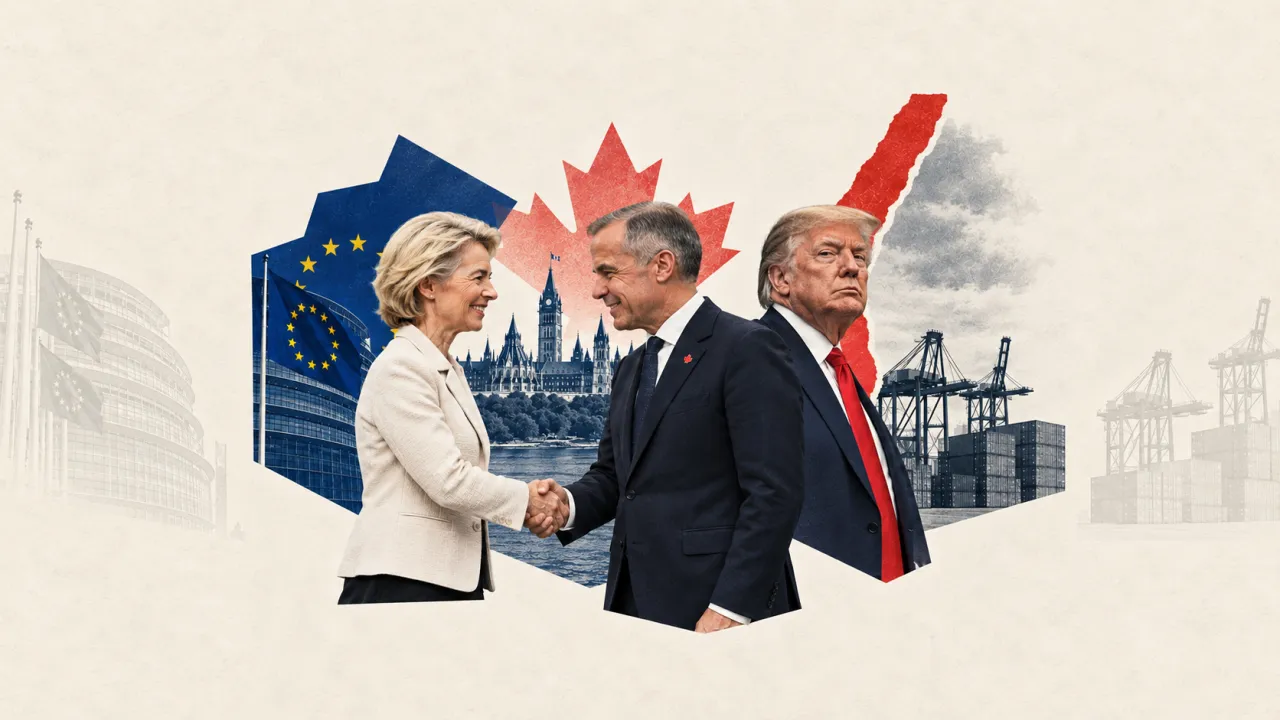

DOMINANT ANGLE
Dhaka takes away from this Strasbourg speech less the diplomatic gesture towards Ottawa than the symptom of a global commercial order that is cracking, a direct risk for exporting economies like its own, caught between closing blocs.
Dominant angle identified — does not reflect unanimity of this country’s media
KEY POINTS
- 01
Von der Leyen proposed on September 16 in Strasbourg to make Canada the first "associate member" of the EU, a status absent from European treaties.
- 02
Mark Carney claims to be seeking a "unique alliance" with the EU, rather than full membership.
- 03
A collapse of Canada-US trade talks last month triggered a series of reciprocal tariff measures between the two countries.
ANALYSIS
Dhaka, September 17, 2026. Ursula von der Leyen proposed on Wednesday, in her annual speech on the state of the Union before the European Parliament in Strasbourg, to make Canada the first "associate member" of the European Union, a status that does not exist in any treaty of the bloc. The European parliamentarians gave her a standing ovation before she went to greet Canadian Prime Minister Mark Carney, who came specially to listen to her speech. "We need to reinvent our partnerships urgently," she declared, invoking "the cold fragility of today's world" to justify this unprecedented rapprochement.
For the press in Dhaka, which relays the analysis of international agencies, the episode is read above all as a sign of the recomposition of trade blocs, at a time when Europe and Canada are "facing increased trade rivalry" from both Washington and Beijing. Canada, whose Prime Minister claims to be seeking a "unique alliance" and not full membership, is acting after the collapse of trade talks with the United States last month, which has already triggered a series of reciprocal tariff measures between Ottawa and Washington.
This context speaks directly to an economy like Bangladesh, whose textile exports depend largely on the trade preferences granted by the European Union. If a G7 partner like Canada deems it necessary to secure a special status in the face of American tariff instability, the fragility it exposes is that of all preferential access to a major Western market, a concern shared by more modest exporting economies, without the same negotiating weight. Von der Leyen detailed the sectors targeted by this future "space of common prosperity": smart manufacturing, technological alliance, industrial defense bases, the Arctic, artificial intelligence, energy, and critical minerals - all supply chains that Asian exporting economies also depend on.
The articles relayed in Dhaka also note that this "associate" status remains legally vague: Berlin had proposed a comparable mechanism for Ukraine in May, as a step before full membership, without obtaining the agreement of several European capitals. Von der Leyen's proposal will therefore have to be validated by the member states, and not by her alone. Carney is due to speak in turn on Thursday before the European parliamentarians.