
DOMINANT ANGLE
Doha is dissecting the legal vacuum behind the term "associate member", a status that European treaties do not provide for and that Ursula von der Leyen herself has not clarified.
Dominant angle identified — does not reflect unanimity of this country’s media
KEY POINTS
- 01
The status of "associate member" does not exist in any EU treaty; Germany had already proposed a comparable status for Ukraine, without success (Gulf Times).
- 02
Without full membership, Canada would become a "rule-taker" in the single market without voting rights, like Iceland, Norway, Switzerland, and Liechtenstein in the European Economic Area (Gulf Times).
- 03
Donald Trump called the idea "laughable" and threatened to impose "very heavy tariffs" or stop trading with Europe "on a lot of things" (Al Jazeera).
ANALYSIS
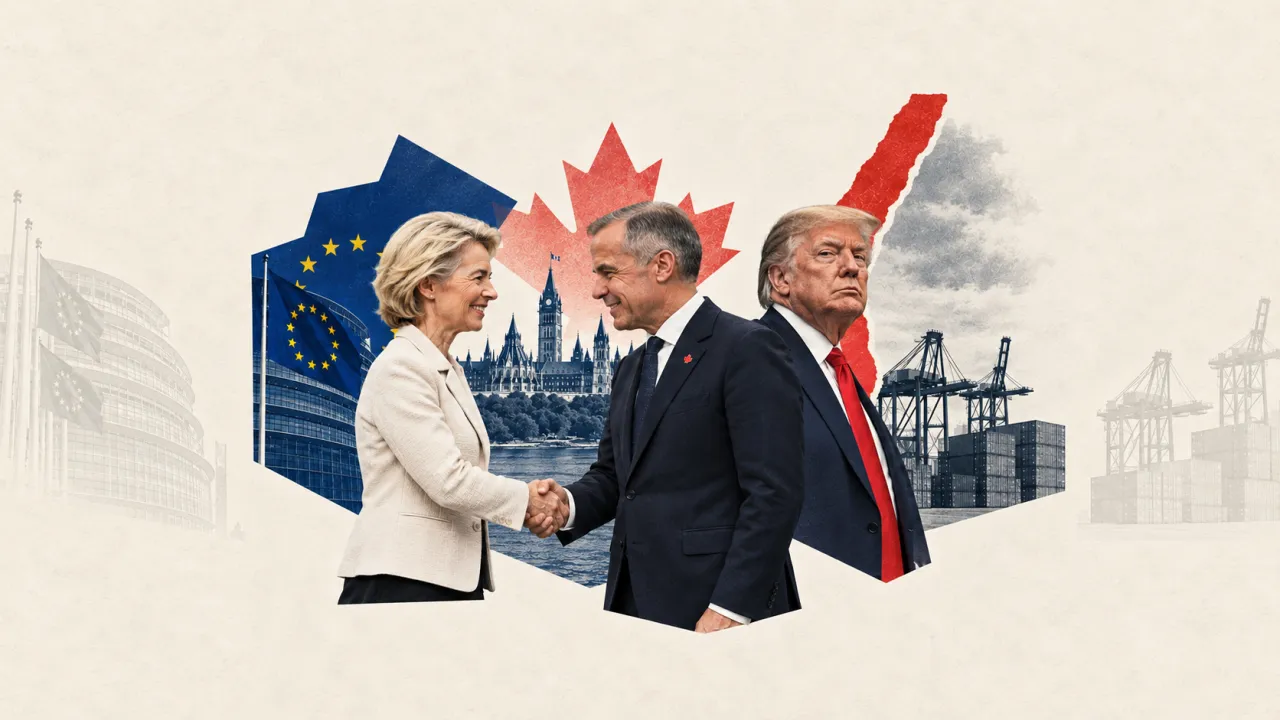
Doha, September 17, 2026. The Qatari press first notes what the Brussels announcement does not say. On Wednesday, before the European Parliament in Strasbourg, Ursula von der Leyen proposed making Canada the first "associate member" of the European Union, to a standing ovation from MEPs, before embracing Canadian Prime Minister Mark Carney. Gulf Times immediately emphasizes that such a status "does not currently exist in any European Union treaty", even if versions of associate membership have already been discussed in the past — Germany had proposed a comparable status for Ukraine, without obtaining the agreement of all capitals.
The Qatari newspaper details what this status would imply in concrete terms: without full membership, Canada would become a "rule-taker", a country that applies the rules of the single market without participating in their drafting, similar to Iceland, Norway, Switzerland, and Liechtenstein within the European Economic Area. Canadian rules, historically calibrated to those of its first commercial partner, the United States, would then need to be realigned with those of Brussels.
This legal interpretation contrasts with the tone of the announcement in Strasbourg: von der Leyen justified the initiative by citing "the cold fragility of today's world" and the need to counter Chinese competition, promising joint work on industrial manufacturing, artificial intelligence, and critical minerals. Mark Carney, who came to listen to the speech, repeated that he was seeking a "unique alliance" with the EU, and not membership.
From North Carolina, Donald Trump immediately described the idea as "laughable" and warned that he could impose "very heavy tariffs" or cease trading with Europe "on many things" if the gesture proved hostile to Washington. He also described Canada as a "terrible trading partner". His reaction, he specified, would depend on the Europeans' actual intention.
For Doha, the episode mainly illustrates how an unprecedented status, without a defined legal definition by von der Leyen herself, is already producing a diplomatic and commercial wave of this magnitude — even before receiving the approval of the twenty-seven member states, a condition that Brussels has not yet obtained.