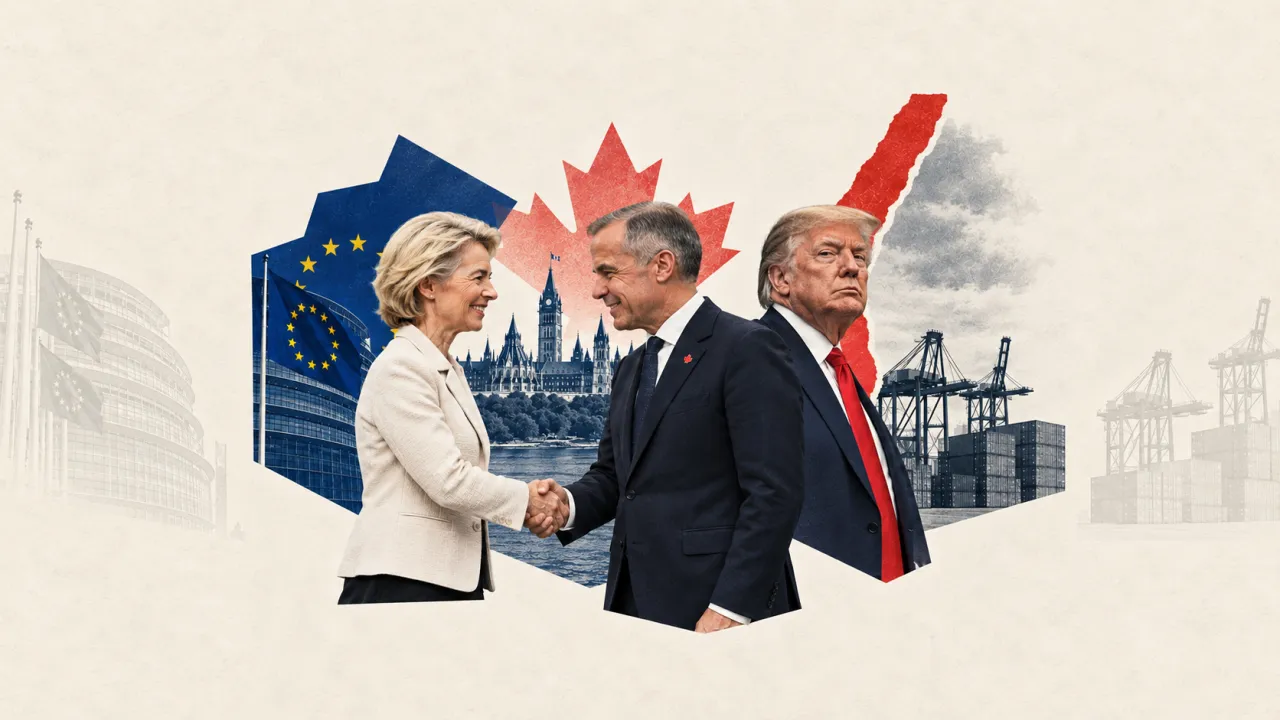

DOMINANT ANGLE
London sees Brussels' move as a risky economic gamble: Ottawa is seeking to break its dependence on Washington by tying itself to the European single market, even if it means provoking the anger of its largest trading partner.
Dominant angle identified — does not reflect unanimity of this country’s media
KEY POINTS
- 01
About 70 % of Canadian exports are destined for the United States, according to The Independent.
- 02
Donald Trump described the proposal for an "associate member" as "laughable" and threatened to impose "very heavy tariffs" or cease trade with Europe if the intention behind it seemed bad.
- 03
Mark Carney clarified that he was seeking a "unique alliance" and not EU membership; he is set to address the European Parliament this Thursday, a day after von der Leyen's speech.
ANALYSIS
London, 17 September 2026. The British press is reading Ursula von der Leyen's proposal through the prism of the trade balance of power opened between Washington and its two main historical partners, Canada and the European Union. On Wednesday, before the European Parliament in Strasbourg, the President of the Commission stated that she wants to "open the door" to an "associated member" status for Canada, a new formula built on the existing CETA free trade agreement and a future "Alliance for the future" aiming for a "common space of prosperity and economic security". She insisted: this is "not a partnership against anyone, but for our common strength".
Mark Carney, present in the hemicycle, is to address the MEPs on Thursday. The Canadian Prime Minister has taken care to distinguish his request from a full membership: he is seeking a "unique alliance" in terms of security and economy, not an entry into the Union. The nuance is important for London newspapers, as it allows Ottawa to keep control over its external relations while reducing its dependence on an American partner that has become unpredictable.
This dependence remains overwhelming: around 70% of Canadian exports go to the United States. Carney has accused the Trump administration of wanting to "break us so that America can own us" and promised to "never forget the lessons" of this "American betrayal", referring to a trade rupture estimated at 640 billion pounds. He now aims to double Canadian trade outside the United States in ten years, presenting his country as a "safe haven" capable of attracting 1,000 billion Canadian dollars in investments in five years.
Donald Trump, who arrived in North Carolina on Wednesday, has described the idea as "laughable" and threatened retaliation if the intention behind it is deemed "bad": "we will impose very heavy tariffs on Europe". He also mentioned the possibility of stopping trade with certain European sectors, recalling that "we carry European nations" on cars, wood, and food. For the British press, this sequence illustrates how "economic integration is being transformed into a pressure tool", in Carney's own words during the investment summit in Toronto on Tuesday, where tariffs now serve as a diplomatic lever as much as a commercial tool.
SOURCES (3)
- The IndependentMEDIUM