
DOMINANT ANGLE
Mexico City sees in Trump's threat a direct echo of its own trade dependence on Washington, as revealed by the Canadian case.
Dominant angle identified — does not reflect unanimity of this country’s media
KEY POINTS
- 01
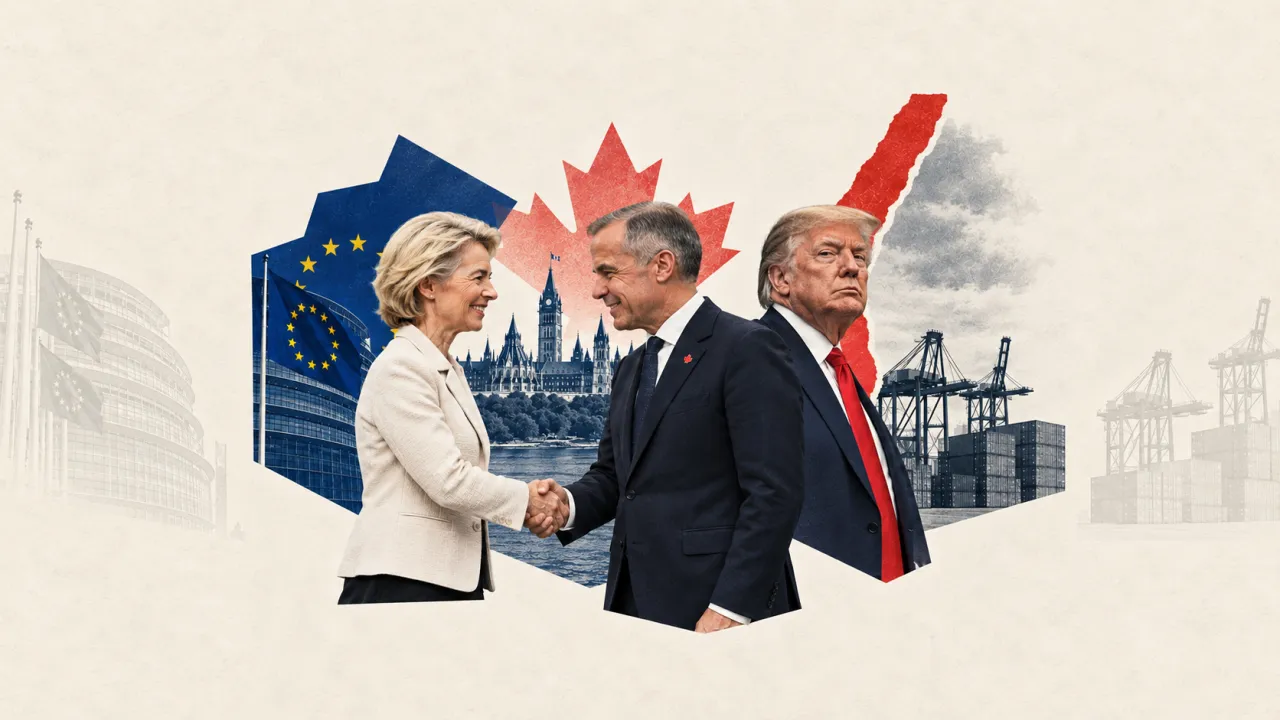
Von der Leyen proposes making Canada the first "associate member" of the EU, by expanding the CETA agreement through a "Alliance for the future".
- 02
Trump has described the proposal as a possible "hostile act" and threatened new tariffs against the European bloc.
- 03
About 70 % of Canadian exports depend on the US market, driving the search for a "unique alliance" with the EU according to Carney.
ANALYSIS
Mexico, September 17, 2026. In her annual address on the state of the Union in Strasbourg, European Commission President Ursula von der Leyen proposed making Canada the first "associate member" of the European Union, a status built on the existing CETA free trade agreement, extended by an "Alliance for the future" intended to create, in her words, "a common space of prosperity and economic security." She presented this rapprochement as based not only on trade but on shared democratic values, saying to Canadian Prime Minister Mark Carney: "Above all, dear Mark, Europe and Canada believe in democracy." Carney, present in the hemicycle, received a standing ovation from European parliamentarians; he is to address the European Parliament on Thursday.
The Mexican press, which is following this file via AFP and AP dispatches, is reporting the immediate response from Donald Trump: from North Carolina, the American president described the proposal as a possible "hostile act" and threatened, if it were to materialize, to respond with new tariffs against the European bloc. This sequence resonates particularly in Mexico, whose economy is also exposed to the same tariff levers that Washington wields against its North American partners.
A Canadian official told the AP that Ottawa is exploring ties with the EU that could go as far as a step towards full membership, with an agreement allowing its citizens to live and work in Europe without a visa. Prime Minister Mark Carney, for his part, insists that he is seeking a "unique alliance" and not full membership, a distinction that Mexican media outlets are reporting without further comment.
The core of the issue, extensively documented in the articles consulted, is Canada's dependence: around 70% of the country's exports go to the United States, a figure that explains Ottawa's quest for diversification after Trump repeated his desire to see Canada become the "51st American state." For Mexico, linked to the United States by the USMCA North American agreement and facing the same tariff tensions, the Canadian episode illustrates a familiar pattern: a G7 partner, economically tied to Washington, seeking elsewhere the guarantees that its neighbor no longer offers. However, none of the articles in the corpus develop the direct implications for Mexico itself, or for the expanded NAFTA.