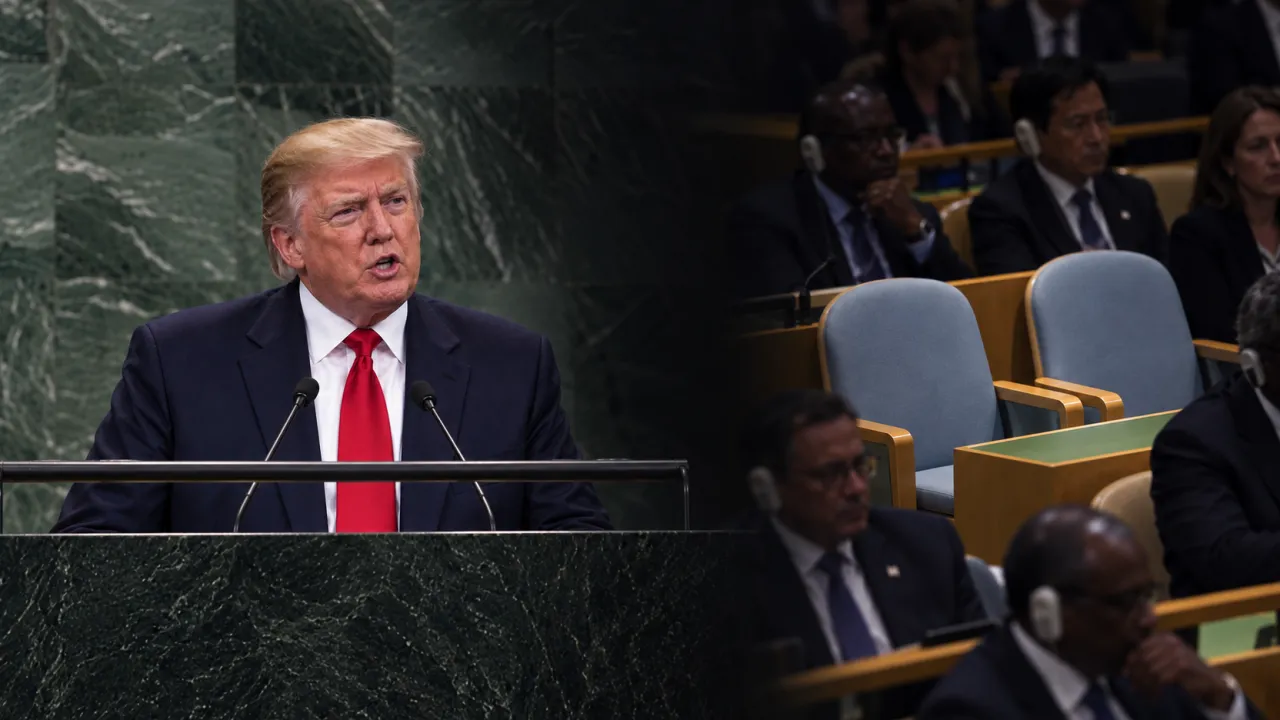
Beyond the already known sequence of threat and dialogue, global coverage of this UN summit converges on three aspects that have taken a back seat: a timeline deemed electoral by a large portion of the Western press, a Gulf region described as already unstable, and open bilateral tensions, from Madrid to Mexico and including Havana.
No agreement is signed: a new round of talks is scheduled without a fixed date, while the Strait of Hormuz remains closed and the US blockade of Iranian ports is in effect.
A large portion of the Western press associates the shift between threat and diplomatic opening with the internal fragility of the American president. Le Monde cites a CNN-SSRS poll according to which 71% of Americans disapprove of his foreign policy, 70% believe the war against Tehran has harmed the interests of the United States, and 75% think the White House has no clear plan to exit the crisis. Handelsblatt, on its part, notes a Reuters/Ipsos poll placing Trump's trust rating at its lowest level since the beginning of his political career.
The Independent reports that six weeks before the election, Republican elected officials are starting to distance themselves from Trump on the war in Iran and gas prices, a party source quoted by the newspaper judging his presence "not useful" in certain campaigns. The LA Times notes that less than a third of Americans approve of his handling of the conflict, more than six months after its outbreak.
32 perspectives, each in the voice of that country's press.
 Bangladesh
Dhaka is measuring the economic impact of Trump's big U-turn at the UN: the promise to reopen the Strait of Hormuz carries more weight, for an oil-importing economy, than the threat to "annihilate" Iran.
2 sources
 Belgium
Brussels sees in Trump's about-face between the threat of annihilation and resuming dialogue with Tehran the proof of an erratic American diplomacy, coddling authoritarian regimes while brandishing the annihilation of a UN member state.
3 sources
 Brazil
Brasília interprets Trump's sequence of threat followed by dialogue on Iran as an electoral calculation, noting that he is putting off any agreement until the November midterms while Lula and he take their respective campaigns to the same UN platform.
4 sources
 Canada
Ottawa is separating the threat made against Iran from the diplomatic maneuver that followed, and is primarily focused on the fact that its own Prime Minister was defending multilateralism from the same podium that Trump is trying to undermine.
5 sources
 China
ChinaBeijing is watching the decline in traffic in the Strait of Ormuz more than the rhetoric, seeing it as a concrete indicator of the outcome of the negotiations between Washington and Tehran.
2 sources
Berlin is deciphering Trump's double talk as an electoral calculation: threatening Iran with "hell" from the UN podium while putting off any agreement until after the November 3 midterms, at a time when his approval rating is at an all-time low.
3 sources
Jerusalem is particularly noting the absence: while Washington threatens to "annihilate" Iran and then re-engages with Tehran, Netanyahu will have neither a tête-à-tête with Trump nor a Texas stop with Elon Musk at the UN.
2 sources
Mexico City distinguishes the charge brought against the cartels from the Iranian aspect of Trump's speech at the UN, and entrusts the Senate with the task of relativizing its scope.
4 sources
Buenos Aires is separating the rhetoric from market calculations: the Argentine press is mainly noting the drop in the barrel price after the announcement of a US-Iranian meeting in New York.
2 sources
Canberra sees the postponement of an Iranian agreement after the midterms as an electoral calculation made by Washington, at the very moment when Trump rejects the global pact on artificial intelligence that Australia has just cosigned.
6 sources
Quito takes away from the New York platform less the threat to Tehran than the warning launched at Latin America, a region that Ecuador is a part of and that Washington is openly putting in its military crosshairs.
2 sources
Madrid is questioning the credibility of the threat of "annihilation", when Pedro Sánchez judges Trump's speech "not backed by facts and data" and dodges his reception at the UN.
5 sources
Helsinki is gauging the gap between the threat to "annihilate" Iran made at the UN and a Finnish military calculation, the behind-the-scenes of which are being retraced by the local press: a strike prepared against the Houthis in Yemen, suspended at the last minute.
2 sources
Paris is deciphering a calendar that is above all electoral: the threat made to Iran puts off any agreement until after the November midterms, a deadline that the French press reads as a sign of a weakened presidency in public opinion.
5 sources
Jakarta is first measuring the threat to "annihilate" Iran made by Trump at the UN, before the announced resumption of dialogue with Tehran.
2 sources
New Delhi is deciphering the huge gap between the threat of annihilation made from the UN podium and the subsequent opening for a meeting with Iranian officials in New York.
2 sources
Tehran denounces Trump's threat as an admission of American "strategic despair", while confirming the resumption of talks on the Strait of Hormuz and warning of harsher strikes in the event of aggression.
2 sources
Rome is particularly focused on the electoral dimension of Trump's speech, where the ultimatum issued to Iran serves as a backdrop for a promise of a deal postponed until after the midterms.
2 sources
Seoul first notes the absence of any North Korean mention in Trump's UN speech, and reads the November midterm election clock as the real determinant of the tempo, for both Iran and its own $200 billion investment negotiations.
3 sources
Vilnius is gauging the sequence in terms of the barrel: the promise of a Washington-Tehran dialogue has driven Brent below $100, more so than the threat to "annihilate" Iran made at the UN.
2 sources
Kathmandu is particularly concerned about the slump in oil prices following the announcement of talks, which is more damaging to its import-based economy than the verbal threats against Tehran.
2 sources
Lima is more focused on the slump in oil prices following the announcement of a US-Iranian meeting in New York, than on the threat to "annihilate" Iran made by Trump at the UN podium.
3 sources
Islamabad is gauging both flattery and risk: Donald Trump praised Prime Minister Shehbaz Sharif as a "formidable man" at the UN podium, just before threatening to "annihilate" Iran, Pakistan's direct neighbour via Balochistan.
4 sources
Doha warns that the Gulf is experiencing one of its most dangerous phases since the start of the American-Israeli war against Iran, while welcoming the resumption of dialogue announced by Washington.
2 sources
Moscow is deciphering the huge gap between the threat of "annihilation" made by Trump at the UN podium and the admission, on the same day, that no agreement with Tehran is expected before the US midterm elections, a sequence seen as primarily calibrated for domestic opinion.
2 sources
Stockholm sees the postponement of the "major decision" on Iran as an electoral calculation, with the Swedish press linking the UN ultimatum to the November midterm elections, which are weakening Trump's Republican camp.
3 sources
Ankara is separating the threat of annihilation made from the UN podium from the diplomatic breakthrough that followed: the Turkish press is mainly focusing on the conditions set by Tehran to reopen the Strait of Hormuz.
2 sources
Kyiv takes away from the threat-then-dialogue sequence with Iran a pattern it hopes to see repeated on its own Russian dossier, carried by the same emissaries Witkoff and Kushner.
2 sources
London is interpreting the threat of "annihilation" made by Trump at the UN as a speech intended more for the midterms than for Tehran, with the British press emphasizing that the promised agreement is not expected until after the November vote.
4 sources
The United States government measures this double message against the electoral calendar: the threat to "annihilate" Iran gives way, in a matter of minutes, to the announcement of a postponed agreement after the midterms on November 3.
3 sources
Caracas gauges the word "annihilate" by its own fate: a few months after claiming the military capture of Nicolás Maduro, Washington wields the same determination against Iran, a warning that Venezuela reads as valid for all of Latin America.
3 sources
Pretoria is deciphering the huge gap between the threat to "annihilate" Iran made from the UN podium and the resumption of dialogue announced afterwards, as well as the departure of the Iranian delegation during the speech.
3 sources
Common ground and differences in coverage across the media analysed.
Before the United Nations General Assembly on Tuesday, Donald Trump stated he had to choose between an agreement ending the war with Iran and the destruction of the Islamic Republic, which he presented as a decision for him to make.
A few minutes after his speech, Trump announced that a three-hour meeting had taken place in New York between American representatives, led by Steve Witkoff and Jared Kushner, and Iranian officials, which he described as 'very good' and 'very productive', with another session in preparation.
A large part of the coverage presents the New York meeting as a fact and a positive development, while another part describes it as not formally confirmed or without effect on negotiations that it says are stalled.
Coverage aligned with this reading
BangladeshDOMINANT ANGLE
Dhaka is measuring the economic impact of Trump's big U-turn at the UN: the promise to reopen the Strait of Hormuz carries more weight, for an oil-importing economy, than the threat to "annihilate" Iran.
KEY POINTS
ANALYSIS
Dhaka, Wednesday, September 23, 2026. For the Bangladeshi press, the UN summit played out in two opposing phases, and it's this gap that Dhaka is focusing on first. Before the General Assembly, Donald Trump presented his decision on Iran as a personal one: "I have a big decision to make: will an agreement be reached with Iran that will allow it to rebuild and create a much larger country? Or will I annihilate the Islamic Republic... and lead them to hell with no chance of survival?" According to TBS Top News and The Daily Star, nearly the entire Iranian delegation left the room within the first few minutes of the speech; the Cuban delegation did the same after Trump called Cuba a failed state and promised that freedom would come to the island.
A few minutes later, Trump announced the resumption of dialogue: American representatives Steve Witkoff and Jared Kushner, and Iranian Foreign Minister Abbas Araghchi, held a three-hour meeting in New York, described as "very good" and "very productive", with another session already scheduled. Trump linked any agreement to the US electoral calendar: "I think we'll make a deal just after the election, it doesn't make sense for them not to do it. They're waiting to see how I do in the midterms."
Explore every perspective on this subject across 32 countries.
Compare viewpoints and see where they diverge.
The shift between threat and dialogue is described as a 'strategic desperation' by the Iranian military, while some Western and Russian media see it as a calculation related to the November midterm elections.
Coverage aligned with this reading
Coverage that diverges
Some coverage highlights the de-escalation conditions mentioned during the talks, including the reopening of the Strait of Hormuz, while another part relays the warning from the Iranian armed forces announcing tougher strikes in case of aggression.
This grouping describes the publications analysed, not the position of these countries’ populations or of their governments.
It's the economic dimension of this standoff that's grabbing attention in Dhaka, an energy-importing economy exposed to any closure of the Strait of Hormuz. The Daily Star recalls that the war waged by Washington against Tehran has "caused vast economic damage" via this strait. A senior Iranian official indicated that Tehran could reopen the strait to Gulf ships "within a seven-day period" if Washington lifted military pressure and the blockade imposed on Iranian ports, a proposal transmitted through mediators. Secretary of State Marco Rubio said the United States was "open to talking to the Iranians".
Another thread followed by Bangladeshi headlines: a CNN fact-check, relayed by TBS, highlights several "inaccurate or largely exaggerated" claims by Trump before the Assembly, including his statement that he had resolved eight wars when two of them never had that status. A Reuters/Ipsos poll cited by TBS puts his popularity rating at a historic low of 32%.
BelgiumDOMINANT ANGLE
Brussels sees in Trump's about-face between the threat of annihilation and resuming dialogue with Tehran the proof of an erratic American diplomacy, coddling authoritarian regimes while brandishing the annihilation of a UN member state.
KEY POINTS
ANALYSIS
Brussels, September 23, 2026. At the United Nations podium on Tuesday, Donald Trump summarized his dilemma over Iran in a memorable question: "Do I send them to hell?" He presented it as his choice between an agreement and the annihilation of the Islamic Republic. A few minutes later, he announced the resumption of dialogue with Tehran, revealed during a press conference alongside Ukrainian President Volodymyr Zelensky. The Belgian press first notes this great divide. La Libre Belgique, in a severe editorial, sees it as "a finding of failure": seven months after the outbreak of war against Iran, Washington is reduced to hoping to restore the previous situation, a Strait of Hormuz "open without hindrance to navigation". The editorialist speaks of a resounding fiasco "facing a power that is ultimately medium-sized" and a global economy "plunged into chaos".
On the substance of the discussions, La Libre reports that the meeting in New York lasted three hours, led on the American side by Steve Witkoff — "I feel very good", he said — and Jared Kushner, both of whom were already present during the interrupted talks in June. A new session is announced "in the very near future". The DH notes that, according to Iranian state television Irib, Tehran communicated its conditions for reopening the strategic strait during these exchanges, and that Trump now links any agreement to the electoral calendar: a compromise would be possible after the November midterm elections, where his party risks losing Congress due to high fuel prices.
The VRT, via its US specialist Bert De Vroey, situates this double discourse in a broader register: a tone deemed more moderate than in 2024 towards the UN itself — Trump having thanked the Security Council twice — but frontal attacks on UNESCO and the International Criminal Court, as well as a defense of American strikes in Venezuela deemed incompatible with the organization's principles. La Libre adds the mention, deemed revealing, of trade with Belarus rather than Canada. For the Belgian press, it is not the threat itself that makes sense, but the inconsistency of a diplomacy that spares authoritarian regimes while brandishing the annihilation of a UN member state.
BrazilDOMINANT ANGLE
Brasília interprets Trump's sequence of threat followed by dialogue on Iran as an electoral calculation, noting that he is putting off any agreement until the November midterms while Lula and he take their respective campaigns to the same UN platform.
KEY POINTS
ANALYSIS
Brasília, September 23, 2026. The Brazilian press is reading Donald Trump's speech before the UN General Assembly, on Tuesday, September 22, in New York, through an electoral rather than strictly diplomatic prism. The American president said he has a "great decision" to make: conclude an agreement with Iran or "annihilate the Islamic Republic and send it to hell", before adding, according to G1, that he would try to "conclude a fair agreement after the elections". A few hours later, he announced that a US delegation and an Iranian delegation had held a three-hour meeting in New York, which he described as "very good", promising a new session "in the very near future".
For the Brazilian media, this shift from threat to dialogue is first and foremost part of the American electoral calendar, that of the midterms on November 3. The Jornal de Brasília recalls that Trump is facing growing unpopularity on the eve of the election, linked to the cost of living, while Folha highlights that he mentioned Joe Biden nearly 900 times this year, according to a Reuters count, on average three times a day, a tactic that a Republican strategist cited by the newspaper attributes to the desire to keep public opinion focused on the former president rather than on his own difficulties.
G1 explicitly associates the two heads of state in the same reading: "With the impending elections in both countries", Lula and Trump have taken their respective electoral agendas to the UN podium. Lula, who opened the debate according to tradition, defended sovereignty and multilateralism, criticized the embargo on Cuba, and launched, without naming him, that "Brazil is nobody's backyard". The Jornal de Brasília notes that he also asked Trump not to interfere in the Brazilian election in October, where he faces a tight second-round runoff against Senator Flávio Bolsonaro (PL), a declared ally of the American president.
The Brazilian press also notes that Trump described Cuba as a "failed state" when announcing the imminent fall of its government, as his diplomats left the room, and that he promised to use "unmatched military power" in the Western Hemisphere against the cartels, citing the operation carried out against Nicolás Maduro in Venezuela. The Brazilian corpus dwells little on the reaction of the Iranian forces or on oil prices: the retained angle remains that of the electoral parallel between the two presidents.
CanadaDOMINANT ANGLE
Ottawa is separating the threat made against Iran from the diplomatic maneuver that followed, and is primarily focused on the fact that its own Prime Minister was defending multilateralism from the same podium that Trump is trying to undermine.
KEY POINTS
ANALYSIS
Ottawa, September 23, 2026. Before the United Nations General Assembly on Tuesday, Donald Trump warned that he would have to "decide" between an agreement allowing Iran "to rebuild into a much greater country", or "annihilate the Islamic Republic" and "send them to hell with no chance of survival". He said he believed an agreement would come "just after the election" in the November mid-term, repeating his promise that Iran "will never have a nuclear weapon" and evoking a reality that "too many people have chosen to ignore". The National Post notes that during this passage, "all members of the Iranian delegation except one" left the room. Minutes later, Trump revealed that American and Iranian representatives had met for three hours in New York — Iranian Minister Abbas Araghchi facing presidential emissary Steve Witkoff and presidential son-in-law Jared Kushner —, describing the exchange as a "very good, very productive" meeting, with another one "planned very soon".
Canadian coverage highlights another thread: on the same day, at the same podium, Prime Minister Mark Carney attended the opening of a General Assembly that Trump has been trying to weaken for months — by withholding funding, withdrawing from the WHO and UNESCO. For a year, according to Global News, Carney has been traveling the world to defend a multilateralism based on "shared interests, and sometimes shared values, rather than shared institutions", seeking a bridge between the European Union and the CPTPP bloc in the face of economic coercion from Washington and Beijing. After Ursula von der Leyen mentioned a "associate member" status for Canada, Trump deemed the prospect "hostile".
The CBC also notes that the speech devoted a significant portion to the Western Hemisphere: claiming Venezuelan oil as war spoils, strikes against traffickers in the Caribbean, and a warning against any adverse power gaining a foothold "anywhere in the Western Hemisphere" — a revived Monroe Doctrine, which the channel reports was welcomed by the Kremlin. The war with Iran began on February 28 with Israeli-American strikes that killed Supreme Leader Ali Khamenei, who was replaced by his son Mojtaba.
ChinaDOMINANT ANGLE
Beijing is watching the decline in traffic in the Strait of Ormuz more than the rhetoric, seeing it as a concrete indicator of the outcome of the negotiations between Washington and Tehran.
KEY POINTS
ANALYSIS
Beijing, September 23, 2026. Before the United Nations General Assembly on Tuesday, Donald Trump once again justified his war against Iran, claiming to have prevented Tehran from obtaining nuclear weapons and warning that he could "annihilate the Islamic Republic" if no agreement was found to end the conflict. "I will never allow Iran to have nuclear weapons," he said at the 81st session of the General Assembly, describing Tehran as the "brute of the Middle East" that "is no more." The Iranian delegation left the room within ten minutes of the speech; President Masoud Pezeshkian and Foreign Minister Abbas Araghchi, who were in New York for the session, did not attend.
A few hours later, Trump announced that his special envoys, Steve Witkoff and Jared Kushner, had held a three-hour meeting with Iranian officials on the sidelines of the UN general debate. "It was a very good meeting," he told journalists, adding: "it's either great potential or annihilation, there are two choices." He estimated that an agreement would come after the midterm elections on November 3.
On the Iranian side, the state agency IRIB, citing an exclusive source, reported that Araghchi had transmitted Tehran's "decisive positions" to the American side via Witkoff, regarding the reopening of the Strait of Hormuz: lifting the American naval blockade, unblocking frozen Iranian assets, and ending the war on all regional fronts. The maritime tracking company Kpler recorded only two commercial ships passing through the strait on Monday, compared to ten the day before — a concrete signal, for Beijing, more meaningful than the rhetoric from the podium on this vital route for global oil supplies.
On the same day, Trump presented his domestic record as a global success: "I can proudly announce that America is back, and our country is stronger today than ever," he said, citing a decline in crime, innovation, and tax cuts as benefits for the international community — a tone that the Hong Kong press considers closer to a campaign rally than a UN address.
 Germany
DOMINANT ANGLE
Berlin is deciphering Trump's double talk as an electoral calculation: threatening Iran with "hell" from the UN podium while putting off any agreement until after the November 3 midterms, at a time when his approval rating is at an all-time low.
KEY POINTS
ANALYSIS
Berlin, September 23, 2026. The German press first notes the US electoral calendar behind Donald Trump's double announcement at the UN podium. Before the General Assembly on Tuesday, the US President again threatened to send Iran "in die Hölle" — to hell — if no agreement is reached, while ensuring that a "very good" three-hour meeting had just taken place in New York between American and Iranian representatives, reports Tagesschau. According to the public channel, Trump stated: "Ich glaube, wir werden direkt nach der Wahl eine Einigung erzielen" — I believe we will reach an agreement just after the election — thus postponing any diplomatic outcome until after the midterm elections on November 3, which will renew the House of Representatives and part of the Senate.
Handelsblatt highlights the domestic context of this sequence: a Reuters/Ipsos poll cited by the economic daily shows Trump's confidence rating has fallen to its lowest level since the beginning of his political career, in a climate marked by high and unpopular gas prices. The newspaper notes that Trump began his speech with a strong praise of the United States — "Amerika ist zurück" — before addressing Iran, which he called the "tyrant of the Middle East" that would no longer be one. The US President reaffirmed: "I will never let Iran possess a nuclear weapon."
Deutsche Welle broadens the scope to a region that continues to deteriorate nearly seven months after the start of the conflict in late February: Iranian-backed Houthi militias are advancing in Yemen and threatening traffic in the Red Sea, while Saudi Arabia accuses militias close to Tehran of targeting a strategic oil pipeline. According to the New York Times cited by DW, Saudi Crown Prince Mohammed bin Salman called Trump on Sunday to pressure him to intervene against the Houthis; Axios reports that Washington rejected a previous Saudi request for strikes.
None of the German articles consulted mention Trump's exchanges on Cuba or Mexico, nor the response from the Spanish head of government. The German reading remains focused on the articulation between military pressure, postponed negotiation, and the American electoral deadline.
 Israel
DOMINANT ANGLE
Jerusalem is particularly noting the absence: while Washington threatens to "annihilate" Iran and then re-engages with Tehran, Netanyahu will have neither a tête-à-tête with Trump nor a Texas stop with Elon Musk at the UN.
KEY POINTS
ANALYSIS
Jérusalem, September 23, 2026. Before the United Nations General Assembly on Tuesday, Donald Trump stated that it would be up to him to decide whether to "annihilate" Iran if no agreement is reached to end the war in the Middle East, before announcing, a few minutes later, the resumption of dialogue with Tehran. According to him, American and Iranian representatives, led on the American side by Steve Witkoff and Jared Kushner, held a three-hour meeting in New York that he described as "very good" and "very productive", with another session being prepared. An agreement, he estimated, could come after the American mid-term elections. According to Haaretz, this speech comes in the context of an "American-Israeli war against Iran" and growing instability in the Middle East, which should mark Trump's remarks as well as his meetings with regional leaders.
Two days later, on Thursday, it was Benjamin Netanyahu's turn to address the General Assembly, but in a format reduced to a minimum. According to the Jerusalem Post, the Prime Minister is expected to arrive in New York on Thursday morning, speak around 2 pm local time (9 pm in Israel), and then return to Israel the same day, probably without spending a night on American soil. "The program has undergone several changes in recent days," the newspaper notes: Netanyahu was initially supposed to arrive on Wednesday, with an additional stop in Texas where a meeting with Elon Musk, along with a possible visit to SpaceX facilities, had been planned. An advanced Israeli team had already traveled to the location to prepare for this visit when, over the weekend, they learned of its cancellation.
No meeting with Donald Trump is also planned, despite the efforts of Netanyahu's advisors to organize one: a senior American official indicated that the Israeli Prime Minister was not among the leaders that Trump planned to receive. The Texas stop also posed logistical complications, as the "Wing of Zion" plane cannot fly from Israel to Texas without a refueling stop, without any indication that this constraint motivated the cancellation.
While Washington oscillates between the threat to "annihilate" Iran and the relaunch of a diplomatic channel with Tehran, the Israeli presence at the UN this week is thus reduced to a solo round trip, without a symbolic stop or tête-à-tête with the American President.
 Mexico
DOMINANT ANGLE
Mexico City distinguishes the charge brought against the cartels from the Iranian aspect of Trump's speech at the UN, and entrusts the Senate with the task of relativizing its scope.
KEY POINTS
ANALYSIS
Mexico, Wednesday, September 23, 2026. From the lengthy speech delivered Tuesday by Donald Trump before the United Nations General Assembly, the Mexican press mainly retains the passage that directly concerns it: "México es el epicentro de la violencia de los cárteles." The American president deemed it "inacceptable" that the United States shares a 3,200-kilometer border with a territory he claims is "controlled by enemy cartels," which he equates, since their classification in 2025 as terrorist organizations, to "enemies of humanity." However, he assured that he maintains an "excellent relationship" with the government of President Claudia Sheinbaum, stating that Mexico also does not want the cartels.
Trump highlighted, in the same vein, at least 70 strikes carried out in the Caribbean and the Pacific against suspected drug trafficking vessels, which killed 234 people presented as narcotraffickers, as well as the operation conducted earlier in the year against Nicolás Maduro in Venezuela, presented as being subject to American justice for drug trafficking.
On the institutional side, the president of the Mexican Senate, Higinio Martínez, from the Morena party, qualified the remarks as "graves" but estimated that they should not be a cause for concern, judging them to be in line with the "style" of the American president. He referred the matter to the federal government to respond "through institutional channels," while awaiting the position of the Mexican chancellor at the UN, and dismissed the idea of a bilateral rupture, recalling that the shared border remains a lasting link between the two countries.
The same speech also described Cuba as a "failed state," prompting the departure of the Cuban delegation and a response from Chancellor Bruno Rodríguez denouncing "falsedades" and an "economic war." The consulted Mexican articles do not link this passage to the threats made against Iran or the announcement of a resumption of dialogue with Tehran later in the same speech: the Mexican reading isolates the regional aspect, that of the threat of military force in Latin America if Washington deems its interests threatened, without connecting it to the Iranian thread that dominates the international coverage of the summit.
 Argentina
DOMINANT ANGLE
Buenos Aires is separating the rhetoric from market calculations: the Argentine press is mainly noting the drop in the barrel price after the announcement of a US-Iranian meeting in New York.
KEY POINTS
ANALYSIS
Buenos Aires, September 23, 2026. The Argentine press clearly distinguishes between the two parts of Donald Trump's speech at the United Nations podium. On +Perfil, in the program Ronda de Corresponsales, journalist Norman Powell breaks down the forty minutes of speech, marked by an unusual fidelity to the teleprompter: "Trump on this occasion hardly deviated from his text on the teleprompter." The American president first boasted about his domestic record — stock market, poverty, immigration, crime — before dedicating the bulk of his speech to the war between Russia and Ukraine, promising that it "will end soon," and to the conflict pitting Israel and the United States against Iran.
It is on this last point that Clarín focuses its analysis, but from a decidedly economic angle. The newspaper recalls that Trump mentioned an "important decision" before the UN: to conclude an agreement or "drag Iran to hell." A few hours later, he announced a "very good" three-hour meeting between American and Iranian representatives in New York, without naming the negotiators. On Wednesday, oil prices fell in Asia: Brent fell to $98.91 (-0.3%), WTI to $89.93 (-0.7%), both contracts remaining below the symbolic threshold of $100, which has been repeatedly crossed since the outbreak of war in the Middle East in February.
Clarín quotes analyst Stephen Innes, from Quintex Intel, who believes that this meeting "shifted the market from a quote based exclusively on the escalation towards a genuine diplomatic process, although a definitive agreement still seems distant." The newspaper also recalls that seven months after the American-Israeli strikes that triggered the conflict, the parties remain at an impasse: Tehran keeps the Strait of Hormuz closed, Washington continues its counter-blockade of Iranian ports.
For the Argentine press, the gap between the threatening rhetoric of the podium and the almost simultaneous announcement of a dialogue is less of a contradiction than a deliberate calculation: the threat serves as leverage, the meeting serves as a signal to the markets. Neither of the two articles mentions the diplomatic incident in the hall or the American electoral calendar.
 Australia
DOMINANT ANGLE
Canberra sees the postponement of an Iranian agreement after the midterms as an electoral calculation made by Washington, at the very moment when Trump rejects the global pact on artificial intelligence that Australia has just cosigned.
KEY POINTS
ANALYSIS
Canberra, Wednesday, 23 September 2026. Before the United Nations General Assembly, on Tuesday (New York time), Donald Trump summed up his stance on Iran with a blunt phrase: "I have a big decision to make. Will we make a deal with Iran, which would allow them to rebuild and create a country much greater than it has ever been? Or will I annihilate the Islamic Republic?" he said, according to reports from SBS and the ABC. Most of the Iranian delegation left the room during his speech.
The Australian press is focusing more on the calendar than the threat itself. The ABC notes that this speech, given "six weeks before the US midterm elections", was intended to respond to criticism that Trump's foreign policy "was harming the United States and making the world more unstable and dangerous". SBS points out that domestic discontent with this war, which began in February, has already eroded the popularity of several Republican lawmakers close to Trump ahead of the November election.
Trump himself sealed this electoral reading: he predicted that a deal would be signed after the midterms, "because it wouldn't make sense for them not to do it. They're waiting to see how I do in the midterm election", as quoted by PerthNow. On the same day, an Iranian official told Reuters that Tehran could soon reopen the Strait of Hormuz if Washington lifted its military pressure, a move that would lower oil prices, which have risen since the start of the war, according to SBS.
Another thread followed by the Australian press, separate from the Iran issue, which fuels the reading of a speech turned towards the American electorate: Trump rejected what he called a "globalist project" to regulate artificial intelligence - the same one that Australia had just co-signed with twenty-one other leaders, according to the Sydney Morning Herald and The Age. He announced his intention to rename AI "superintelligence" in US official documents, hoping the world would follow. Crikey, sarcastically, sums up this passage as the "usual bombastic rhetoric" of a tiring leader to listen to.
For Canberra, this sequence portrays a president who is speaking more to his November electorate than to the UN - even if it means offending a partner that has just aligned its position on AI with his own.
 Ecuador
DOMINANT ANGLE
Quito takes away from the New York platform less the threat to Tehran than the warning launched at Latin America, a region that Ecuador is a part of and that Washington is openly putting in its military crosshairs.
KEY POINTS
ANALYSIS
Quito, September 23, 2026. From the stands of the United Nations General Assembly, the Ecuadorian press first retains the regional scope of Donald Trump's speech, delivered on Tuesday, September 22, 2026, in New York, more than the sole threat to Tehran. According to Primicias, the American president defended his country's military offensive in the world and warned that he would use military force in Latin America if the United States felt threatened — a statement that directly puts the region, which includes Ecuador, in Washington's crosshairs.
The newspaper reports that Trump, a fierce critic of an institution he accuses of being unable to resolve global conflicts, spoke on the first day of a six-day session, whose two announced axes are the war in the Middle East and the risks of artificial intelligence. El Universo specifies that 71 heads of state, 45 heads of government, and 11 vice-presidents are expected at the podium, alongside 50 ministers and a crown prince, according to the spokesperson for the Secretary-General Stéphane Dujarric; the first speakers were Brazilian Lula da Silva, Trump himself, King Abdallah II of Jordan, and then Turkish Recep Tayyip Erdogan.
Ecuadorian President Daniel Noboa is also participating in this Assembly, the last one led by Guterres, notes Primicias, which also highlights that Emmanuel Macron called on countries to build together an alternative model of artificial intelligence.
Another fact noted by the local press: as soon as his speech was finished, Trump chained bilateral meetings before an "informal encounter" with the interim president of Venezuela, Delcy Rodríguez, a detail provided by US Ambassador to the UN Mike Waltz. Primicias recalls that since the capture of President Nicolás Maduro by American forces in January, Washington has focused on restarting the exploitation of Venezuela's subsoil, guaranteeing privileged access to the United States, and that Rodríguez has aligned herself with American economic objectives.
For the Ecuadorian press, the threat launched against Iran from the podium is thus doubled with a direct warning to Latin America, in a week where the great powers parade before the Assembly against the backdrop of war in the Middle East and regional recomposition around Venezuela.
 Spain
SpainDOMINANT ANGLE
Madrid is questioning the credibility of the threat of "annihilation", when Pedro Sánchez judges Trump's speech "not backed by facts and data" and dodges his reception at the UN.
KEY POINTS
ANALYSIS
Madrid, September 23, 2026. Before the United Nations General Assembly on Tuesday, Donald Trump stated that he had to choose between an agreement with Iran or "annihilate" the Islamic Republic, adding that he believed an agreement would come "just after the elections". For the Spanish press, the phrase is not just a threat: it's an electoral exercise, uttered six weeks before the midterms, in a shorter speech than last year's, thirty minutes versus fifty-seven, according to El País. The head of the Spanish government, Pedro Sánchez, who was present at the opening of the general debate, responded directly. Asked on The Weekly Show with Jon Stewart, he judged Trump's speech as "very ideological, not backed by facts and data", particularly on climate and the war in Iran, estimating that these theses are not "widely supported by many countries in the world".
This verbal distance is accompanied by a protocol gesture: Sánchez declined, due to scheduling reasons according to his entourage, the invitation to the reception offered by Trump to the heads of delegation, as in 2024 and 2025. El Confidencial and Expansión see this as a symptom of a long-standing tense relationship: repeated tariff threats against Spain for its refusal to increase its military spending, disputed use of Spanish bases for strikes against Iran, and Trump's accusation against the "weakness" of the Madrid government after the arrival of Moroccan migrants in Ceuta.
Regarding Iran itself, the Spanish press notes the contrast between the rhetoric of the speech, with Trump invoking the union of the UN to "annihilate" Tehran, and the announcement, minutes later, of a "very good" meeting with Iranian representatives, led by Steve Witkoff and Jared Kushner. ElDiario.es emphasizes that this is not the first time Trump has brandished such a threat: in the spring, a message on Truth Social mentioning "erasing a civilization" had sparked a wave of condemnations, while Tuesday's statement was mostly read as a demonstration of diplomatic strength to which the rest of the world has become accustomed. El País finally notes that the war in Iran, which was supposed to be brief, has now been going on for seven months, while Houthi rebels threaten to expand the regional conflict.
 Finland
DOMINANT ANGLE
Helsinki is gauging the gap between the threat to "annihilate" Iran made at the UN and a Finnish military calculation, the behind-the-scenes of which are being retraced by the local press: a strike prepared against the Houthis in Yemen, suspended at the last minute.
KEY POINTS
ANALYSIS
Helsinki, September 23, 2026. The Finnish press is reading the New York sequence in light of an episode that remained secret until Sunday: according to the New York Times, cited by Helsingin Sanomat, the bombs were already loaded onto the planes last weekend and the target lists were approved to strike the Houthi rebels in Yemen. All that was missing was the presidential order. At the very last moment, Donald Trump chose to suspend the attack, despite the call from the Saudi crown prince, because the Houthis, allies of Tehran, had promised to no longer target American ships in the waters of the Middle East. A strike would have blown this arrangement to pieces and opened a new front for the American army.
For Helsingin Sanomat, the region remains "on a knife's edge": the war could spread from one day to the next, and the week of the UN General Assembly offers only a small diplomatic window to calm the situation. The newspaper details the deterioration of the Saudi position, the world's second-largest oil producer: the Houthis have quickly conquered cities and ports on the Red Sea, approaching the Bab-el-Mandeb Strait, the southern gateway to this sea. The American-Israeli strikes against Iran had already reduced deliveries via the Strait of Hormuz to a fraction, pushing Riyadh to reorient a large part of its exports via pipeline to the Red Sea - precisely the route now under threat. At the beginning of September, Iranian-backed rebels in Iraq damaged another pipeline, which could remain out of service for weeks.
It is in this climate that MTV Uutiset reports on the three-hour meeting held on Tuesday in New York, on the sidelines of the General Assembly, between Iran and the United States. Trump informed journalists about it after threatening, earlier the same day, to send Iran "to hell" if there was no agreement. On the Iranian side, Foreign Minister Abbas Araghchi met with emissary Steve Witkoff and the president's son-in-law, Jared Kushner. Trump described the exchange as "very good" and "very productive", and announced a new session soon. MTV recalls that the war has been bogged down for months in a stalemate: thousands of deaths, a constantly rising barrel price, and neighboring countries drawn into the conflict.
For the Finnish press, the alternation between the threat of annihilation and the resumption of dialogue is part of a larger sequence, where Washington's military restraint has less to do with diplomacy than with a tactical calculation already tested in Yemen.
 France
DOMINANT ANGLE
Paris is deciphering a calendar that is above all electoral: the threat made to Iran puts off any agreement until after the November midterms, a deadline that the French press reads as a sign of a weakened presidency in public opinion.
KEY POINTS
ANALYSIS
Paris, September 23, 2026. At the United Nations podium on Tuesday, Donald Trump blew hot and cold on Iran: the threat to "annihilate" the Islamic Republic, followed a few minutes later by the announcement of a resumption of dialogue with Tehran. Members of the Iranian delegation left the room during his speech. The French press, while meticulously recording this sequence, focuses mainly on what it reveals about the internal fragility of the American president as the midterm elections approach.
The French government notes that Donald Trump, "weakened politically", did not display "the same aggressiveness as in 2025" and cites a CNN-SSRS poll according to which 71% of Americans disapprove of his foreign policy, 70% believe that the war against Tehran has harmed the interests of the United States, and 75% believe that the White House has "no clear plan to exit the crisis". It is in this context that the president promised: "I believe we will reach a fair agreement after the elections" legislative elections in November, where his party risks losing Congress - notably, as 20 Minutes specifies, "due to the high price of fuel because of the war".
The French press details the shift: a three-hour meeting in New York between Steve Witkoff, Jared Kushner, and the Iranian delegation led by Abbas Araghchi, focused on the reopening of the Strait of Hormuz, with a new session announced "in the very near future". On BFM Business, the program Le Monde qui bouge summarizes the weariness of French observers in the face of repeated announcements: "Imminent agreements, Donald Trump has already announced almost 40 to us in seven months, but in reality, it is rather the Revolutionary Guards who are imposing their rhythm."
In the background of this Iranian dossier, the French press is also following the Democratic mobilization: The HuffPost devotes an article to Kamala Harris, who has entered the campaign in Michigan alongside Abdul El-Sayed in an attempt to save a decisive Senate seat before the November 3 election. The same UN speech also saw Donald Trump predict the fall of the Cuban government, a statement that Cuban Foreign Minister Bruno Rodríguez described as "slander". The French reading thus retains a president who subordinates his Iranian diplomacy to a tight electoral calendar, rather than a real strategic shift towards Tehran.
 Indonesia
DOMINANT ANGLE
Jakarta is first measuring the threat to "annihilate" Iran made by Trump at the UN, before the announced resumption of dialogue with Tehran.
KEY POINTS
ANALYSIS
Jakarta, September 23, 2026. The Indonesian press first picked up on the word that rang out on Tuesday at the UN podium: "annihilate". According to CNN Indonesia, citing Reuters, Donald Trump warned that he could destroy the Islamic Republic "in an instant" if there is no agreement to end the war between Washington and Tehran since late February. "Should I annihilate the Islamic Republic and do it quickly, without giving them the chance to kill and destroy people and countries again?", the American president said, presenting this choice as a decision that would be his alone.
The same article reports that negotiators from the two countries met on the same day in New York: emissary Steve Witkoff and Jared Kushner led, on the American side, a meeting that Trump described as "very productive" with Iranian mediators, before estimating that an agreement could be reached "just after the midterm elections". Tempo English notes, citing DW, that Trump also described Tehran as the "bully of the Middle East" and linked its intransigence to the 9/11 attacks and those of October 7, 2023, carried out by Hamas, which he claims is supported by Iran.
On the diplomatic front in Jakarta itself, the Iranian embassy in Indonesia responded with satire, according to CNN Indonesia: a cartoon published in Indonesian compares the United States to a Schrödinger's cabinet, a stack of plates ready to collapse, labeled global hegemony, sanctions, national debt, proxy wars, and declining credibility. "From the outside, everything seems solid. But behind the closed door, the pressures are accumulating", the caption comments.
The Indonesian press is also following the arrival in New York of Iranian President Masoud Pezeshkian, presented as a gesture of defiance: Washington has reduced the number of visas granted to the Iranian delegation and prohibited the purchase of luxury goods by some of its members, but Pezeshkian is expected to speak at the General Assembly on Wednesday. For Jakarta, the sequence illustrates less a shift towards peace than an ongoing balance of power, while the two camps maintain their naval blockade and oil prices remain under tension since February.
 India
IndiaDOMINANT ANGLE
New Delhi is deciphering the huge gap between the threat of annihilation made from the UN podium and the subsequent opening for a meeting with Iranian officials in New York.
KEY POINTS
ANALYSIS
New Delhi, September 23, 2026. The Indian press first notes the great disparity between the two registers used by Donald Trump before the 81st session of the UN General Assembly, on Tuesday: the threat and the outstretched hand, almost in the same breath.
Before the delegations, the American president stated that he would have "a major decision" to make: conclude an agreement that would allow Iran "to rebuild" and become "one of the greatest countries in the Middle East, or even the world", or "annihilate the Islamic Republic, and quickly, to never again give it the chance to kill and destroy". He said he believes an agreement would be signed "just after the election", estimating that Tehran is waiting to see how he fares in the midterm elections — while specifying, according to The Hindu Business Line, that he himself is not running and that he will give "no credit" to this electoral calendar in his decision on Iran.
Trump also thanked the Security Council for voting on a resolution condemning Iran's "despicable terrorist attacks" against commercial shipping, claiming that the American navy has escorted over a billion barrels out of the Strait of Hormuz and a flow of oil "greater than at any time since the start of the war", with 22 to 37 ships evacuated every day.
The Times of India then shifts the angle to the diplomatic track: according to CNN citing an American official, Washington is considering a meeting with Tehran on the sidelines of the General Assembly, "if the conditions are met", without any formal meeting being scheduled — a meeting could also only involve Trump's advisors. The newspaper emphasizes the uncertainty on the American side about whether the Iranian diplomats present in New York, including Minister Abbas Araghchi and President Massoud Pezeshkian, have the green light from Supreme Leader Mojtaba Khamenei, the sole final decision-maker. Secretary of State Marco Rubio and UN envoy Mike Waltz have both said Trump is "always open" to dialogue, Waltz asking CNN: "who speaks for the ayatollah?"
This juxtaposition — public ultimatum then half-open doors — fuels the Indian reading of an American diplomacy with two speeds, where the firmness of the platform coexists with a channel that remains active in New York.
 Iran
IranDOMINANT ANGLE
Tehran denounces Trump's threat as an admission of American "strategic despair", while confirming the resumption of talks on the Strait of Hormuz and warning of harsher strikes in the event of aggression.
KEY POINTS
ANALYSIS
Tehran, September 23, 2026. Before the United Nations General Assembly on Tuesday, Donald Trump warned that it would be up to him to decide whether to "annihilate" Iran if no agreement is reached to end the war in the Middle East. The Iranian delegation left the room during the speech. A few minutes later, the American president announced the resumption of dialogue with Tehran, mentioning a three-hour "very good" and "very productive" meeting in New York between his envoys Steve Witkoff and Jared Kushner and an Iranian delegation, with another session in preparation. He judged that an agreement could be reached after the American midterm elections, saying he felt "a lot of momentum" towards a settlement.
The General Staff of the Armed Forces and the Khatam al-Anbiya Central Command responded in a statement relayed by Mehr News, dismissing Trump's remarks as an internal communication tool rather than a fact-based assessment. The text states that the repetition of threats, "given the exhaustion of the American army, is not a sign of power but a sign of strategic despair". It promises "more severe, more crushing and less predictable" strikes against aggressors if the United States or Israel takes action, and presents Iran as the anchor of regional security in the face of what is deemed an illegitimate American presence.
On the diplomatic channel, Iranian state television confirmed that Foreign Minister Abbas Araghchi had met with Witkoff "at the insistence of the American party" and transmitted Tehran's conditions: lifting the American naval blockade, unfreezing Iranian frozen assets, and ending the war on all "resistance fronts". An Iranian official told Reuters that the country could reopen the Strait of Hormuz, at the center of negotiations conducted through Qatar and other regional mediators, in exchange for American concessions.
For the Iranian press, these two sequences - public threat at the UN podium and discreet talks behind closed doors - illustrate an American diplomacy deemed contradictory, where the firmness displayed in front of the cameras coexists with an active search for an agreement whose calendar would be set by the American electoral calendar.
 Italy
ItalyDOMINANT ANGLE
Rome is particularly focused on the electoral dimension of Trump's speech, where the ultimatum issued to Iran serves as a backdrop for a promise of a deal postponed until after the midterms.
KEY POINTS
ANALYSIS
Rome, September 23, 2026. The Italian press has taken note of Donald Trump's speech before the United Nations General Assembly on Tuesday, September 22, 2026, focusing less on the threat made against Iran than on the electoral mechanism underlying it. According to ANSA, the American president devoted nearly 40 minutes of his speech to listing the records of his administration — economy, immigration — before addressing foreign policy, in a speech "with decided and aggressive tones" driven by the America First doctrine.
On Iran, Trump posed the alternative in his own terms: "I must decide whether to annihilate Iran or make a deal. And if I have to annihilate them, I will do it quickly. But I am convinced that they will make a deal after the elections" — a formula, reported verbatim by ANSA, which frames the outcome of the Iranian dossier in the calendar of American midterms rather than in that of the negotiations themselves.
The rest of the speech followed the same logic of settling internal scores: Trump asked Vladimir Putin to put an end to the war in Ukraine; he reserved the term "failed state" for Cuba, destined to "fall," prompting the immediate departure of the Havana delegation. Another Italian headline succinctly summarizes that, according to Trump, "Iran is no longer the boss of the Middle East" — a sign that Rome is primarily retaining the rhetoric of victory displayed rather than the content of ongoing negotiations. A video dispatch from the agency, broadcast on the same day, also announces "upcoming" agreements, both with Iran and between Russia and Ukraine, in stark contrast to the severity of the tone used at the podium.
Even before taking the stage, Trump had reopened another front, this time media-related: arriving at the Glass Palace after 9 am with the First Lady, he again targeted CNN, present at the UN but denied access to the White House — "it should not be here," he said before answering a question about his message to Putin. The Italian press thus links, without prioritizing, the Iranian ultimatum, the attack on Cuba, and the quarrel with an American channel: three episodes of the same exercise in domestic politics played out on the world stage, the diplomatic outcome of which remains pending after the midterm elections.
 South Korea
DOMINANT ANGLE
Seoul first notes the absence of any North Korean mention in Trump's UN speech, and reads the November midterm election clock as the real determinant of the tempo, for both Iran and its own $200 billion investment negotiations.
KEY POINTS
ANALYSIS
Seoul, September 23, 2026. Before the United Nations General Assembly on Tuesday, Donald Trump said he had to choose between an agreement allowing Iran to "rebuild" and become one of the largest countries in the Middle East, or "annihilate the Islamic Republic" and "drive it into hell with no chance of survival," according to the Korea Times. He added that he believed an agreement could come just after the November midterm elections, linking this timeline to the fact that Tehran was waiting to see how his party would perform in an election where Republicans risk losing Congress, in part due to the fuel price surge linked to the war. A few minutes later, he announced a three-hour meeting in New York between his emissaries Steve Witkoff and Jared Kushner and Iranian officials, described as a "very good meeting," while specifying that the latter were "not of the highest level, but it's already something," reports the Korea Herald.
For the South Korean press, the notable fact lies less with Iran than with what the speech did not contain: the Korea Times notes that Trump made no mention of North Korea or the peninsula, while he discussed Iran, Ukraine, artificial intelligence, Cuba, and Venezuela, while also reaffirming his intention to meet Kim Jong-un later this year. This omission echoes the summit held four days earlier on the sidelines of the Assembly, where Trump and President Lee Jae-myung discussed the resumption of dialogue with Pyongyang, Trump presenting himself as a "peacemaker" and Lee as a "pacemaker," according to KBS World. The same interview noted progress on the promised South Korean investment in the tariff agreement, cooperation on fuel supply, nuclear-powered submarines, and civil uranium enrichment.
That's where Seoul sees the real stake of the American electoral calendar: Korea Pro reports that the midterm election clock is driving up the stakes for South Korean negotiations on $200 billion in investment, the same electoral tempo that governs, according to Trump himself, the fate of the agreement with Iran.
 Lithuania
DOMINANT ANGLE
Vilnius is gauging the sequence in terms of the barrel: the promise of a Washington-Tehran dialogue has driven Brent below $100, more so than the threat to "annihilate" Iran made at the UN.
KEY POINTS
ANALYSIS
Vilnius, September 23, 2026. At the United Nations podium on Tuesday, Donald Trump said he had to make a "great decision": conclude an agreement allowing Iran to rebuild, or "quickly annihilate the Islamic Republic, never giving them the chance to kill and destroy again". A few hours later, on the same day, the American president changed his tone in front of journalists, on the sidelines of a meeting with Volodymyr Zelensky: a three-hour meeting between American and Iranian representatives in New York turned out to be "very good" and "very productive", with another session already planned.
The Lithuanian economic press, which closely followed the sequence, first notes its effect on the markets. Brent crude fell to $98.91 a barrel and US WTI to $89.93, dropping below the symbolic threshold of $100, which has been crossed several times since the outbreak of war in the Middle East. Nearly seven months after the US-Israeli strikes on Tehran that triggered the conflict, Iran is still keeping the Strait of Hormuz closed, while the United States continues its blockade of Iranian ports. The conflict in Yemen between government forces supported by Riyadh and Houthi rebels backed by Tehran has spread to the Saudi kingdom, restricting energy exports from the Red Sea.
Stephen Innes, an analyst at Quintex Intel, quoted by the Lithuanian press, believes that the meeting "pushes the market from a pricing based solely on the risk of escalation towards a genuine diplomatic process, even if a final agreement still seems distant". Trump promised that oil prices would drop "as soon as" the United States wins the war.
The president repeated his belief that an agreement with Tehran would come just after the November midterms, where his party risks losing Congress, in part due to the high fuel prices caused by the war. "I believe we will reach an agreement just after the elections, because it would not be logical for them not to do so", he said, adding: "They are waiting to see how I will do in the midterms. They do not understand that I am not on the ballot." Trump also said he believes a Russian-Ukrainian agreement is imminent. On Wall Street, the indices closed in a mixed order: the S&P 500 almost stable at 7,764.76 points, the Dow Jones down 0.36% at 51,863.69 points.
 Nepal
NepalDOMINANT ANGLE
Kathmandu is particularly concerned about the slump in oil prices following the announcement of talks, which is more damaging to its import-based economy than the verbal threats against Tehran.
KEY POINTS
ANALYSIS
Katmandou, 23 September 2026. Nepal's capital is focused on the dual move by Donald Trump at the United Nations General Assembly on Tuesday — threatening to "annihilate" Iran before announcing the resumption of dialogue with Tehran — which is occupying the Nepalese press, but it's the oil mechanism of the crisis that's drawing the most attention in Katmandou, a country with no domestic hydrocarbon production and exposed to any variation in global prices.
The Kathmandu Post, quoting a Reuters dispatch, cites Trump's words before the Assembly: "I have a big decision to make." The newspaper recalls that the Iranian Armed Forces have described these remarks as "propaganda", promising in return "severe, crushing and unpredictable" strikes against their adversaries. Two articles by Ratopati on Trump's address detail in parallel the figures that count for Katmandou: the Brent barrel has risen from around 70 to 100 dollars since the start of the war, Saudi Arabia has closed a major oil pipeline after attacks attributed to groups supported by Iran, and commercial traffic in the Red Sea and the Bab al-Mandab Strait remains risky due to the activities of Yemen's Houthi rebels.
Ratopati also reports that US envoy Steve Witkoff stated on X that there were "long" exchanges between Washington and Tehran on the sidelines of the Assembly, led by mediators who shuttled between the two delegations all day, and that he hopes to see these discussions prove "constructive and promising". In Doha, Qatari Foreign Ministry spokesperson Majed Al-Ansari indicated that mediators are seeking to reduce a "deep deficit of trust" between Washington and Tehran to bring the two parties back to the negotiating table.
For Katmandou, this sequence has a direct impact on the wallet: Nepal imports all its petroleum products, largely via India, and any fluctuation in global prices is almost immediately reflected in domestic fuel and transport prices. The prospect of an agreement — mentioned by Trump for the period following the US midterm elections — is therefore seen less as a diplomatic gesture than as a potential signal for energy markets, in a context where prices had already fallen after the announcement of the resumption of discussions.
 Peru
PeruDOMINANT ANGLE
Lima is more focused on the slump in oil prices following the announcement of a US-Iranian meeting in New York, than on the threat to "annihilate" Iran made by Trump at the UN podium.
KEY POINTS
ANALYSIS
Lima, September 23, 2026. From the New York podium of the United Nations General Assembly on Tuesday, Donald Trump said he had to make "a big decision": conclude an agreement allowing the reconstruction of Iran, or "quickly annihilate the Islamic Republic". The Peruvian press has retained more what followed the threat rather than the threat itself. According to Diario Correo, Trump assured shortly after that Washington and Tehran were continuing to discuss, while Secretary of State Marco Rubio indicated that the United States was willing to talk to Iranian representatives on the sidelines of the Assembly, without a meeting being scheduled at the time of his statements.
On Wednesday, this announcement was translated into numbers on the markets. Andina reports that Brent and West Texas Intermediate fell in Asia, to $98.91 (-0.3%) and $89.93 (-0.7%) a barrel, after Trump described as "very good" a three-hour meeting between American and Iranian representatives in New York. The two contracts remain below the symbolic threshold of $100, which has been repeatedly crossed since the outbreak of the conflict in the Middle East in February. Analyst Stephen Innes, quoted by Andina, sees a shift: the market would be moving "from a quote based exclusively on escalation to an authentic diplomatic process, even if a final agreement seems still distant". The file remains blocked on two concrete points: the Strait of Ormuz, which Tehran maintains is closed, and the counter-blockade of Iranian ports to which the United States has been clinging for seven months.
RPP Noticias, covering the opening of the general debate live, situates this episode in a broader climate of doubt about the UN itself: Lula da Silva expressed his "indignation" before an organization that "fails" to protect the most vulnerable, and the President of the Assembly, Khalilur Rahman, warned of the risk of a "great global fracture" if the great powers refuse to admit the limits of their power.
For Lima, where the price of imported fuel directly affects household budgets, the decline in crude oil is worth more than the martial rhetoric heard from the podium: it is a sign that the sequence of threat-then-dialogue, as contradictory as it may be, is already moving global markets.
 Pakistan
DOMINANT ANGLE
Islamabad is gauging both flattery and risk: Donald Trump praised Prime Minister Shehbaz Sharif as a "formidable man" at the UN podium, just before threatening to "annihilate" Iran, Pakistan's direct neighbour via Balochistan.
KEY POINTS
ANALYSIS
Islamabad, September 23, 2026. At the United Nations General Assembly podium on Tuesday, Donald Trump first raised the most radical threat: "annihilating" Iran if no agreement puts an end to the war in the Middle East. "I have a big decision to make," he said, opposing "annihilation" to "much greater greatness" for Tehran. A few minutes earlier in the same speech, he had praised Pakistani Prime Minister Shehbaz Sharif as a "formidable man" and described Pakistan as a "great country," recalling its claimed role in stopping the conflict with India in May 2025, an intervention he credits with having "saved 30 million lives."
The Pakistani press, widely relaying agency dispatches, notes that this firmness did not prevent the resumption of dialogue: according to Trump, his emissaries Steve Witkoff and Jared Kushner held a three-hour meeting with an Iranian delegation in New York, deemed "very good" and "very productive," with another session already scheduled. Witkoff mentioned mediators who "shuttled between the two sides all day," hoping for "constructive and promising" exchanges.
Iran's armed forces dismissed these remarks as "propaganda," promising "crushing, unpredictable" strikes against their aggressors. For Islamabad, a direct neighbor of Iran through Balochistan, this rhetoric is far from abstract: a resumption of strikes would once again pose a risk of border destabilization in a region already fragile, seven months after the start of a conflict that has caused, according to the relayed dispatches, thousands of deaths.
Business Recorder also highlights the issue of the Strait of Hormuz, through which a fifth of the world's oil and gas passes: an Iranian official said Tehran could reopen it to Gulf ships within seven days if Washington lifted its military blockade and eased pressure on Iranian ports. Secretary of State Marco Rubio said Washington is open to talking to Tehran "if it can lead to something positive." Trump, for his part, called for Iran's "complete economic isolation" while predicting an agreement "just after the election," saying his interlocutors should "wait and see" the result of the November midterms.
 Qatar
QatarDOMINANT ANGLE
Doha warns that the Gulf is experiencing one of its most dangerous phases since the start of the American-Israeli war against Iran, while welcoming the resumption of dialogue announced by Washington.
KEY POINTS
ANALYSIS
Doha, September 23, 2026. At the United Nations podium on Tuesday, Donald Trump presented Iran with a binary choice: "potential greatness or annihilation," affirming that it would be up to Iran to decide whether to "annihilate the Islamic Republic." A few minutes later, he announced a "very good" and "very productive" three-hour meeting between American and Iranian officials in New York, led on the American side by Steve Witkoff and Jared Kushner, with another session planned "in the very near future." He mentioned a possible agreement after the November midterm elections, estimating that Tehran "is waiting to see" how they will unfold.
On the same Tuesday, the Emir of Qatar, Sheikh Tamim bin Hamad Al Thani, spoke before the General Assembly, stating that the Gulf is going through "one of its most dangerous phases" due to the American-Israeli war against Iran, advocating for diplomacy as the only lasting solution. The statement contrasts with Washington's threat-then-dialogue sequence: for Doha, which hosts the largest American base in the region, the issue is far from rhetorical. Iranian media also reported the sound of an explosion near the Iranian island of Qeshm, in the Strait of Hormuz, without any cause being established — an episode that, in this context, recalls the proximity of the risk for the Gulf monarchies.
On a completely different note, Trump praised Qatar's management of humanitarian aid to Gaza, ensuring that the funds are going "where they are needed." This endorsement comes after a series of accusations relayed by Israeli media and an article in The New Yorker mentioning irregularities in Qatar's distribution. The Qatar International Media Office denounced documents it claims are falsified, allegedly circulated by Israeli far-right figures, and reaffirmed that it has never funded Hamas.
For Doha, these three threads converge: a region considered to be in a maximum danger zone, a diplomatic opening welcomed with caution, and a humanitarian reputation that must now be publicly defended, with the support of the American president himself.
 Russia
DOMINANT ANGLE
Moscow is deciphering the huge gap between the threat of "annihilation" made by Trump at the UN podium and the admission, on the same day, that no agreement with Tehran is expected before the US midterm elections, a sequence seen as primarily calibrated for domestic opinion.
KEY POINTS
ANALYSIS
Moscow, September 23, 2026. Before the United Nations General Assembly in New York on Tuesday, Donald Trump said he was facing a "great decision": concluding an agreement that would allow Iran to "rebuild a country much greater than before", or, in his words, "annihilate the Islamic Republic and do it quickly", by "leading it to hell with no chance of survival". The American president defended the war waged by Washington and Israel against Tehran for nearly seven months, accusing the Iranians of seeking nuclear weapons, supporting terrorism, and attacking commercial traffic. He also called on other countries to join the United States in imposing "complete economic isolation" on Iran until its conditions are met. The Iranian delegates left the room during the speech, leaving only a subordinate representative in place.
A few hours later, the tone changed: Trump revealed that his envoys Steve Witkoff and Jared Kushner had held a "very productive" meeting with Iranian representatives, which he hailed as "constructive and promising". He claimed to believe that an agreement would be found "just after the election" - that is, after the American mid-term elections in November - and that Washington and Tehran would "necessarily get there, one way or another".
According to the TASS agency, Trump returned to the meeting during an event dedicated to the regional alliance Shield of the Americas, explaining that "mediators, not of the highest level, but still" had participated in the exchanges, and that "many good ideas" had emerged, "things that work very well".
For the Russian press, this sequence - public threat followed by a conciliatory retreat, and especially this explicit referral of any settlement to the post-midterms period - outlines a calendar dictated first and foremost by the American domestic electoral agenda rather than by the proclaimed urgency at the UN tribune. The gap between the language of annihilation, spoken in public, and the announcement, on the same day, of a meeting described as productive, fuels the reading of a speech designed for the American electorate as much as for Tehran, the November deadline serving as a convenient vanishing point for any promise of settlement.
 Sweden
DOMINANT ANGLE
Stockholm sees the postponement of the "major decision" on Iran as an electoral calculation, with the Swedish press linking the UN ultimatum to the November midterm elections, which are weakening Trump's Republican camp.
KEY POINTS
ANALYSIS
Stockholm, September 23, 2026. Before the UN General Assembly, Donald Trump presented as his own the decision to "annihilate" Iran, a phrase picked up by Svenska Dagbladet and Aftonbladet: "Ska jag förinta Iran?" The president posed the alternative in these terms, cited by the two newspapers: "Kommer en överenskommelse att göras med Iran som låter dem återuppbygga och skapa ett mycket större land än det någonsin varit tidigare? Eller ska jag förinta den Islamiska Republiken och göra det snabbt?" — an agreement that would allow Tehran to rebuild, or the rapid annihilation of the Islamic Republic.
The Swedish press highlights the discrepancy between this martial tone and the situation on the ground: the Strait of Ormuz, vital for global trade, remains blocked, energy prices remain high, and peace negotiations are at a standstill. Trump nonetheless affirmed that an agreement with Iran could be concluded after the mellanårsval, the midterm election in November. SvD and Aftonbladet publish a nearly identical account of the speech, while Dagens Nyheter adds a distinct editorial reading.
It is this electoral deadline that Dagens Nyheter puts at the center of its analysis. Journalist Ingmar Nevéus recalls that Trump has already given this speech in the past "utan att få slut på kriget" (without ending the war), and reads the postponement of the "great decision" — pushing the country "till helvetet" or coming to an agreement with the Tehran regime — as calibrated to the Congressional calendar. He notes that Trump's Republican Party is facing "ett svårt mellanårsval i höst", a difficult midterm election this autumn.
Trump also cited Venezuela as an example: the capture of former President Nicolás Maduro and the agreement imposed on Caracas regarding its oil reserves illustrate, according to him, a broader hemispheric doctrine. "USA kommer inte längre att tillåta att hot mot USA får fotfäste någonstans på västra halvklotet", he warned, promising the use of his military power if necessary.
For the Swedish press, the UN ultimatum weighs less as an imminent threat than as an electoral calendar lever: the decision on Iran, reads Stockholm, remains suspended pending the midterm election.
 Turkey
DOMINANT ANGLE
Ankara is separating the threat of annihilation made from the UN podium from the diplomatic breakthrough that followed: the Turkish press is mainly focusing on the conditions set by Tehran to reopen the Strait of Hormuz.
KEY POINTS
ANALYSIS
Ankara, September 23, 2026. The Turkish press took note of Donald Trump's New York speech less for its martial tone than for the diplomatic machinery that followed in the hour. On Tuesday, before the United Nations General Assembly, the American president presented as his own the decision to "annihilate" Iran: "I have a big decision to make. Will we conclude an agreement with Iran that allows it to rebuild... or will I annihilate the Islamic Republic and do it quickly, without ever giving them the chance to kill and destroy people and countries again?" he said, before adding that he believes an agreement will come "just after the elections" on November 3, Iranian leaders waiting, according to him, for the outcome.
Daily Sabah reports that Trump justified the American-Israeli military campaign against Iran as a means of preventing Tehran from acquiring nuclear weapons, an ambition that the Islamic Republic constantly denies.
It is the detailed report by BBC News Türkçe that sets the Turkish angle: on the same September 22, a three-hour meeting was held on the sidelines of the UN in New York between American emissaries, Steve Witkoff and Jared Kushner, and Iranian officials. Trump described it as "very good and very productive" without specifying who, on the Iranian side, attended. The official Iranian agency IRNA confirmed a meeting between Foreign Minister Abbas Araghchi and American emissary Witkoff, specifying that it had taken place "at the insistence" of Washington. According to the Iranian public channel, relayed on Telegram, the Iranian objective was to transmit the conditions for the reopening of the Strait of Hormuz: immediate lifting of the naval blockade, unfreezing of all frozen Iranian assets, and an end to the war on all fronts, including those of the "Axis of Resistance".
This clause on Hormuz, through which a critical part of global oil traffic passes, places the region in an equation where verbal threat and concrete negotiation progress in parallel. Turkey, Iran's direct neighbor and a regional actor exposed to any instability in the strait, takes note of this episode as confirmation that a discussion channel exists behind the rhetoric of the speech.
 Ukraine
DOMINANT ANGLE
Kyiv takes away from the threat-then-dialogue sequence with Iran a pattern it hopes to see repeated on its own Russian dossier, carried by the same emissaries Witkoff and Kushner.
KEY POINTS
ANALYSIS
Kyiv, September 23, 2026. A single Tuesday at the United Nations tribune was enough to unfold, before the eyes of Ukrainian diplomats, a method that Kyiv is beginning to recognize in the way Donald Trump handles his war files: public threat first, negotiation table next. The American president warned that he should "annihilate" the Islamic Republic of Iran if there is no agreement, prompting the departure of most of the Iranian delegation during his speech. A few hours later, he revealed that American and Iranian officials had just held three hours of talks in New York, which he described as "very productive", led on the American side by Steve Witkoff and Jared Kushner — the same two emissaries who traveled to Moscow and then Kyiv earlier this month, according to Kyiv Post.
For the Ukrainian press, this sequence is not read in isolation: it echoes its own. It was on the sidelines of his bilateral meeting with Volodymyr Zelensky on Tuesday that Trump mentioned the Iranian talks, adding that Vladimir Putin "is ready to meet" his Ukrainian counterpart and "wants to see the war end". Ukrinform notes that before the same tribune, the American president said he hopes for peace between Ukraine and Russia "faster than people understand", adding that he "regularly" looks at photos from the front and no longer wants to see them. On the same day, according to the agency, Trump signed the law on sanctions targeting Russia, carried by the late Senator Lindsey Graham, which targets Russian banks, energy and defense companies as well as the "ghost fleet" used to circumvent restrictions.
Kyiv retains a cautious parallel rather than a promise: if Washington obtains a second meeting with Tehran "in the very near future", in Trump's words, the same scheme — maximum pressure followed by diplomatic opening — could apply to the Russian-Ukrainian file, where Witkoff and Kushner have already made multiple trips. The question of a Putin-Zelensky summit on the sidelines of the December G20 remains, with the location still uncertain and no date set yet.
 United Kingdom
DOMINANT ANGLE
London is interpreting the threat of "annihilation" made by Trump at the UN as a speech intended more for the midterms than for Tehran, with the British press emphasizing that the promised agreement is not expected until after the November vote.
KEY POINTS
ANALYSIS
London, 23 September 2026. What the British press has taken away from Donald Trump's speech before the United Nations General Assembly on Tuesday, 22 September, is not so much an ultimatum to Tehran, but an exercise in domestic politics. The BBC notes that the president, before mentioning Iran, devoted a large part of his speech to touting his economic and migration record, in remarks that "sounded more intended for the voters in the November midterms than for the diplomats in Manhattan". His phrase about the "big decision" to be made - to "annihilate" the Islamic Republic or reach an agreement - is thus placed in an electoral calendar rather than a diplomatic urgency.
The Guardian highlights the unprecedented nature of the scene, comparing Trump's outburst to Nikita Khrushchev's in 1960, while also noting that these repeated threats have often, in the past, preceded a de-escalation. The Independent recalls that the war launched by Trump against Iran in February is entering its seventh month with no end in sight. Just minutes after his speech, however, Trump announced a "very good" and "very productive" three-hour meeting with Iranian representatives, led by Steve Witkoff and Jared Kushner; he judged that an agreement could only come after the midterms, according to the Daily Mail, which also notes the drop in oil prices following the announcement.
It is above all the domestic angle that dominates the British press pool. The Independent documents the beginnings of a Republican rebellion: six weeks before the election, some GOP elected officials are starting to distance themselves from Trump on the war in Iran and the price of gasoline, a Republican source assuring that the president would "not be useful" in certain campaigns, while his approval ratings are near historic lows. The same newspaper reports that the Democrats, for their part, are facing a nearly $200 million deficit in public funding compared to the Republican camp as the election approaches.
For the London press, the sequence of threat followed by dialogue is therefore not seen as a decisive diplomatic shift, but as a calculated electoral move: to gain time on Iran until a vote whose outcome will condition Trump's majority in Congress.
 United States
DOMINANT ANGLE
The United States government measures this double message against the electoral calendar: the threat to "annihilate" Iran gives way, in a matter of minutes, to the announcement of a postponed agreement after the midterms on November 3.
KEY POINTS
ANALYSIS
Washington, September 23, 2026. Before the United Nations General Assembly on Tuesday, Donald Trump posed the question in these terms: "Will an agreement be reached with Iran... Or will I annihilate the Islamic Republic, and I do it quickly?", according to CNBC. A few minutes later, he announced the resumption of dialogue: a three-hour meeting with Iranian emissaries in New York, led on the American side by Steve Witkoff and Jared Kushner, which he described as "very good" and "very productive", specifying that another session is being prepared, according to Bloomberg.
The American press links this sequence to the electoral calendar more than to regional diplomacy. Trump himself set the deadline: an agreement "just after" the midterms on November 3, "because it wouldn't make sense for them not to do it", he said according to CNBC, adding: "They're waiting to see how I do in the midterm election. What they don't realize is that I'm not a candidate."
The LA Times recalls the political cost of this war, which has been going on for over six months: less than a third of Americans approve of his handling of the conflict, in a context of inflation and rising energy prices linked to disruptions in Middle Eastern maritime traffic. Defense officials cite growing pressure on American ammunition stocks, as Tehran continues to fire missiles and drones at American bases.
This electoral tension is spilling over into the White House's relationship with the press. On the sidelines of the speech, Trump told CNN journalist Kaitlan Collins, who was questioning him about a poll in which two-thirds of Americans believe the United States is not winning the war: "You shouldn't be here covering me." The Justice Department is defending in federal court the ban on CNN, MS NOW, and Politico from the White House, which is being contested in court by the three media outlets in the name of the First Amendment.
Strategists also recall the financial balance of power before the election: Republican committees had around $233.4 million in cash at the beginning of September, compared to $130.4 million for the Democrats, a gap accentuated by the approximately $416 million of Trump's super PAC MAGA Inc., according to a CNBC analysis of Federal Election Commission documents.
 Venezuela
DOMINANT ANGLE
Caracas gauges the word "annihilate" by its own fate: a few months after claiming the military capture of Nicolás Maduro, Washington wields the same determination against Iran, a warning that Venezuela reads as valid for all of Latin America.
KEY POINTS
ANALYSIS
Caracas, September 23, 2026. The Venezuelan press first notes, in Donald Trump's lengthy speech before the United Nations General Assembly, the passage that directly concerns it: the American president claimed "a massive military operation" carried out in January "in the heart of the Venezuelan capital, Caracas", which allowed for the "detention of a criminal, a dictator" — Nicolás Maduro, captured along with Cilia Flores and now incarcerated in a federal prison in New York, twenty minutes from the UN headquarters. Runrun.es reports that interim president Delcy Rodríguez and the rest of the Venezuelan delegation followed this account "passively" from their seats. Trump added, regarding Venezuelan oil: "to the victor go the spoils", before warning that the operation served as an "alert" for the rest of Latin America and that Washington would not authorize "any threat" to its security in the hemisphere, resorting to its "military might" if necessary.
On the same day, according to Descifrado, Trump assured that his administration is "working with Venezuelan leaders" to build "a better future", citing the release of hundreds of political prisoners and a bilateral energy agreement — 65 billion barrels according to El Nacional — supposedly representing more than 60% of global crude and set to lower energy prices on a global scale.
It is within this same security framework that the Venezuelan press reports, in response, the announcement regarding Iran: El Nacional confirms that Trump described as "very good" a three-hour meeting held in New York between his special envoys and the Iranian delegation, while specifying that the war continues. None of the articles consulted mention the delegations that left the room during the speech, nor the Cuban response to the comments about Havana, nor the remark by Spanish Prime Minister Pedro Sánchez about the lack of facts in the speech.
For Caracas, the lesson learned has less to do with diplomacy towards Tehran than with the demonstration of force already applied to Venezuela: the same hand that considers "annihilating" Iran is the one that claims the capture of Maduro, a warning that Trump himself presented as valid for "the rest of the nations" in Latin America.
 South Africa
DOMINANT ANGLE
Pretoria is deciphering the huge gap between the threat to "annihilate" Iran made from the UN podium and the resumption of dialogue announced afterwards, as well as the departure of the Iranian delegation during the speech.
KEY POINTS
ANALYSIS
Pretoria, September 23, 2026. The South African press notes a stark contrast between the scene and the behind-the-scenes in New York. On Tuesday, at the United Nations General Assembly podium, Donald Trump defended his decision to have gone to war against Iran in February, claiming it had prevented Tehran from obtaining a nuclear weapon. "I have a big decision to make. Will a deal be made with Iran... Or will I annihilate the Islamic Republic quickly, without ever giving them a chance to kill and destroy people and countries again?" he said, as reported by the Daily Maverick. The American president called on Tehran to fully reopen the Strait of Hormuz and return to the negotiating table, while accusing it of stalling until the November 3 midterm elections. Most of the Iranian delegation left the room during his speech, while dozens of anti-Iranian government protesters gathered in front of the UN headquarters with signs demanding freedom and democracy.
The Iranian armed forces immediately described these remarks as "propaganda", promising in return "more severe, crushing, and unpredictable blows against the aggressors".
But TimesLIVE and Business Day note that, far from the inflammatory rhetoric, discussions have continued: American envoy Steve Witkoff announced on X that Washington and Tehran had held lengthy talks on the sidelines of the Assembly on Tuesday, through mediators who "shuttled between the two sides all day", saying he was confident that the meeting would be "constructive and promising". Trump also met with Middle Eastern leaders who want to restore navigation in the Strait of Hormuz - a passage of a fifth of the world's oil and gas flows before the war - but are wary of giving too much weight to their Iranian rival; several host American bases that have been repeatedly targeted by Iranian strikes during the conflict. "We think the situation with Iran could be resolved just after the midterm elections, maybe before. You never know," he said in front of them.
Pretoria finally notes that this conflict, born of the joint American-Israeli strikes in February, has caused thousands of deaths, driven up oil prices, and involved neighboring countries - a reminder that a negotiated outcome, if confirmed, far exceeds Washington and Tehran.
Trump himself contests this reading. According to the Hindu Business Line, he specified that he is not running in the November election and gives "no credit" to this calendar in his decision on Iran. But before journalists, quoted by CNBC, he also said about Tehran: "They're waiting to see how I come out of the midterm election. What they don't realize is that I'm not a candidate."
According to the New York Times, cited by Helsingin Sanomat, the bombs were already loaded and the target lists approved for a strike against the Houthi rebels in Yemen the weekend prior to the summit. Trump chose to suspend the attack at the last moment, despite the call from Saudi Crown Prince Mohammed bin Salman, because the Houthis had promised to no longer target American ships in the region.
« the Gulf is going through one of its most dangerous phases »
Deutsche Welle reports that the Houthis, supported by Iran, continue to advance in Yemen and threaten traffic in the Red Sea; the media adds that Saudi Arabia accuses militias close to Tehran of having targeted a strategic oil pipeline, towards which Riyadh had redirected part of its exports, after reducing deliveries via the Strait of Hormuz. Helsingin Sanomat specifies that another oil pipeline, in Iraq, was damaged at the beginning of September by rebels supported by Iran and could remain out of service for weeks.
According to the maritime tracking company Kpler, cited by CGTN, only two commercial ships passed through the Strait of Hormuz on Monday, compared to ten the day before. Before the General Assembly, the Emir of Qatar, Sheikh Tamim bin Hamad Al Thani, also warned, advocating for diplomacy as the only lasting solution. Iranian media have also reported the sound of an explosion near the Iranian island of Qeshm, in the Strait of Hormuz, without any cause being established, according to Al Jazeera.
In Spain, Prime Minister Pedro Sánchez declined the invitation to the reception hosted by Trump for delegation heads at the UN, as in 2024 and 2025, according to El Confidencial. Expansión links this gesture to a long-standing strained relationship: tariff threats related to Spain's refusal to increase its military spending, disputed use of Spanish bases for strikes against Iran, and accusations by Trump against Madrid's handling of the arrival of Moroccan migrants in Ceuta.
In Cuba, Trump called the country a "failed state" and promised the imminent fall of its government, prompting the Cuban delegation to leave during his speech. Cuban Foreign Minister Bruno Rodríguez denounced "falsedades" and an "guerra económica", according to El Financiero.
In Israel, Benjamin Netanyahu's visit to the General Assembly, scheduled for Thursday, was reduced to a round trip: according to the Jerusalem Post, the Prime Minister is to deliver his speech and then leave the same day, likely without spending the night in the United States. A planned stop in Texas, including a meeting with Elon Musk and a possible visit to SpaceX facilities, was cancelled the previous weekend; no meeting with Trump is planned either, despite efforts by Netanyahu's advisors to organize one.
Before the Assembly, Trump described Mexico as the "epicentre of cartel violence", deeming it unacceptable to share a 3,200-kilometre border with a territory he claims is controlled by enemy cartels, according to El Norte. The President of the Mexican Senate, Higinio Martínez, described these remarks as "grave" while believing they should not be a cause for concern, considering them consistent with the usual style of the American president, and referred the task of responding to them to the federal government through institutional channels.
The same speech was used by Trump to claim at least 70 strikes conducted in the Caribbean and the Pacific against vessels suspected of trafficking, which killed 234 people presented as narcotraffickers, as well as the January operation that, according to him, allowed for the capture of former Venezuelan President Nicolás Maduro, now incarcerated in New York. He mentioned, regarding Venezuelan oil, that "the spoils go to the winner", according to Runrun.es and El Nacional, and announced a bilateral energy agreement involving 65 billion barrels with Caracas.
According to Primicias, he warned that he would employ military force in Latin America if the United States felt threatened, before holding, barely after his speech was finished, an unprecedented informal meeting with Venezuelan interim President Delcy Rodríguez, as specified by US Ambassador to the UN Mike Waltz.
Pedro Sánchez judges Trump's speech "not backed by facts and data", according to HuffPost Spain.
The Iranian general staff describes the threat as a "strategic desperation", citing the exhaustion of the US army.
The war began on February 28 with strikes that killed Supreme Leader Ali Khamenei, who was replaced by his son Mojtaba.
Tehran sets three conditions for the reopening of Ormuz: lifting of the naval blockade, unfreezing of assets, and an end to the war.
published on
countries
sources
articles